

Canton Price Forecast: CC rally targets $0.20 as network enables atomic composability via Ethereum
- Canton surges by over 8% as rising demand improves recovery potential toward the $0.20 resistance level.
- Zeneth enables atomic composability through an execution layer connecting Ethereum developer tooling to Canton's privacy architecture.
- Atomic composability is a blockchain architecture that bundles multiple distinct operations into a single, indivisible unit.
Canton (CC) edges higher above $0.1700 at the time of writing on Thursday, building on risk-on sentiment after the network announced a software update that enables atomic composability.
Canton enables atomic composability

Canton has announced that the network has achieved atomic composability following a software upgrade released by Zeneth, an Ethereum Virtual Machine (EVM).
Zeneth built the execution by connecting the Ethereum developer tooling to Canton’s privacy and compliance architecture. The software upgrade enables atomic composability across both networks, Canton and Zeneth.
Atomic composability is a fundamental principle in Decentralized Finance (DeFi) and blockchain architecture that allows developers to combine multiple distinct actions or smart contract iterations into a single, indivisible transaction.
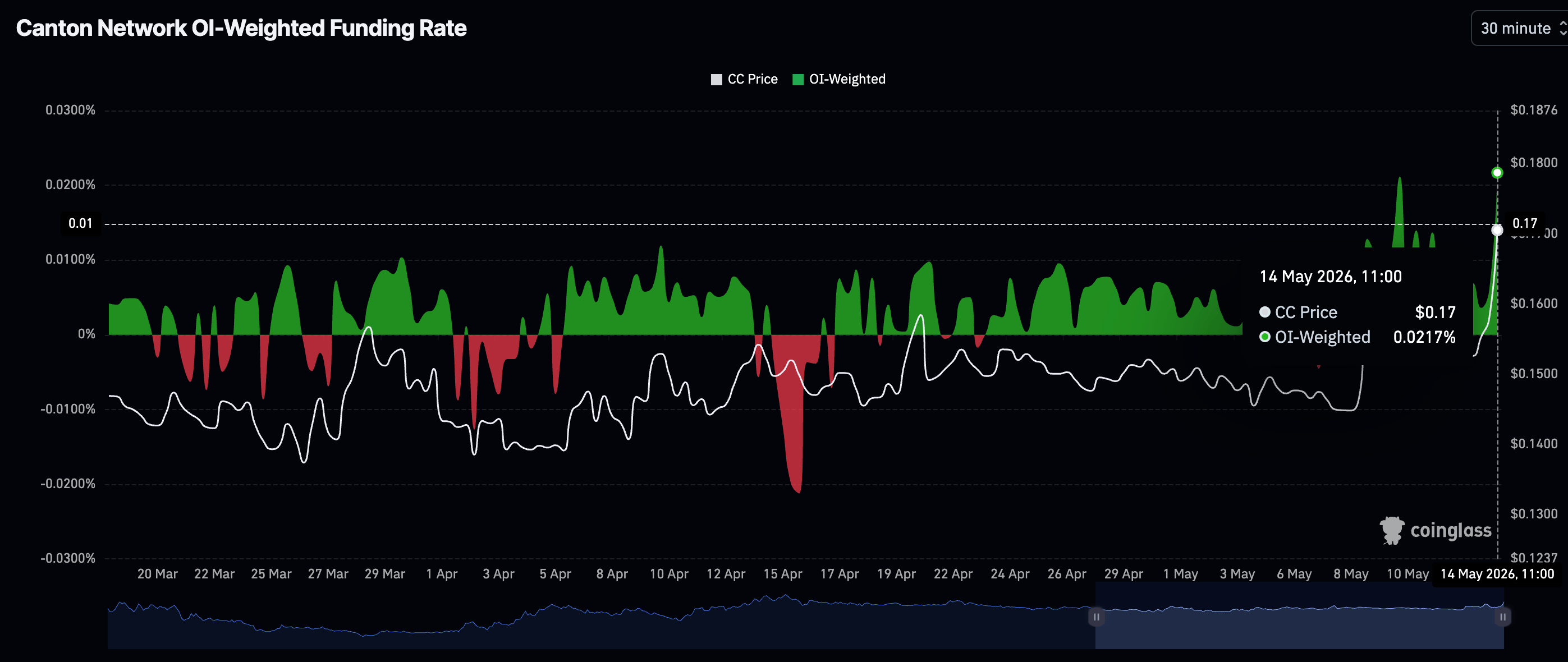
Retail demand continues to improve, suggesting confidence in Canton’s development, as evidenced by the futures Open Interest-Weighted Funding Rate, which rose to 0.0217% on Thursday, in positive territory, according to CoinGlass data. This metric has largely remained in the positive region since mid-April.
Price analysis: Canton bulls tighten grip
Canton trades slightly above $0.1700, holding above major Exponential Moving Averages (EMAs), the 50-day EMA at $0.1501 and the 100-day EMA at $0.1456. Momentum remains constructive, reinforced by a positive Moving Average Convergence Divergence (MACD) histogram on the daily chart. A daily close above $0.1700 would support the rally, aiming for a break above the next key resistance at $0.2000.
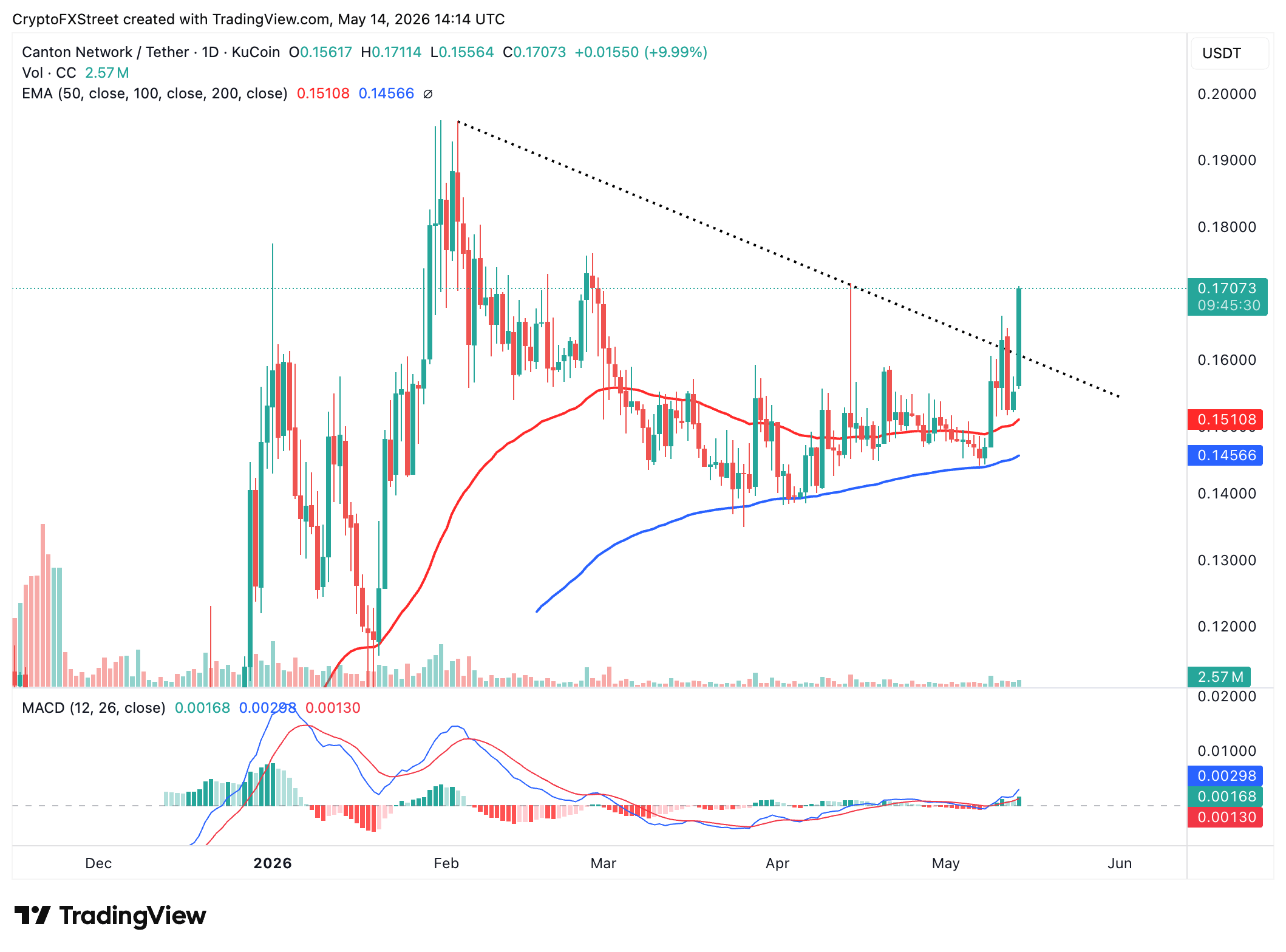
Failure to hold support at $0.1700 see Canton moderate toward the descending trendline, with projected support around $0.1600. A decisive break below this demand zone could expose the 50-day EMA at $0.1501 and the 100-day EMA at $0.1456 as the next tentative support levels.
Bitcoin, altcoins, stablecoins FAQs
Bitcoin is the largest cryptocurrency by market capitalization, a virtual currency designed to serve as money. This form of payment cannot be controlled by any one person, group, or entity, which eliminates the need for third-party participation during financial transactions.
Altcoins are any cryptocurrency apart from Bitcoin, but some also regard Ethereum as a non-altcoin because it is from these two cryptocurrencies that forking happens. If this is true, then Litecoin is the first altcoin, forked from the Bitcoin protocol and, therefore, an “improved” version of it.
Stablecoins are cryptocurrencies designed to have a stable price, with their value backed by a reserve of the asset it represents. To achieve this, the value of any one stablecoin is pegged to a commodity or financial instrument, such as the US Dollar (USD), with its supply regulated by an algorithm or demand. The main goal of stablecoins is to provide an on/off-ramp for investors willing to trade and invest in cryptocurrencies. Stablecoins also allow investors to store value since cryptocurrencies, in general, are subject to volatility.
Bitcoin dominance is the ratio of Bitcoin's market capitalization to the total market capitalization of all cryptocurrencies combined. It provides a clear picture of Bitcoin’s interest among investors. A high BTC dominance typically happens before and during a bull run, in which investors resort to investing in relatively stable and high market capitalization cryptocurrency like Bitcoin. A drop in BTC dominance usually means that investors are moving their capital and/or profits to altcoins in a quest for higher returns, which usually triggers an explosion of altcoin rallies.














