

Crude Oil rallies on fresh missile strikes, can Brent reach $115?
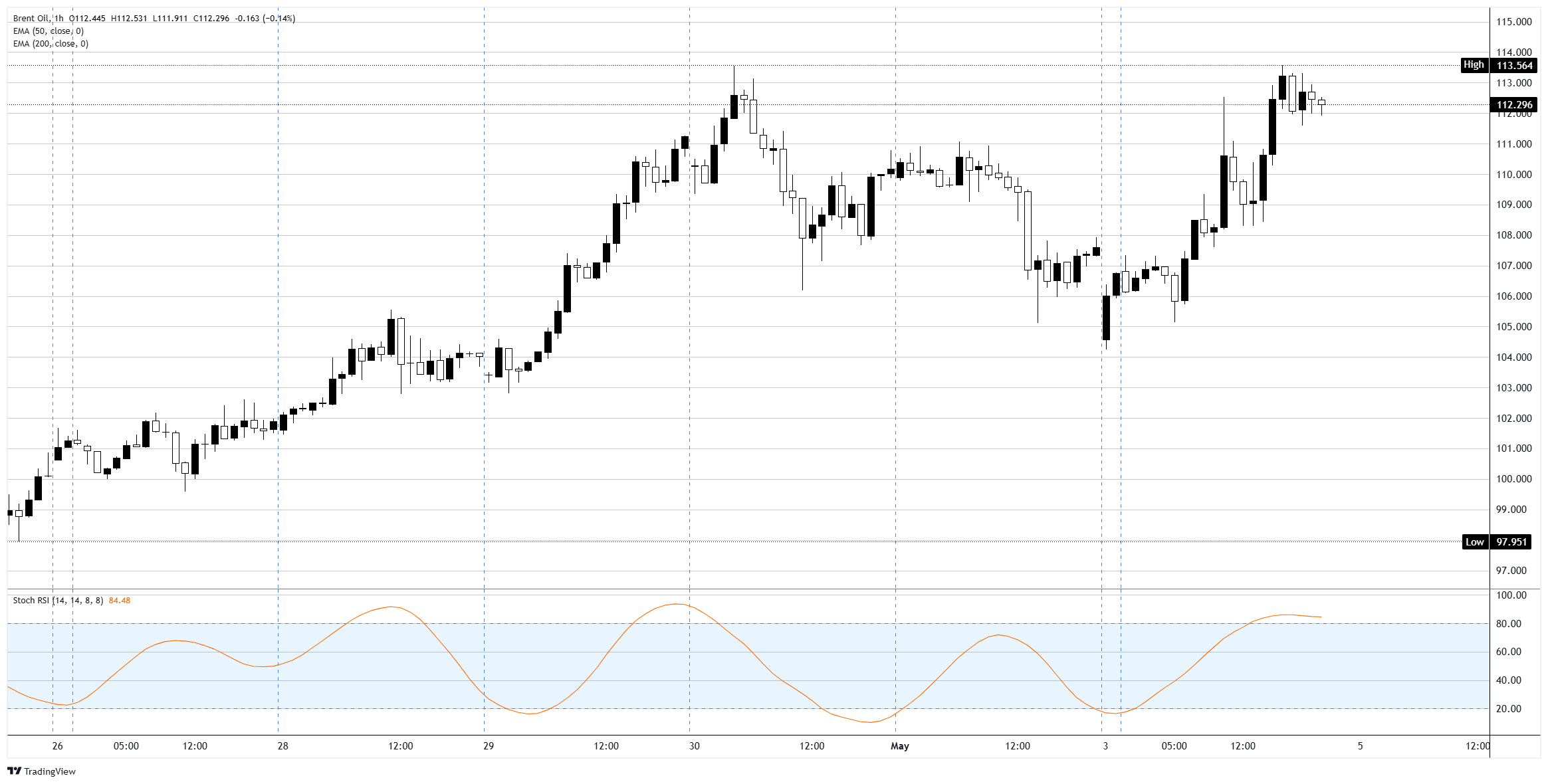
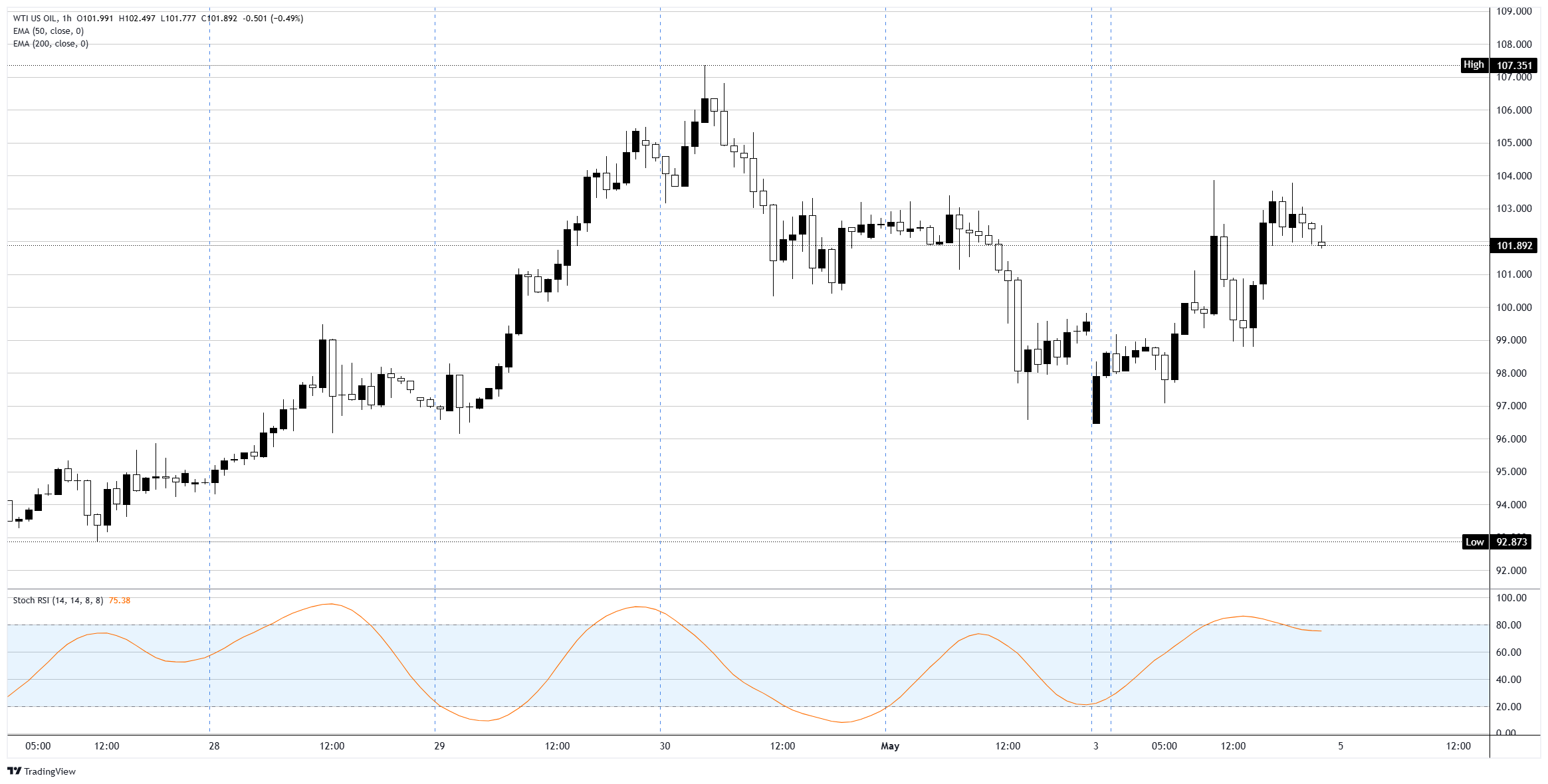
Crude Oil came roaring back on Monday, with both major benchmarks tearing out of last week's dip on a wave of fresh geopolitical anxiety. Brent climbed back above $112 a barrel and pressed toward fresh weekly highs, while WTI clawed back above the $100 mark to trade near $103, both posting multi-percent intraday recoveries as Iran struck deep into the United Arab Emirates and the US Navy expanded its presence in the Strait of Hormuz. The move all but erased the late-week softness that had begun to suggest the fragile ceasefire might finally be stabilizing flows.

Notably, Brent has now traded into a fresh weekly high while WTI still lags beneath its late-April peak near $107, a familiar divergence when the supply shock skews toward seaborne Gulf barrels rather than US production. Heading into the new trading week, the same script is back in play that has driven prices roughly 50% higher since hostilities began in late February, along with a renewed sense that the worst may not yet be priced in.
Iran's missiles, Trump's blockade
The fresh catalyst on the Iranian side was a coordinated barrage on the UAE, with the Gulf state's defense ministry confirming it engaged 12 ballistic missiles, three cruise missiles, and four drones launched from Iranian territory. A fire at the Fujairah Oil hub, attributed to a drone strike, sharpened the picture of regional infrastructure as a live target. Tehran's military followed up with a blunt warning for the US to "keep out of Hormuz", hours after Washington formally launched Project Freedom, a naval operation involving guided-missile destroyers and more than 100 aircraft and unmanned platforms tasked with escorting neutral commercial vessels through the strait.
President Donald Trump also reportedly rejected an updated Iranian proposal that would have seen the strait reopened in exchange for the lifting of the US blockade on Iranian ports, signaling the naval squeeze stays in place until a broader nuclear deal is reached. Trump's rhetoric has continued to harden, with the President framing the blockade as more effective than the bombing campaigns earlier in the war and arguing that Iranian leadership is buckling under the economic pressure. With Iran refusing to release the chokepoint and Trump refusing to ease it, the deadlock is unresolved and the supply backdrop is, if anything, deteriorating.
What can break the supply chokehold
Heading into the week, the structural picture remains the strongest tailwind for prices. Goldman Sachs has estimated that the closure of Hormuz and attacks on energy infrastructure have stripped roughly 14.5 million barrels per day from global production, while the International Energy Agency has labeled the disruption the largest in oil market history. Chevron (CVX) CEO Mike Wirth warned Monday that fuel shortages are becoming a genuine concern in pockets of the global market, and Exxon Mobil (XOM) CEO Darren Woods told investors on the company's earnings call last week that traders have not yet absorbed the full impact of the closure. Against that, demand is showing cracks, with Goldman flagging that April global consumption may have run as much as 3.6 million barrels per day below February levels, with weakness concentrated in jet fuel and petrochemicals.
The question for the next several sessions is whether any incremental peace-process headline out of Pakistan, where mediators are still circulating an Iranian proposal Trump has called insufficient, can puncture the bid, or whether a single further escalation, be it another tanker strike or a US response to Monday's UAE attack, sends Brent back toward the $120 mark touched in late April. For now, the path of least resistance is higher, and the burden of proof sits squarely with the de-escalation camp.
Brent Crude Oil, 1-hour chart
WTI Crude Oil, 1-hour chart
WTI Oil FAQs
WTI Oil is a type of Crude Oil sold on international markets. The WTI stands for West Texas Intermediate, one of three major types including Brent and Dubai Crude. WTI is also referred to as “light” and “sweet” because of its relatively low gravity and sulfur content respectively. It is considered a high quality Oil that is easily refined. It is sourced in the United States and distributed via the Cushing hub, which is considered “The Pipeline Crossroads of the World”. It is a benchmark for the Oil market and WTI price is frequently quoted in the media.
Like all assets, supply and demand are the key drivers of WTI Oil price. As such, global growth can be a driver of increased demand and vice versa for weak global growth. Political instability, wars, and sanctions can disrupt supply and impact prices. The decisions of OPEC, a group of major Oil-producing countries, is another key driver of price. The value of the US Dollar influences the price of WTI Crude Oil, since Oil is predominantly traded in US Dollars, thus a weaker US Dollar can make Oil more affordable and vice versa.
The weekly Oil inventory reports published by the American Petroleum Institute (API) and the Energy Information Agency (EIA) impact the price of WTI Oil. Changes in inventories reflect fluctuating supply and demand. If the data shows a drop in inventories it can indicate increased demand, pushing up Oil price. Higher inventories can reflect increased supply, pushing down prices. API’s report is published every Tuesday and EIA’s the day after. Their results are usually similar, falling within 1% of each other 75% of the time. The EIA data is considered more reliable, since it is a government agency.
OPEC (Organization of the Petroleum Exporting Countries) is a group of 12 Oil-producing nations who collectively decide production quotas for member countries at twice-yearly meetings. Their decisions often impact WTI Oil prices. When OPEC decides to lower quotas, it can tighten supply, pushing up Oil prices. When OPEC increases production, it has the opposite effect. OPEC+ refers to an expanded group that includes ten extra non-OPEC members, the most notable of which is Russia.














