

Crypto Weekly Radar: Bitcoin gains constrained, sentiment weak amid ceasefire, token unlocks
- Bitcoin steadies above $71,000 as weak sentiment limits the potential for a recovery toward $75,000.
- Failed US-Iran peace negotiations suppress market sentiment, with the crypto Fear & Greed Index holding in extreme fear.
- Roughly $49 million in token unlocks this week, led by a $16 million Connex release, could drive market volatility.
The cryptocurrency market commences the week weighed down by deteriorating sentiment after peace talks between the United States (US) and Iran failed to yield a deal in Pakistan over the weekend. Bitcoin (BTC) hovers above $72,000 at the time of writing on Monday, building on support at $71,000. Still, its upside remains largely constrained toward the distant key hurdle at $75,000.

Meanwhile, market participants are focusing on the fragile ceasefire in the Middle East and whether the Strait of Hormuz could be reopened to ease pressure on markets and the global economy.
Focus stays on the US-Iran ceasefire as market sentiment wobbles
The peace talks between the US and Iran in Pakistan failed, with both parties leaving Islamabad on Sunday with little to show for it. US Vice President JD Vance and Iranian officials said significant differences remain amid efforts to reach a deal that could bring peace to the Middle East.
Despite US President Donald Trump stating on Truth Social that most points had been agreed to, except for the issue of whether Iran can commit to not building a nuclear weapon.
Iran’s parliament Speaker Mohammad Bagher Ghalibaf wrote on X that the US was unable “to gain trust of the Iranian delegation.” Trump added that the US military would blockade the Strait of Hormuz to reopen the shipping channel.
“Effective immediately, the United States Navy, the Finest in the World, will begin the process of BLOCKADING any and all Ships trying to enter, or leave, the Strait of Hormuz," President Trump wrote on Truth Social.
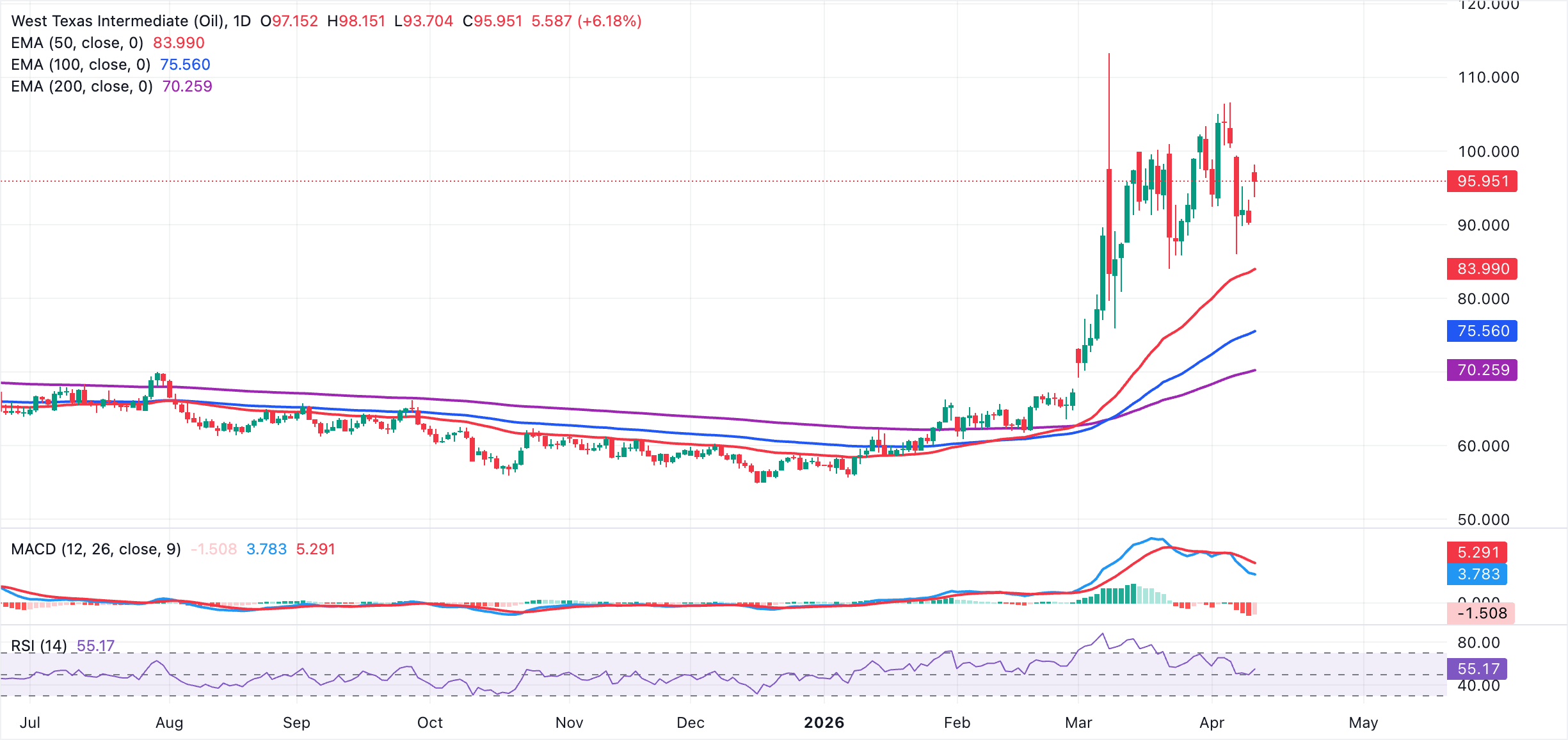
West Texas Intermediate (WTI) Oil prices surged, trading around $96.00 at the time of writing, up from roughly $86.00 on Wednesday. At least 20% of the world’s Oil and Gas supplies pass through the Strait of Hormuz, and its reopening could ease pressure on the global economy.
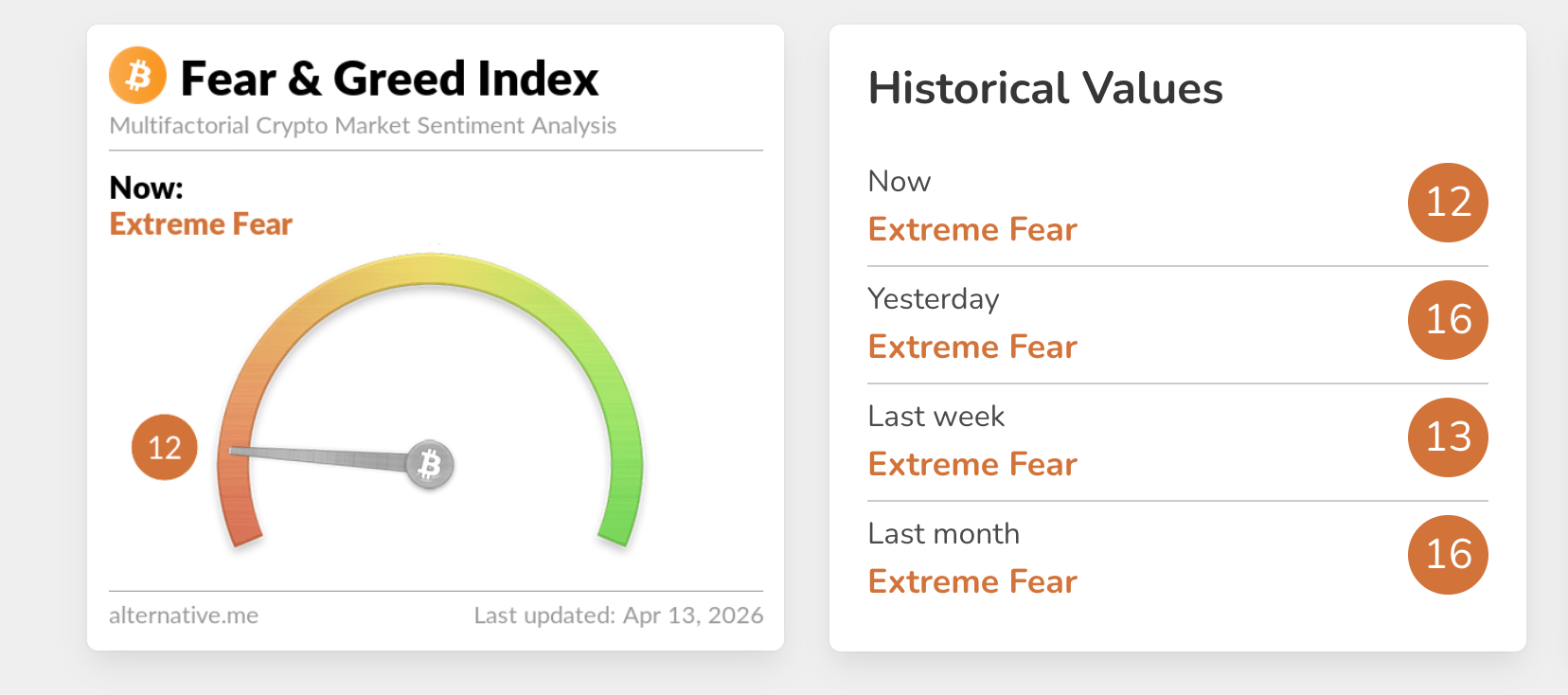
The crypto Fear & Greed Index remains in the extreme fear territory, with a reading of 12 on Monday, down from 16 the previous day. Wars rarely benefit risk assets, so if this bearish mood persists, crypto prices could struggle to sustain their recovery, leading to frequent pullbacks.
Bitcoin builds on key support
Bitcoin trades at $71,774.97, maintaining a neutral‑bullish tone as it consolidates above the 50-day Exponential Moving Average (EMA) at roughly $70,774, while still capped by higher-timeframe barriers. Despite the crypto king holding modest daily gains, it is facing trendline resistance at about $73,374, while both the 100-day EMA near $75,265 and the distant 200-day EMA around $83,397 remain firmly overhead.
Momentum is constructive, with the Relative Strength Index (RSI) hovering in the mid‑50s on the daily chart and the Moving Average Convergence Divergence (MACD) in positive territory, hinting that buyers retain the upper hand as long as price holds above nearby dynamic support.
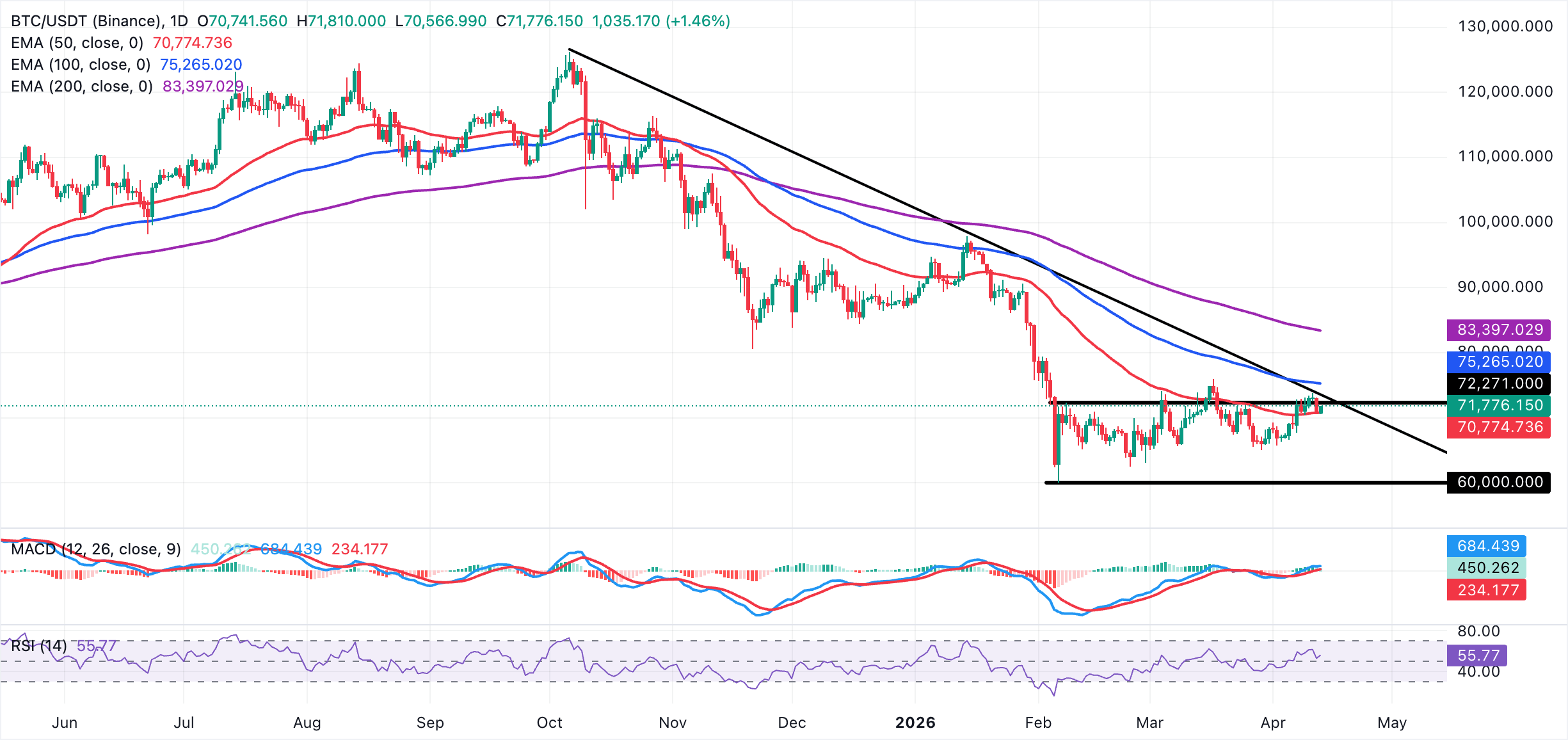
On the topside, initial resistance is seen at the descending trendline barrier around $73,374, followed by the 100-day EMA at $75,265. A daily close above that zone would open the way toward the more strategic 200-day EMA at roughly $83,400. On the downside, immediate support is provided by the 50-day EMA at about $70,775, and a break below this level would signal fading bullish pressure and expose a deeper corrective phase toward lower recent swing areas not yet tested in this leg.
Potential supply shock ahead of $49 million token unlocks
Several token unlocks totaling approximately $49 million are expected this week, which could see volatility surge. On Monday, the largest releases are Celestia (TIA) and Geodnet (GEOD), totaling roughly $86,000 and $13,600, respectively.
On Tuesday, notable unlocks include Alaya AI (AGT) at $1.14 million and CyberConnect at $448,796.
Connex (CONX), Arbitrum (ARB) and Vana (VANA) stand out among the largest unlocks on Wednesday, with tokens worth $15.98 million, $10.33 million and $3.39 million, respectively.
Three releases are scheduled for Thursday, including EigenCloud (EIGEN), Celestia (TIA), and Thala (THL), at approximately $364,000, $86,000, and $1,900, respectively. On Friday, the unlocks will feature deBridge at $10.85 million and Omni Network (OMNI) at $5.92 million, among others. As for Saturday, Celestia (TIA) will unlock roughly $86,000.
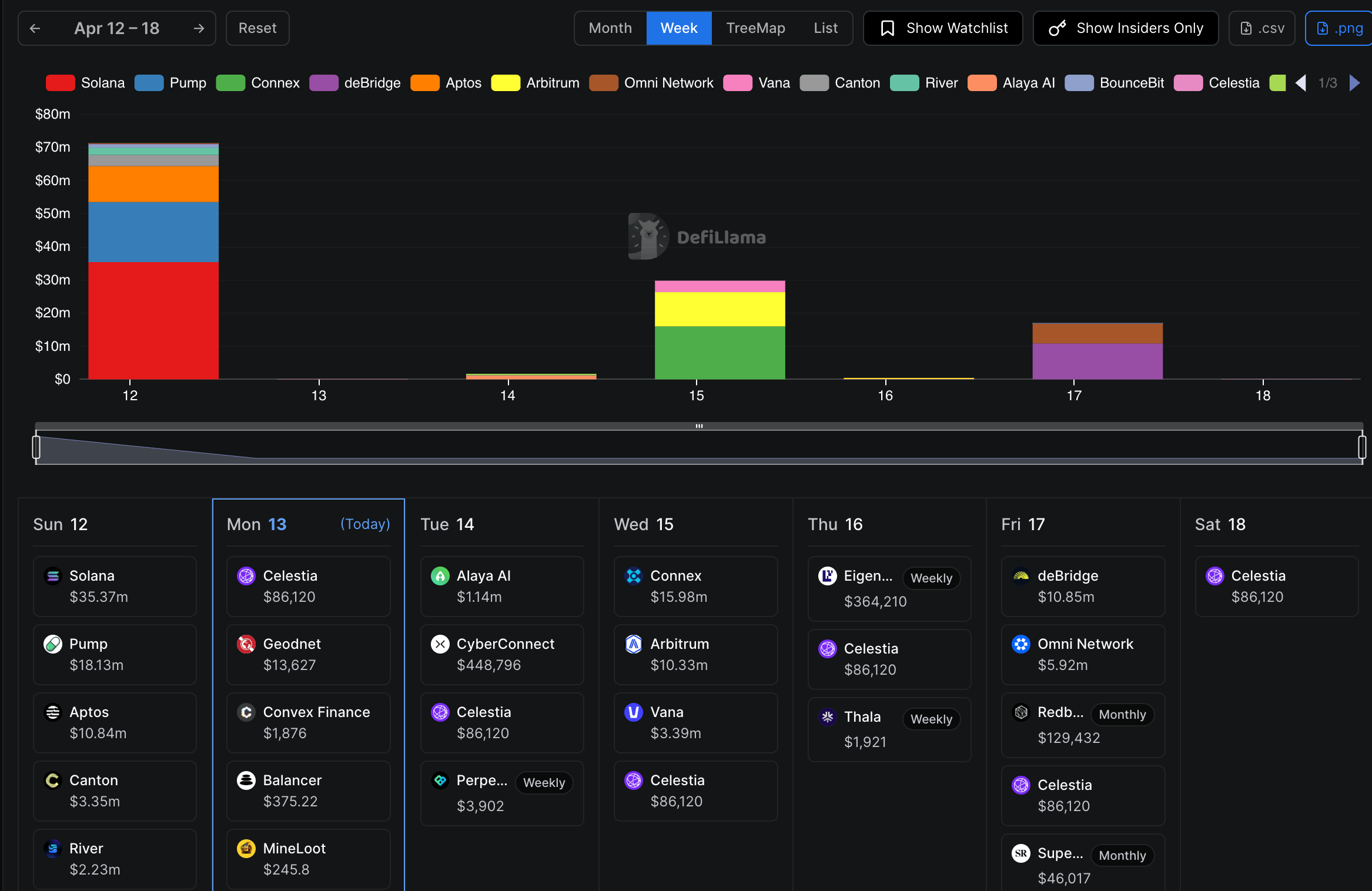
Token releases represent predictable supply-side events that frequently act as scheduled supply shocks, often driving increased market volatility. Market participants may engage in anticipatory selling ahead of these unlocks. However, the actual impact remains complex, calling for real-time monitoring, as price effects are sometimes partially or fully priced in prior to the event.
Cryptocurrency metrics FAQs
The developer or creator of each cryptocurrency decides on the total number of tokens that can be minted or issued. Only a certain number of these assets can be minted by mining, staking or other mechanisms. This is defined by the algorithm of the underlying blockchain technology. On the other hand, circulating supply can also be decreased via actions such as burning tokens, or mistakenly sending assets to addresses of other incompatible blockchains.
Market capitalization is the result of multiplying the circulating supply of a certain asset by the asset’s current market value.
Trading volume refers to the total number of tokens for a specific asset that has been transacted or exchanged between buyers and sellers within set trading hours, for example, 24 hours. It is used to gauge market sentiment, this metric combines all volumes on centralized exchanges and decentralized exchanges. Increasing trading volume often denotes the demand for a certain asset as more people are buying and selling the cryptocurrency.
Funding rates are a concept designed to encourage traders to take positions and ensure perpetual contract prices match spot markets. It defines a mechanism by exchanges to ensure that future prices and index prices periodic payments regularly converge. When the funding rate is positive, the price of the perpetual contract is higher than the mark price. This means traders who are bullish and have opened long positions pay traders who are in short positions. On the other hand, a negative funding rate means perpetual prices are below the mark price, and hence traders with short positions pay traders who have opened long positions.
(The technical analysis of this story was written with the help of an AI tool.)














