

GBP/USD Price Forecast: Fails to hold above 20-day EMA
- GBP/USD trades with caution around 1.3450 amid uncertainty over the US-Iran deal.
- US Secretary of State Rubio said that the deal finalization with Iran may take a few days.
- Lower UK gilt yields due to easing BoE hawkish prospects have weighed on the British Pound.
The GBP/USD pair trades cautiously near Tuesday’s low around 1.3450 in the early European trade on Wednesday. The Cable is under pressure as investors turn cautious regarding the longevity of the ceasefire between the United States (US) and Iran, following Washington’s attacks on southern Iran.

On Tuesday, Iran condemned US attacks on Iranian boats and its missile-launching strikes, which were described as “defensive” moves by the US Central Command. The same day, Iran’s Islamic Revolutionary Guard Corps (IRGC) also reported that it identified a hostile aircraft entering its airspace and intercepted an MQ-9 drone.
Meanwhile, comments from US Secretary of State Marco Rubio that the deal finalization with Iran may take a few days have also dashed hopes of an early breakthrough in US-Iran negotiations.
In addition to geopolitical tensions, declining UK gilt yields due to eased hopes of a near-term interest rate hike by the Bank of England (BoE) are also hurting the British Pound (GBP). On Tuesday, 10-year UK gilt yields tumbled to 4.82%, the lowest level seen in over a month.
During the press time, the US Dollar Index (DXY) trades flat around 99.00, with investors awaiting the US Personal Consumption Expenditure Price Index (PCE) data for April scheduled on Thursday.
GBP/USD technical analysis
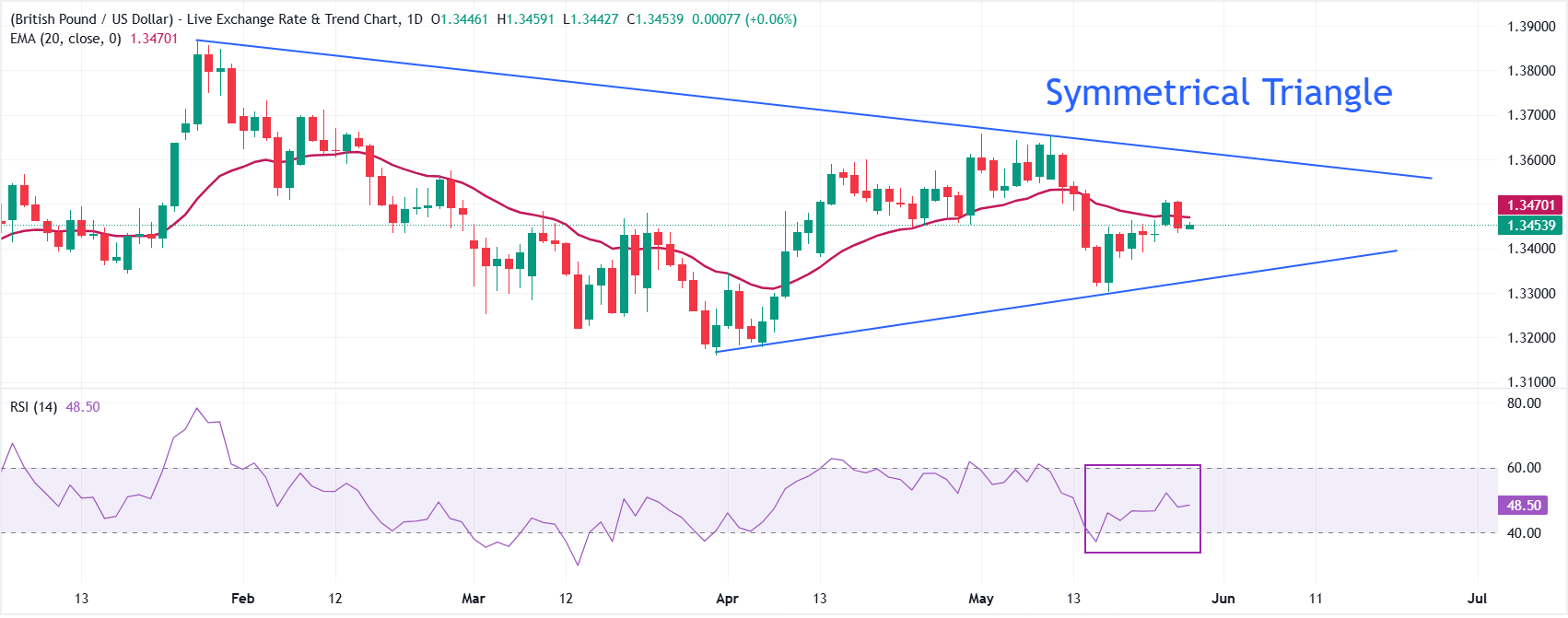
GBP/USD trades marginally higher at around 1.3450 as of writing. The near-term tone of the pair remains uncertain as it struggles to return above the 20-day Exponential Moving Average (EMA), which is at 1.3470. The overall trend of the pair appears sideways amid the Symmetrical Triangle formation, which reflects indecisiveness among investors.
The Relative Strength Index (RSI) wobbles inside the 40.00-60.00 zone, reflecting a sideways trend.
On the topside, immediate resistance is located at the 20-period EMA around 1.3470; a sustained break above this level would be needed to ease near-term pressure before the next hurdle at the downward resistance trend line near 1.3618. On the downside, the pair could slide towards the upward-sloping border around 1.3333 if it falls below the May 26 low at 1.3434.
(The technical analysis of this story was written with the help of an AI tool.)
Pound Sterling FAQs
The Pound Sterling (GBP) is the oldest currency in the world (886 AD) and the official currency of the United Kingdom. It is the fourth most traded unit for foreign exchange (FX) in the world, accounting for 12% of all transactions, averaging $630 billion a day, according to 2022 data. Its key trading pairs are GBP/USD, also known as ‘Cable’, which accounts for 11% of FX, GBP/JPY, or the ‘Dragon’ as it is known by traders (3%), and EUR/GBP (2%). The Pound Sterling is issued by the Bank of England (BoE).
The single most important factor influencing the value of the Pound Sterling is monetary policy decided by the Bank of England. The BoE bases its decisions on whether it has achieved its primary goal of “price stability” – a steady inflation rate of around 2%. Its primary tool for achieving this is the adjustment of interest rates. When inflation is too high, the BoE will try to rein it in by raising interest rates, making it more expensive for people and businesses to access credit. This is generally positive for GBP, as higher interest rates make the UK a more attractive place for global investors to park their money. When inflation falls too low it is a sign economic growth is slowing. In this scenario, the BoE will consider lowering interest rates to cheapen credit so businesses will borrow more to invest in growth-generating projects.
Data releases gauge the health of the economy and can impact the value of the Pound Sterling. Indicators such as GDP, Manufacturing and Services PMIs, and employment can all influence the direction of the GBP. A strong economy is good for Sterling. Not only does it attract more foreign investment but it may encourage the BoE to put up interest rates, which will directly strengthen GBP. Otherwise, if economic data is weak, the Pound Sterling is likely to fall.
Another significant data release for the Pound Sterling is the Trade Balance. This indicator measures the difference between what a country earns from its exports and what it spends on imports over a given period. If a country produces highly sought-after exports, its currency will benefit purely from the extra demand created from foreign buyers seeking to purchase these goods. Therefore, a positive net Trade Balance strengthens a currency and vice versa for a negative balance.














