

Gold jumps above $4,500 as war fears revive haven buying spree
- Gold rebounds sharply as dip buyers return amid escalating Middle East tensions.
- Rising oil prices and higher inflation expectations reinforce bullion's safe-haven appeal.
- Stronger Dollar and higher yields fail to deter aggressive Gold buyers.
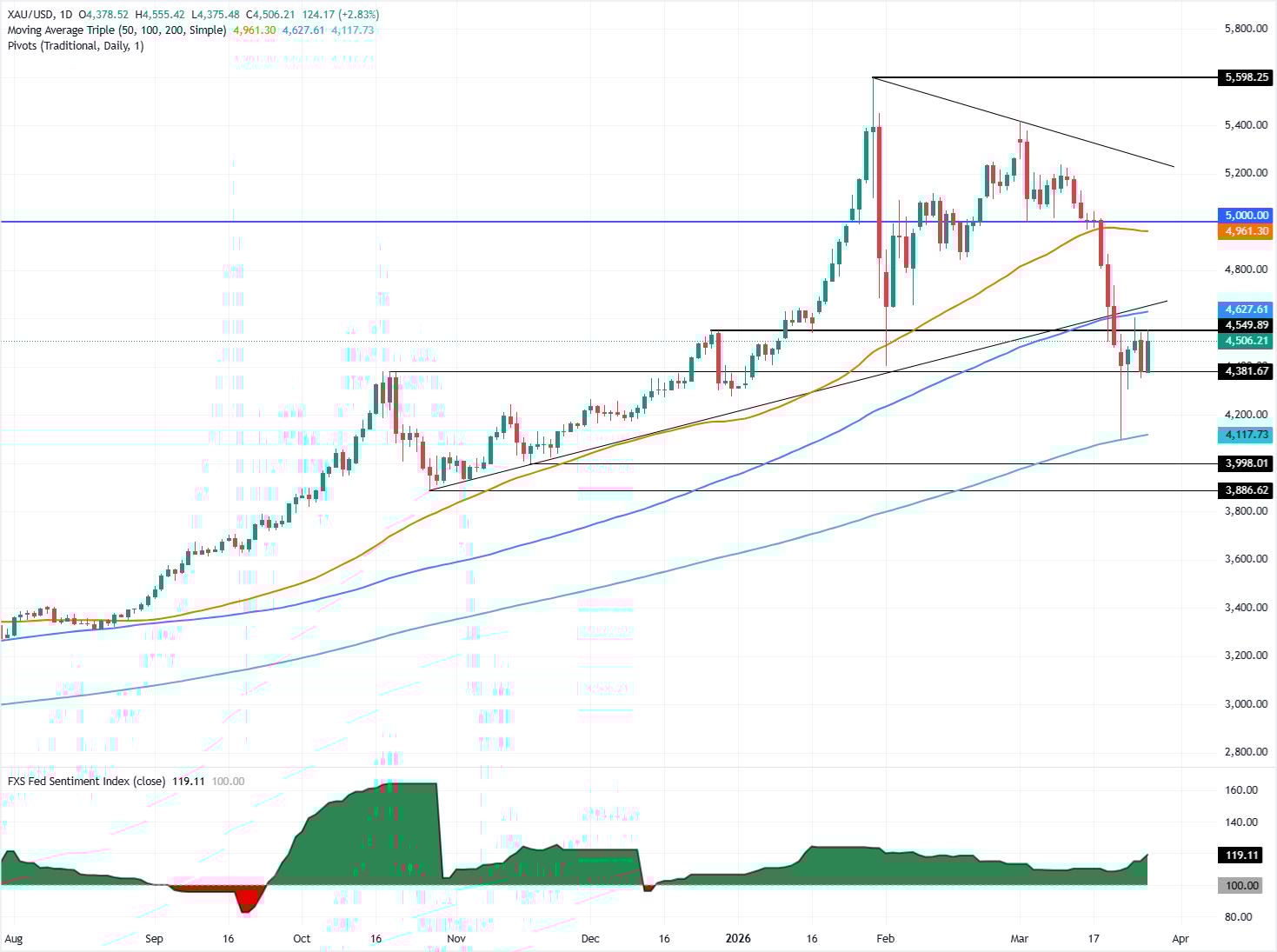
Gold (XAU/USD) price rallies over 3% on Friday as dip buyers emerge, amid the conflict entering its fifth week of hostilities, with no signs of de-escalation, and as inflation pressures rise. At the time of writing, XAU/USD trades at $4,510 after bouncing off daily lows of $4,375.

Heightened geopolitical tensions underpin Gold, Oil and the US Dollar
Market sentiment remains dismal as US equities fall to 7-month lows. The rise in US Treasury bond yields and broad US Dollar strength has not been an excuse for bullion buyers, who are driving prices higher amid growing uncertainty over the Middle East conflict.
The US Dollar Index (DXY), which measures the buck's performance against six peers, is up 0.30% to 100.16, underpinned by the rise in US yields. The US 10-year T-note is up nearly two basis points at 4.428%.
Over the last two days, geopolitical headlines have been driving price action. On Thursday, US President Donald Trump calmed the markets, delaying the pause on attacks on Iranian energy installations until April 6, prolonging the pause by an extra day early on Friday (check).
Nevertheless, the White House is sending mixed signals as the Wall Street Journal reported that the Pentagon is deploying an additional 10,000 troops to the region.
As a result, investors ignored Trump's attempt to de-escalate the conflict, as evidenced by soaring energy prices, with WTI rallying nearly 5% to $98.33 per barrel.
Recently, Iran's Islamic Revolutionary Guard Corps has said that the Strait of Hormuz is closed.
US economic data
Data-wise, the University of Michigan revealed that American households are turning pessimistic about economic conditions. The Consumer Sentiment in March dipped from 55.5 to 53.3, below forecasts of 54. Inflation expectations for the next twelve months jumped from 3.4% in February to 3.8%, while for the five years remained unchanged at 3.2%.
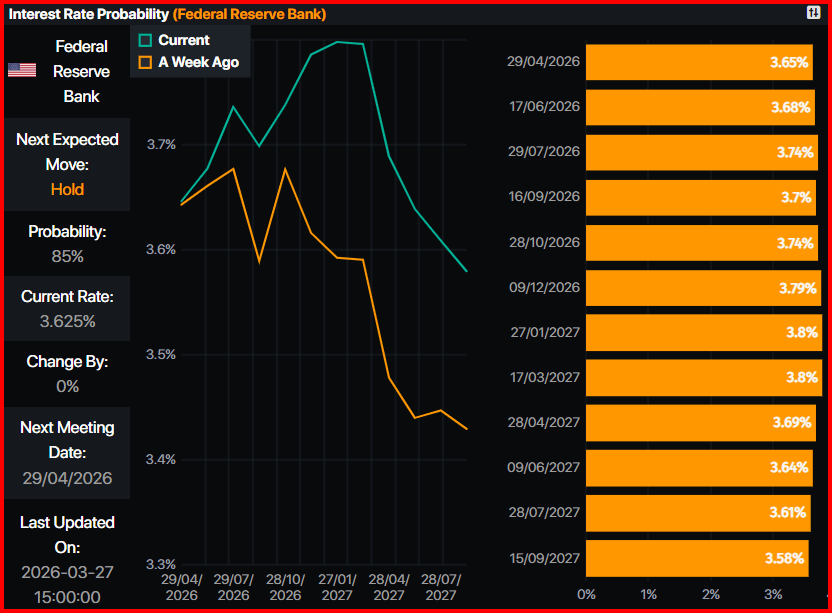
Money markets now expect the Federal Reserve's (Fed) next move to be a rate hike, given the current scenario of high energy prices. So far, traders have priced in six basis points of tightening towards the year-end, as revealed b Prime Market Terminal.
Fed's Barkin says "prudent to hold rates," Paulson stays neutral
Richmond Fed President Thomas Barkin favors holding rates to await more clarity on the next move. He said the rapid progress in AI has clouded the economic outlook, while adding that, before the Oil shock, inflation had already stalled.
Recently, Philadelphia Fed Anna Paulson showed a neutral stance, saying that the labor market feels "fragile." Paulson added that the Iran war puts pressure on the dual mandate, and that "inflation levels are still too high."
XAU/USD technical outlook: Gold rally capped ahead of the 100-day SMA
Gold price consolidates on Friday, unable to clear key resistance around $4,560, which could open the door to further upside. It should be noted that momentum remains bearish, as indicated by the Relative Strength Index (RSI), but the index broke a previous peak, suggesting sellers are losing steam.
If XAU/USD rises past the Thursday high of $4,544, this could open the path to challenge the 100-day Simple Moving Average (SMA) at $4,605, which is seen as the next area of interest. Up next lies the March 20 daily high at $4,736, followed by $4,800.
On the downside, if Gold closes daily below $4,500, the next support would be the March 24 daily low at $4,306, followed by the March 23 swing low at $4,098.
Gold FAQs
Gold has played a key role in human’s history as it has been widely used as a store of value and medium of exchange. Currently, apart from its shine and usage for jewelry, the precious metal is widely seen as a safe-haven asset, meaning that it is considered a good investment during turbulent times. Gold is also widely seen as a hedge against inflation and against depreciating currencies as it doesn’t rely on any specific issuer or government.
Central banks are the biggest Gold holders. In their aim to support their currencies in turbulent times, central banks tend to diversify their reserves and buy Gold to improve the perceived strength of the economy and the currency. High Gold reserves can be a source of trust for a country’s solvency. Central banks added 1,136 tonnes of Gold worth around $70 billion to their reserves in 2022, according to data from the World Gold Council. This is the highest yearly purchase since records began. Central banks from emerging economies such as China, India and Turkey are quickly increasing their Gold reserves.
Gold has an inverse correlation with the US Dollar and US Treasuries, which are both major reserve and safe-haven assets. When the Dollar depreciates, Gold tends to rise, enabling investors and central banks to diversify their assets in turbulent times. Gold is also inversely correlated with risk assets. A rally in the stock market tends to weaken Gold price, while sell-offs in riskier markets tend to favor the precious metal.
The price can move due to a wide range of factors. Geopolitical instability or fears of a deep recession can quickly make Gold price escalate due to its safe-haven status. As a yield-less asset, Gold tends to rise with lower interest rates, while higher cost of money usually weighs down on the yellow metal. Still, most moves depend on how the US Dollar (USD) behaves as the asset is priced in dollars (XAU/USD). A strong Dollar tends to keep the price of Gold controlled, whereas a weaker Dollar is likely to push Gold prices up.














