

Gold nears $4,800 as fading Dollar lifts bullion for fourth consecutive day
- Gold climbs nearly 6% weekly as Middle East uncertainty drives demand.
- Weaker US Dollar and softer growth expectations continue to support bullion.
- Traders now await Jobless Claims and Friday's Nonfarm Payrolls report.
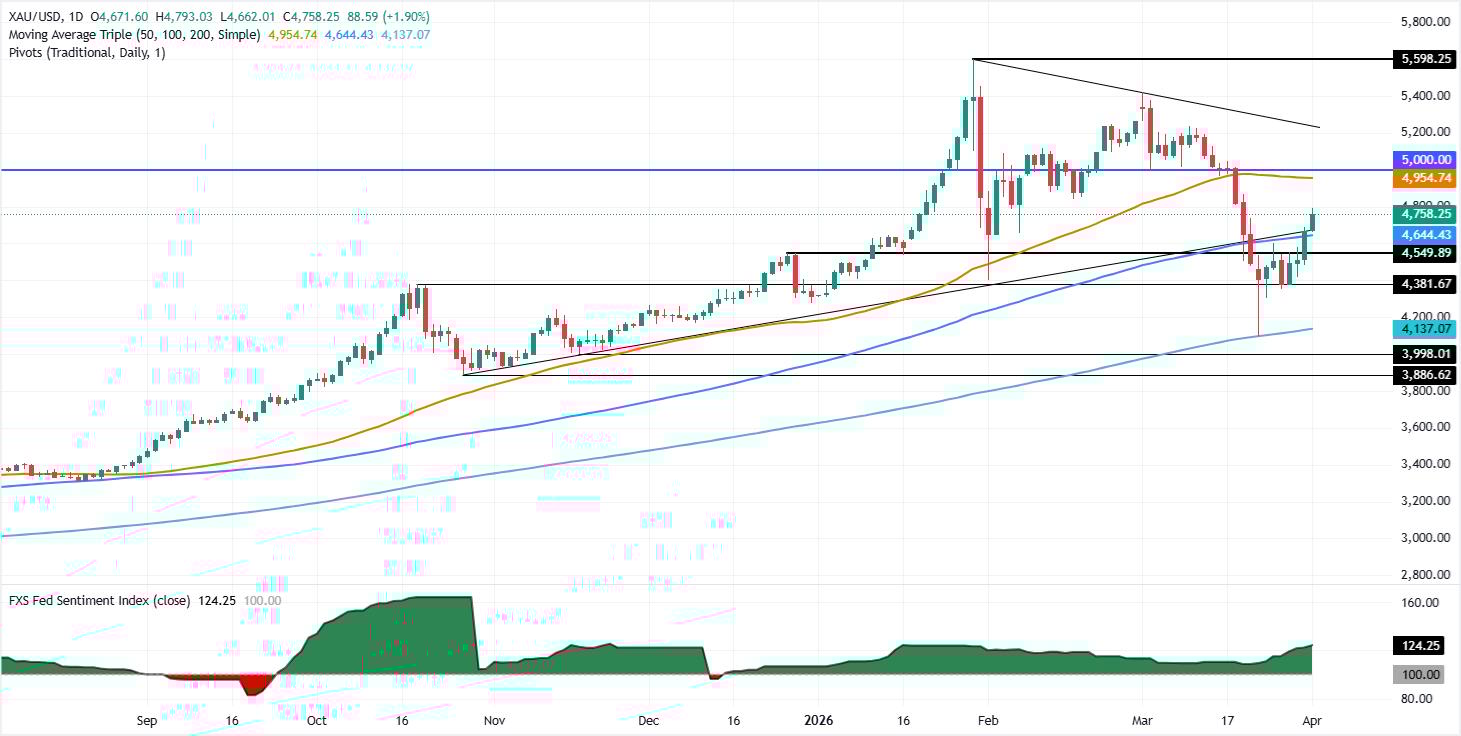
Gold (XAU/USD) price rallies for a fourth straight day on Wednesday, hitting a two-week high near $4,800 as the Greenback depreciates amid growing speculation of an end to the Middle East conflict. At the time of writing, the XAU/USD pair trades at $4,758, up nearly 2%.
Bullion rallies on truce hopes as traders eye US jobs data

Uncertainties on developments in the Middle East are a tailwind for the yellow metal, which is enjoying nearly 6% weekly gains. Although some headlines suggest a possible end to the conflict, others hint at a further extension. On Wednesday, US President Donald Trump said that they are going to be out of the war with Iran "very quickly" in an interview with Reuters. However, Andrew Neil, a Daily Mail columnist, posted on Tuesday that sources at the White House told him that Washington is "considering taking Kharg Island."
Recently, Axios reported that three US officials said discussions are underway and that a ceasefire is possible if Iran opens the Hormuz Strait.
Aside from this, broader economic data in the US showed that business activity remains strong and the labor market remains solid. March's ISM Manufacturing PMI beat expectations, increasing to 52.7 from 52.4 and indicating strong growth despite rising prices. The Prices Paid Index jumped to a nearly four-year high of 78.3.
US ADP Employment Change for March rose by 62K, slightly less than February's 66K but above the forecast of 40K. Retail Sales increased 0.6% MoM in February, beating predictions and marking the biggest rise in seven months after January's revised -0.1%.
Federal Reserve (Fed) speeches did not strengthen the US Dollar, despite data supporting a recovery. Richmond Fed's Thomas Barkin noted energy shocks are viewed as temporary but cautioned rate hikes may be needed if inflation expectations rise. St. Louis Fed's Alberto Musalem believes current policy is well-positioned amid uncertainty and sees no immediate reason to change rates, though he flagged inflation risks from Middle East tensions.
In the meantime, the Atlanta Fed GDPNow updated the estimate for Q1 2026, ticking lower from 2% to 1.9%, following the US economic data release.
Ahead this week, the US economic docket will feature the release of Initial Jobless Claims on Thursday, followed by Nonfarm Payroll figures on Friday, which are expected to show the economy creating 60K jobs, an improvement from February's -92K print.
Given the backdrop, Gold prices are expected to continue rising. Nevertheless, a de-escalation of the conflict and lower energy prices could undermine the yellow metal, and keeping interest rates higher would be a headwind for bullion.
XAU/USD technical outlook: Climbs above 100-day SMA, reinforces Gold’s bullish structure
Gold price remains upwardly biased after climbing past the 100-day Simple Moving Average (SMA) at $4,625, which has driven XAU/USD towards the 20-day SMA at $4,802. Momentum remains constructive, as indicated by the Relative Strength Index (RSI), which is poised to turn bullish as its slope explodes higher.
A breach of the 20-day SMA paves the way for further upside. The next key resistance would be $4,900, followed by the 50-day SMA at $4,952.
Conversely, a failure at $4,800 could exacerbate a re-test of $4,700 ahead of the 100-day SMA at $4,625. On further weakness, the March 26 swing low would be in play at around $4,351.
Gold FAQs
Gold has played a key role in human’s history as it has been widely used as a store of value and medium of exchange. Currently, apart from its shine and usage for jewelry, the precious metal is widely seen as a safe-haven asset, meaning that it is considered a good investment during turbulent times. Gold is also widely seen as a hedge against inflation and against depreciating currencies as it doesn’t rely on any specific issuer or government.
Central banks are the biggest Gold holders. In their aim to support their currencies in turbulent times, central banks tend to diversify their reserves and buy Gold to improve the perceived strength of the economy and the currency. High Gold reserves can be a source of trust for a country’s solvency. Central banks added 1,136 tonnes of Gold worth around $70 billion to their reserves in 2022, according to data from the World Gold Council. This is the highest yearly purchase since records began. Central banks from emerging economies such as China, India and Turkey are quickly increasing their Gold reserves.
Gold has an inverse correlation with the US Dollar and US Treasuries, which are both major reserve and safe-haven assets. When the Dollar depreciates, Gold tends to rise, enabling investors and central banks to diversify their assets in turbulent times. Gold is also inversely correlated with risk assets. A rally in the stock market tends to weaken Gold price, while sell-offs in riskier markets tend to favor the precious metal.
The price can move due to a wide range of factors. Geopolitical instability or fears of a deep recession can quickly make Gold price escalate due to its safe-haven status. As a yield-less asset, Gold tends to rise with lower interest rates, while higher cost of money usually weighs down on the yellow metal. Still, most moves depend on how the US Dollar (USD) behaves as the asset is priced in dollars (XAU/USD). A strong Dollar tends to keep the price of Gold controlled, whereas a weaker Dollar is likely to push Gold prices up.














