

Indian Rupee declines further against US Dollar as hawkish Fed bets remain firm
- The Indian Rupee slides further against the US Dollar amid hawkish Fed bets.
- Lower oil prices are expected to limit the Indian Rupee’s downside.
- Investors await the US PCE Inflation data, which will be released on Thursday.
The Indian Rupee (INR) opens lower, as expected, against the US Dollar (USD) on Wednesday, with the USD/INR pair rising to near 94.85. A positive opening was anticipated from the pair as the US Dollar posts a fresh annual high amid firm expectations that the Federal Reserve (Fed) will deliver at least two interest rate hikes this year.
At press time, the US Dollar Index (DXY), which tracks the Greenback’s value against six major currencies, trades 0.1% higher to near 101.50.
Hawkish Fed bets strengthen US Dollar
According to the CME FedWatch tool, the odds of the Fed hiking interest rates this year are almost 86%. While the possibility of at least two interest rate hikes is 48.3%. This is a sharp turnaround from two interest rate cuts projected before the onset of the Middle East war, which led to a significant increase in inflationary pressures.
The latest United States (US) Consumer Price Index (CPI) report showed that the core inflation – which excludes volatile food and energy items – accelerated to 2.9% in May, the highest level seen in seven months.
For more cues on the current status of inflation, investors await the US Personal Consumption Expenditure Price Index (PCE) data for May, which will be released on Thursday. The US core PCE inflation data, which is the Fed’s preferred inflation gauge, is expected to arrive at 3.4% Year-on-Year (YoY), higher than the previous reading of 3.3%.
Lower oil prices to limit Indian Rupee’s downside
Oil prices extend their decline on hopes that traffic through the Strait of Hormuz, a vital passage to almost 20% of global energy supply, has started normalizing amid continued progress in technical talks between the US and Iran.
According to a Bloomberg report, more ships are openly signaling their intention to traverse the Strait of Hormuz, pointing to growing confidence among shipowners and traders about sending vessels through the chokepoint as tensions ease.
In the opening session, the MCX Crude Oil contract expiring on July 20 is down 0.7% to near 6,900, the lowest level seen in three months.
Lower oil prices bode well for currencies from economies, such as India, which rely heavily on oil imports to meet their energy needs.
Indian stock markets struggle to lure foreign investors
Despite the signing of the US-Iran Memorandum of Understanding (MoU) and continued progress in nuclear talks, the Indian stock market appears to be failing to get a positive response from Foreign Institutional Investors (FIIs). Overseas investors seem less enthusiastic towards the Indian equity market, investing on an irregular basis.
On Tuesday, FIIs turned out to be net buyers, but increased their stake merely by Rs. 17.86 crore. The amount was significantly lower than the selling of Rs. 635.91 crore worth of their stake on Monday.
Technical Analysis: USD/INR strives to break above downward-sloping border of Descending Triangle
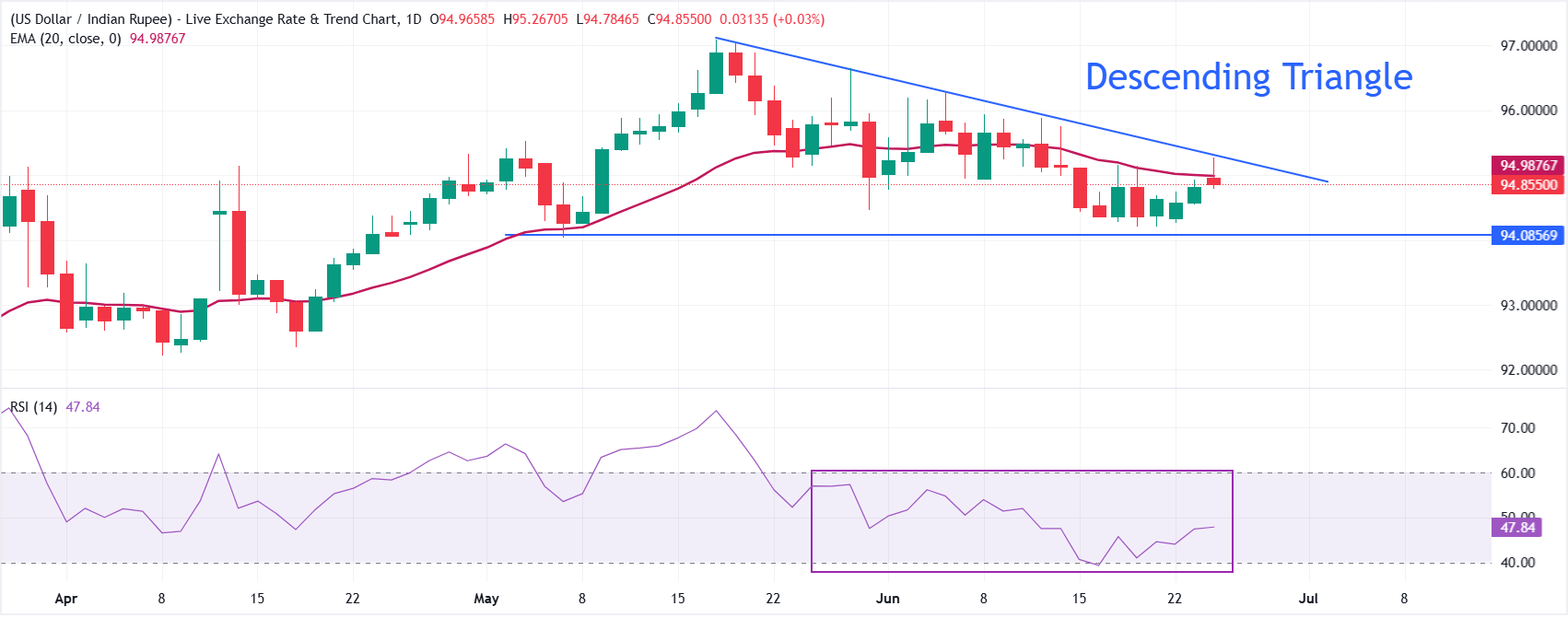
USD/INR trades higher at around 94.85, extending a corrective phase below a key band of moving-average and trendline resistance. The 20-day exponential moving average (EMA) at 94.9877 now caps the pair at the margin, while the broader downward-sloping resistance line traced from 97.1183, with an intermediate reference at the prior break area around 95.2926, reinforces a bearish near-term bias.
The Relative Strength Index (RSI) at 47.84 hovers just below the neutral 50 line, hinting that downside pressure persists but without clear oversold conditions.
On the topside, immediate resistance is located at the 20-day EMA near 95.00, followed by the former break zone around 95.29, where sellers are likely to re-emerge if a bounce develops, before the more distant trendline origin at 97.12. Looking down, the May 7 low at 94.03 is the key support zone; a downside move below the same would expose it to the April 15 high at 93.46.
(The technical analysis of this story was written with the help of an AI tool.)
Indian Rupee FAQs
The Indian Rupee (INR) is one of the most sensitive currencies to external factors. The price of Crude Oil (the country is highly dependent on imported Oil), the value of the US Dollar – most trade is conducted in USD – and the level of foreign investment, are all influential. Direct intervention by the Reserve Bank of India (RBI) in FX markets to keep the exchange rate stable, as well as the level of interest rates set by the RBI, are further major influencing factors on the Rupee.
The Reserve Bank of India (RBI) actively intervenes in forex markets to maintain a stable exchange rate, to help facilitate trade. In addition, the RBI tries to maintain the inflation rate at its 4% target by adjusting interest rates. Higher interest rates usually strengthen the Rupee. This is due to the role of the ‘carry trade’ in which investors borrow in countries with lower interest rates so as to place their money in countries’ offering relatively higher interest rates and profit from the difference.
Macroeconomic factors that influence the value of the Rupee include inflation, interest rates, the economic growth rate (GDP), the balance of trade, and inflows from foreign investment. A higher growth rate can lead to more overseas investment, pushing up demand for the Rupee. A less negative balance of trade will eventually lead to a stronger Rupee. Higher interest rates, especially real rates (interest rates less inflation) are also positive for the Rupee. A risk-on environment can lead to greater inflows of Foreign Direct and Indirect Investment (FDI and FII), which also benefit the Rupee.
Higher inflation, particularly, if it is comparatively higher than India’s peers, is generally negative for the currency as it reflects devaluation through oversupply. Inflation also increases the cost of exports, leading to more Rupees being sold to purchase foreign imports, which is Rupee-negative. At the same time, higher inflation usually leads to the Reserve Bank of India (RBI) raising interest rates and this can be positive for the Rupee, due to increased demand from international investors. The opposite effect is true of lower inflation.














