

Indian Rupee holds gains as Iran touts progress in deal with US
- The Indian Rupee reflects strength against the US Dollar as oil prices have fallen back.
- Iran confirms the establishment of a “de-confliction” cell to ensure a ceasefire in Lebanon.
- The odds of the Fed raising interest rates twice this year have increased to 58.5%.
The Indian Rupee (INR) trades firmly against the US Dollar (USD) in the opening session on Monday. The USD/INR pair holds onto losses near its over six-week low at around 94.25 as oil prices resume their downside journey, following positive commentary from Iran towards ongoing negotiations over the peace deal with the United States (US).
At press time, the MCX Crude Oil contract expiring on July 20 is down 1.25% to near 7,171 in the opening trade.
Currencies from economies, such as India, which rely heavily on imports to meet their energy needs, outperform when oil prices remain lower.
Iran hails great progress in talks with US
Iran’s Foreign Minister Abbas Araghchi has described the talks with the US in Switzerland as having delivered “major progress,” CNBC reported. Araghchi said that Tehran had secured what he described as waivers for oil and petrochemical exports, the lifting of the US blockade on its seaports, the release of some frozen assets, and the launch of a reconstruction and development plan.
Iran’s Foreign Minister Araghchi has also confirmed the establishment of a “de-confliction” cell with the US, facilitated by the mediating countries Qatar and Pakistan, to ensure a ceasefire in Lebanon.
Positive commentary from Iran has dashed fears of the Strait of Hormuz closure again and renewed hostilities in the Middle East. Over the weekend, US President Donald Trump threatened to "take over" the Hormuz, in an interview with Fox News, and hit the nation hard if Iran closes the waterway again. Trump’s threats came after Iran’s news agency reported that Tehran had closed the Hormuz again in response to a ceasefire violation in Lebanon.
FIIs made significant investment in Indian stock market on Friday
Lower oil prices and hopes of continued progress in the US-Iran peace talks have improved the sentiment of foreign investors toward the Indian stock market. On Friday, Foreign Institutional Investors (FIIs) purchased shares worth Rs. 4,859.07 crore, the highest amount of one-day investment seen in months.
US Dollar trades firm on hawkish Fed bets
The USD/INR pair seems under pressure despite the US Dollar’s outperformance in the wake of the accelerating hawkish Federal Reserve (Fed). As of writing, the US Dollar Index (DXY), which tracks the Greenback’s value against six major currencies, trades 0.15% higher to near 100.90.
According to the CME FedWatch tool, the odds of the Fed delivering at least two interest rate hikes this year are 58.5%, a sharp increase from the 17.1% seen a week ago.
Hawkish Fed bets have accelerated following the monetary policy announcement on Wednesday, in which the Economic Projections report showed that nine of 19 policymakers believe they will need to raise the Fed's policy rate this year.
Technical Analysis: USD/INR sees support near 94.00
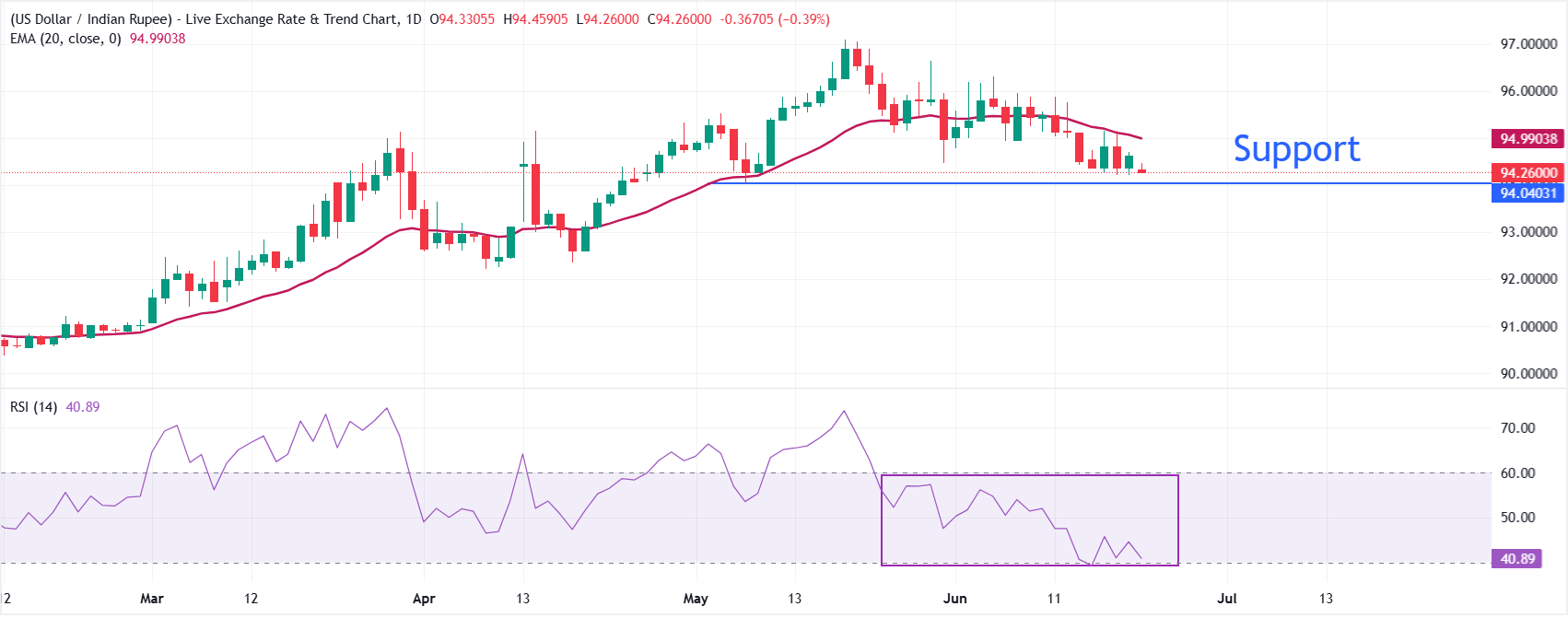
USD/INR trades lower at around 94.26, extending a corrective phase with a bearish near-term bias as price holds well below the 20-day Exponential Moving Average (EMA) at 94.9904. The Relative Strength Index (RSI) at about 40 suggests subdued momentum, hinting that the pair remains under pressure without yet reaching oversold conditions.
On the downside, the pair could slide to 93.00 if it extends its decline below the May 7 low at 94.03. Looking up, the pair could advance to the June 12 high at 95.76 if it rebounds above the 20-day EMA.
(The technical analysis of this story was written with the help of an AI tool.)
Indian Rupee FAQs
The Indian Rupee (INR) is one of the most sensitive currencies to external factors. The price of Crude Oil (the country is highly dependent on imported Oil), the value of the US Dollar – most trade is conducted in USD – and the level of foreign investment, are all influential. Direct intervention by the Reserve Bank of India (RBI) in FX markets to keep the exchange rate stable, as well as the level of interest rates set by the RBI, are further major influencing factors on the Rupee.
The Reserve Bank of India (RBI) actively intervenes in forex markets to maintain a stable exchange rate, to help facilitate trade. In addition, the RBI tries to maintain the inflation rate at its 4% target by adjusting interest rates. Higher interest rates usually strengthen the Rupee. This is due to the role of the ‘carry trade’ in which investors borrow in countries with lower interest rates so as to place their money in countries’ offering relatively higher interest rates and profit from the difference.
Macroeconomic factors that influence the value of the Rupee include inflation, interest rates, the economic growth rate (GDP), the balance of trade, and inflows from foreign investment. A higher growth rate can lead to more overseas investment, pushing up demand for the Rupee. A less negative balance of trade will eventually lead to a stronger Rupee. Higher interest rates, especially real rates (interest rates less inflation) are also positive for the Rupee. A risk-on environment can lead to greater inflows of Foreign Direct and Indirect Investment (FDI and FII), which also benefit the Rupee.
Higher inflation, particularly, if it is comparatively higher than India’s peers, is generally negative for the currency as it reflects devaluation through oversupply. Inflation also increases the cost of exports, leading to more Rupees being sold to purchase foreign imports, which is Rupee-negative. At the same time, higher inflation usually leads to the Reserve Bank of India (RBI) raising interest rates and this can be positive for the Rupee, due to increased demand from international investors. The opposite effect is true of lower inflation.














