

Indian Rupee ticks up as centre hikes import duty on Gold and Silver to 15%
- The Indian Rupee edges up against the US Dollar, following the increase in import tariffs on Gold and Silver.
- Fears of prolonged Hormuz closure are expected to keep oil prices elevated.
- The US Dollar gains as hot inflation data lifts hawkish Fed bets.
The Indian Rupee (INR) exhibits mild strength against the US Dollar (USD) in the opening session on Wednesday. The USD/INR pair trades mildly lower to near 95.60 as the Indian Rupee gains, following the increase in import duty on Gold and Silver to 15% from 6% by the Indian government.

New Delhi raises import tariffs on precious metals to 15%
India’s Department of Revenue under the Customs Act released a notification overnight that reflected a significant increase in the import tariffs on Gold and Silver to 15%. The notification also showed that Gold and Silver findings - small components such as hooks, clasps, clamps, pins, and screw backs used in jewellery manufacturing will now attract 5% customs duty.
Market participants had anticipated that the Indian government could hike import duty on precious metals, in an attempt to curb imports of bullion to ease pressure on the country’s foreign exchange reserves.
Over the weekend, Indian Prime Minister (PM) Narendra Modi urged citizens to postpone their non-essential gold purchases for almost a year while warning that India’s forex reserves are draining due to geopolitical tensions. Indian PM Modi also urged reducing fuel consumption and avoiding foreign travel.
Oil prices remain broadly higher amid the ongoing of US-Iran deadlock
In the Asian trade, the WTI Oil price has corrected to near $97.20, but is still over 6% higher so far this week, as negotiations between the United States (US) and Iran failed to achieve a breakthrough. US President Donald Trump rebuffed Iran’s counterproposal, calling it “totally unacceptable” first and then terming it a “stupid proposal”.
While Iran remains firm on its demands garding a permanent resolution with the US and the reopening of the Strait of Hormuz. Iran’s deputy foreign minister, Kazem Gharibabadi, said earlier in the day, that Iran’s position was that any peace deal must include reparations for Iran, Iranian sovereignty over the Strait of Hormuz, and an end to US sanctions.
FIIs keep dumping stake in Indian stock market
Amid growing concerns regarding India Inc.’s earnings projections due to higher energy prices, foreign investors continue to dump their stake in the Indian stock market. So far in May, Foreign Institutional Investors (FIIs) have remained net sellers in six of seven trading days and have offloaded their stake worth Rs. 21,469.30 crore.
USD/INR could extend the advance amid higher US Dollar
While a sudden hike in import duty on precious metals has put slight pressure on USD/INR, the pair could extend its ongoing rally as hot US inflation data for April has strengthened the US Dollar. During the press time, the US Dollar Index (DXY) is close to its weekly high of 98.46 posted on Tuesday.
The data showed on Wednesday that the US headline CPI grew at an annualized pace of 3.8%, stronger than estimates of 3.7% and the March reading of 3.3%. Signs of further acceleration in inflationary pressures have prompted expectations of interest rate hikes by the Federal Reserve (Fed) this year.
USD/INR technical analysis: USD/INR struggles to extend advance above 95.70
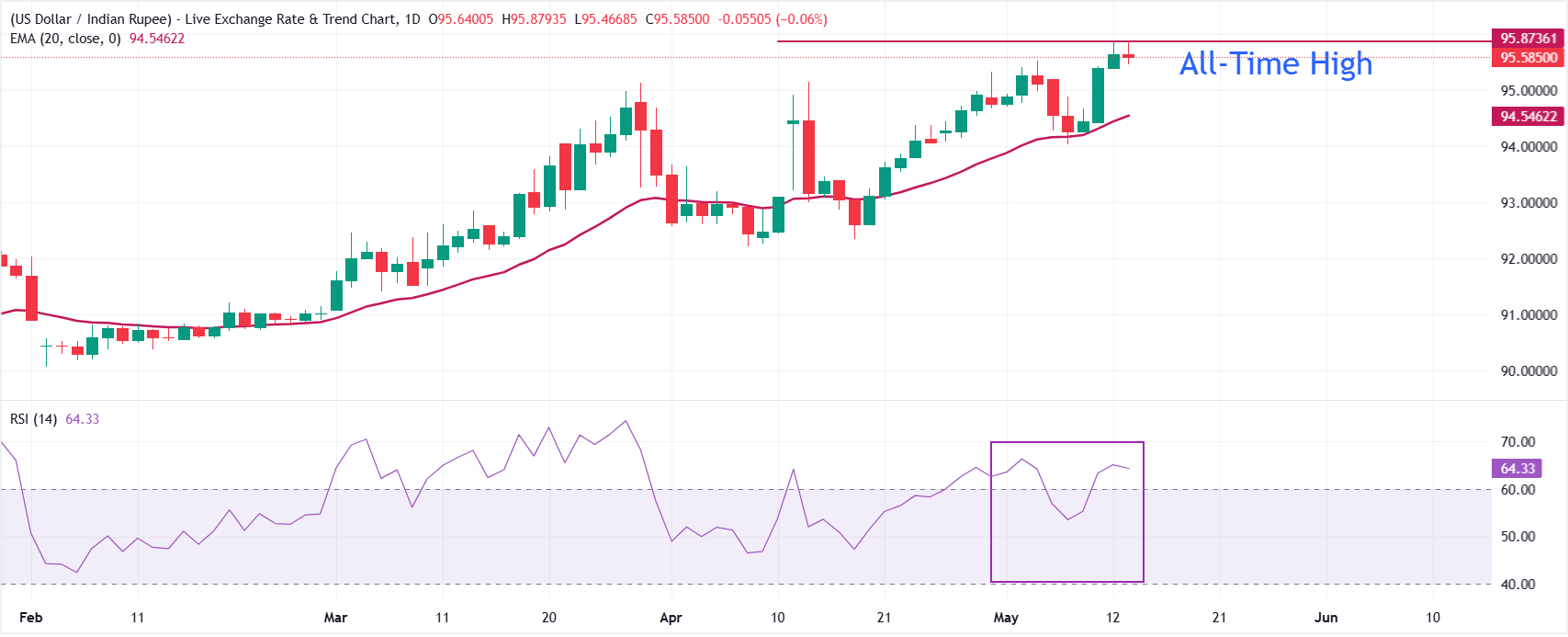
USD/INR trades marginally lower at around 95.60 as of writing. However, the pair maintains a bullish near-term bias as spot holds firmly above the 20-period Exponential Moving Average (EMA) at 94.55. The pair has been carving out higher closes in recent sessions, and the Relative Strength Index (14) around 65 suggests persistent upward momentum, though edging toward overbought territory.
On the downside, initial support is now seen at the 20-period EMA near 94.56, which acts as the first line of demand should any corrective pullback unfold. Looking up, the pair is in uncharted territory and could gain further toward 96.00
(The technical analysis of this story was written with the help of an AI tool.)
Indian Rupee FAQs
The Indian Rupee (INR) is one of the most sensitive currencies to external factors. The price of Crude Oil (the country is highly dependent on imported Oil), the value of the US Dollar – most trade is conducted in USD – and the level of foreign investment, are all influential. Direct intervention by the Reserve Bank of India (RBI) in FX markets to keep the exchange rate stable, as well as the level of interest rates set by the RBI, are further major influencing factors on the Rupee.
The Reserve Bank of India (RBI) actively intervenes in forex markets to maintain a stable exchange rate, to help facilitate trade. In addition, the RBI tries to maintain the inflation rate at its 4% target by adjusting interest rates. Higher interest rates usually strengthen the Rupee. This is due to the role of the ‘carry trade’ in which investors borrow in countries with lower interest rates so as to place their money in countries’ offering relatively higher interest rates and profit from the difference.
Macroeconomic factors that influence the value of the Rupee include inflation, interest rates, the economic growth rate (GDP), the balance of trade, and inflows from foreign investment. A higher growth rate can lead to more overseas investment, pushing up demand for the Rupee. A less negative balance of trade will eventually lead to a stronger Rupee. Higher interest rates, especially real rates (interest rates less inflation) are also positive for the Rupee. A risk-on environment can lead to greater inflows of Foreign Direct and Indirect Investment (FDI and FII), which also benefit the Rupee.
Higher inflation, particularly, if it is comparatively higher than India’s peers, is generally negative for the currency as it reflects devaluation through oversupply. Inflation also increases the cost of exports, leading to more Rupees being sold to purchase foreign imports, which is Rupee-negative. At the same time, higher inflation usually leads to the Reserve Bank of India (RBI) raising interest rates and this can be positive for the Rupee, due to increased demand from international investors. The opposite effect is true of lower inflation.













