

USD/INR moves higher as RBI rolls back partial INR-supportive measures
- The Indian Rupee drops against the US Dollar as the RBI withdraws partial curbs aimed at supporting the domestic currency.
- The US and Iran will likely resume peace talks on Tuesday evening or Wednesday morning.
- Investors await Kevin Warsh’s confirmation hearing later in the day.
The Indian Rupee (INR) trades lower against the US Dollar (USD) at open on Tuesday. The USD/INR pair jumps to near 93.35 as the Indian currency faces selling pressure, as the Reserve Bank of India (RBI) rolls back partial measures that were meant to diminish the impact of one-way excessive moves against the domestic currency.

On late Monday, the RBI announced that it withdrew curbs on state-run banks, which were restricting them from offering non-deliverable forwards (NDFs) to resident and non‑resident users and dropped curbs that prevented users from rebooking foreign exchange derivative contracts, Reuters reports.
Iran agrees to another round of talks with the US
The risk appetite of financial market participants has improved significantly, as Iran has agreed to return to the table with the United States (US) to resume talks regarding a permanent ceasefire.
A report from The Wall Street Journal (WSJ) has shown that Iran has told regional mediators that it would send a negotiating team to Islamabad on Tuesday for the second round of talks with the US. However, there has been no official confirmation by Tehran.
While Washington had already confirmed that Vice President (VP) JD Vance is leaving for Islamabad and will lead the team in negotiations with Tehran, which will likely take place on either Tuesday night or Wednesday morning.
On Monday, market sentiment turned risk-averse after Iran refused to sit down again with the US, while accusing it of violating ceasefire terms. Iran's foreign ministry spokesperson Esmail Baghaei said that there is “no plan for a second round of negotiations with the US for now."
FIIs turn out to be net sellers on Monday
While strength in global markets reflects confidence that the US and Iran would lead to a permanent ceasefire soon, the sentiment of overseas investors toward the Indian stock market continues to remain lackluster.
On Monday, Foreign Institutional Investors (FIIs) remained net sellers in the Indian stock market after raising a little stake in the April 15-17 period. FIIs sold shares worth Rs. 1,059.53 crore on the first trading day of the week. In the last three trading days of the previous week, FIIs purchased shares worth Rs. 1,731.71 (Rs. 577.24 crore on average).
Kevin Warsh’s confirmation hearing and US Retail Sales data in focus
In Tuesday’s session, investors will focus on the speech of US President Donald Trump’s nominee Kevin Warsh for the Federal Reserve’s (Fed) new chairman in his confirmation hearing and US Retail Sales data for March, which will be published at 12:30 GMT.
The Retail Sales data, a key measure of consumer spending, is estimated to have grown 1.4% on a monthly basis against February’s reading of 0.6%. Investors will monitor the data to get cues regarding the overall demand for households.
Technical Analysis: USD/INR returns above 20-day EMA
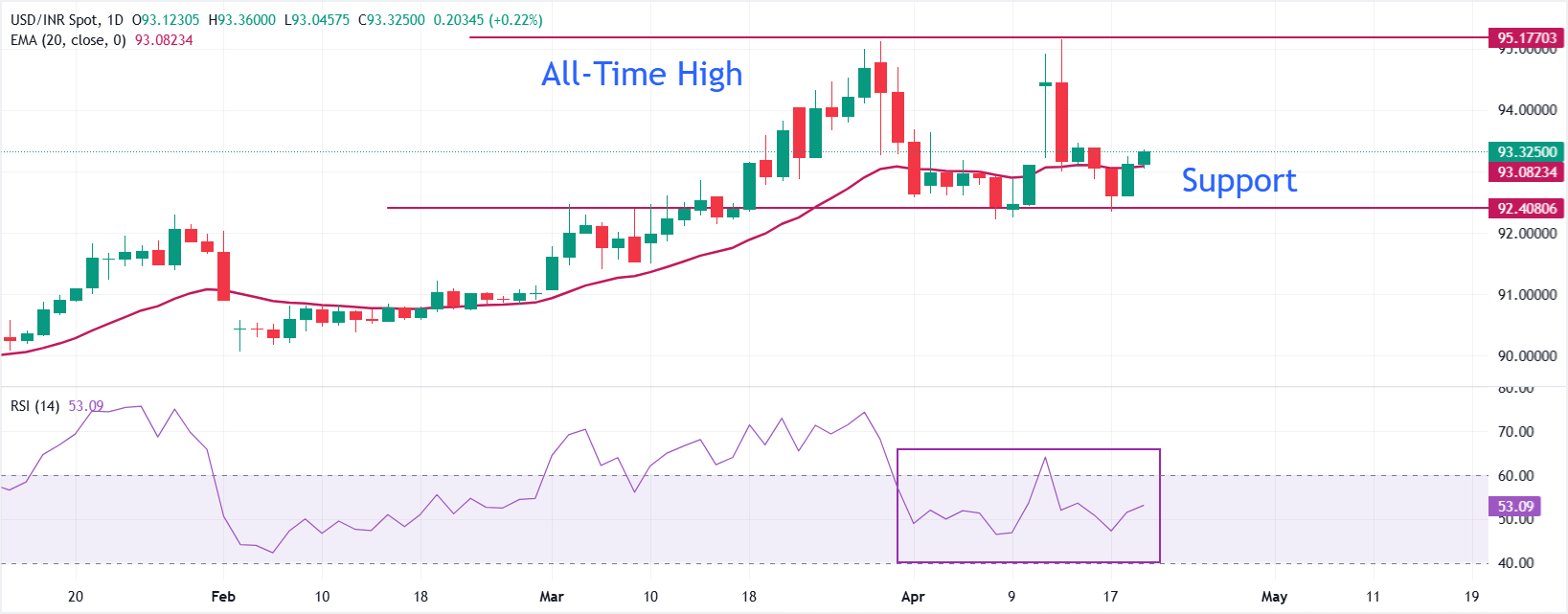
USD/INR trades higher at around 93.35 at the press time. The near-term tone of the pair turns bullish, as it returns above the 20-day Exponential Moving Average (EMA), which is at 93.08.
The Relative Strength Index (14) continues to wobble inside the 40.00-60.00 zone, reflecting a sideways trend.
Looking up, the spot could attempt further recovery towards 94.00 if it manages to sustain firmly above the 20-day EMA. On the downside, the price could return to the March 3 high at 92.46 if it fails to hold above the average.
(The technical analysis of this story was written with the help of an AI tool.)
Indian Rupee FAQs
The Indian Rupee (INR) is one of the most sensitive currencies to external factors. The price of Crude Oil (the country is highly dependent on imported Oil), the value of the US Dollar – most trade is conducted in USD – and the level of foreign investment, are all influential. Direct intervention by the Reserve Bank of India (RBI) in FX markets to keep the exchange rate stable, as well as the level of interest rates set by the RBI, are further major influencing factors on the Rupee.
The Reserve Bank of India (RBI) actively intervenes in forex markets to maintain a stable exchange rate, to help facilitate trade. In addition, the RBI tries to maintain the inflation rate at its 4% target by adjusting interest rates. Higher interest rates usually strengthen the Rupee. This is due to the role of the ‘carry trade’ in which investors borrow in countries with lower interest rates so as to place their money in countries’ offering relatively higher interest rates and profit from the difference.
Macroeconomic factors that influence the value of the Rupee include inflation, interest rates, the economic growth rate (GDP), the balance of trade, and inflows from foreign investment. A higher growth rate can lead to more overseas investment, pushing up demand for the Rupee. A less negative balance of trade will eventually lead to a stronger Rupee. Higher interest rates, especially real rates (interest rates less inflation) are also positive for the Rupee. A risk-on environment can lead to greater inflows of Foreign Direct and Indirect Investment (FDI and FII), which also benefit the Rupee.
Higher inflation, particularly, if it is comparatively higher than India’s peers, is generally negative for the currency as it reflects devaluation through oversupply. Inflation also increases the cost of exports, leading to more Rupees being sold to purchase foreign imports, which is Rupee-negative. At the same time, higher inflation usually leads to the Reserve Bank of India (RBI) raising interest rates and this can be positive for the Rupee, due to increased demand from international investors. The opposite effect is true of lower inflation.














