

Dow Jones Industrial Average declines as trade war rhetoric dampens sentiment
بواسطة Joshua Gibson
تاريخ النشر: 20 Jan 2026 | تاريخ التعديل: 20 Jan 2026


المقالات الشائعة

The Dow Jones Industrial Average (DJIA) ripped open the new trading week on a tariff-fueled weak note, reminiscent of trade war fears that knocked around equity markets early in 2025. A year later, the Trump administration is still grappling with picking a lane and staying in it.
- The Dow Jones shed 220 points from last week’s close as investors pull back following fresh trade war rhetoric.
- US President Donald Trump has vowed to impose new trade tariffs on Europe, European leaders were quick to respond.
- Trump’s fresh tariff threats come on the heels of facing political friction over his suggestion that he take over Greenland.
- Market momentum remains subdued on Monday overall with American markets taking a break for Martin Luther King Day.
The Dow Jones Industrial Average (DJIA) ripped open the new trading week on a tariff-fueled weak note, reminiscent of trade war fears that knocked around equity markets early in 2025. A year later, the Trump administration is still grappling with picking a lane and staying in it.
US President Donald Trump has ramped up his assertions that the US should “own” Greenland, going so far as to suggest that he no longer feels an obligation to “think purely of Peace” (sic), suggesting that part of his newfound aggressive stance on Greenland is owed in part to Trump getting snubbed for the annual Nobel Peace Prize. According to messages between Trump and Norwegian Prime Minister Jonas Gahr Støre obtained by media outlets, Støre reminded Trump that the Nobel Prize is administered by an independent committee, not the Norwegian government.
Trump wants Greenland, but resistance remains firm
President Trump has vowed to impose a 10% tariff on US exports bound for eight European countries, including Denmark, Norway, Sweden, France, Germany, the United Kingdom, the Netherlands and Finland, beginning on February 1.Tariffs would ramp up to an additional 25% by the summer months if the European Union doesn’t break off an entire nation and grant it to the US. US exports to the European economic zone have amounted to very little at the best of times, and it took European leaders a little under two hours to respond to Trump’s newest tariff threats over the weekend with a reciprocal tariff threat. Counter tariffs have had a profound effect on multiple American industrial sectors over the past year, and European leaders are expected to deliver a targeted tariff list that will lean on ongoing US economic pain points.
US markets are in low-volume mode as most American exchanges take the Martin Luther King Day holiday. US equity markets will be back in force from Tuesday, just in time for a fresh update to the ADP Employment Change 4-week average, followed by a scheduled speech from President Trump on Wednesday, with a hot update to US Personal Consumption Expenditure Price Index (PCE) inflation on Thursday. Friday will wrap up the trading week with a fresh round of S&P Global Purchasing Managers Index (PMI) survey results for January.
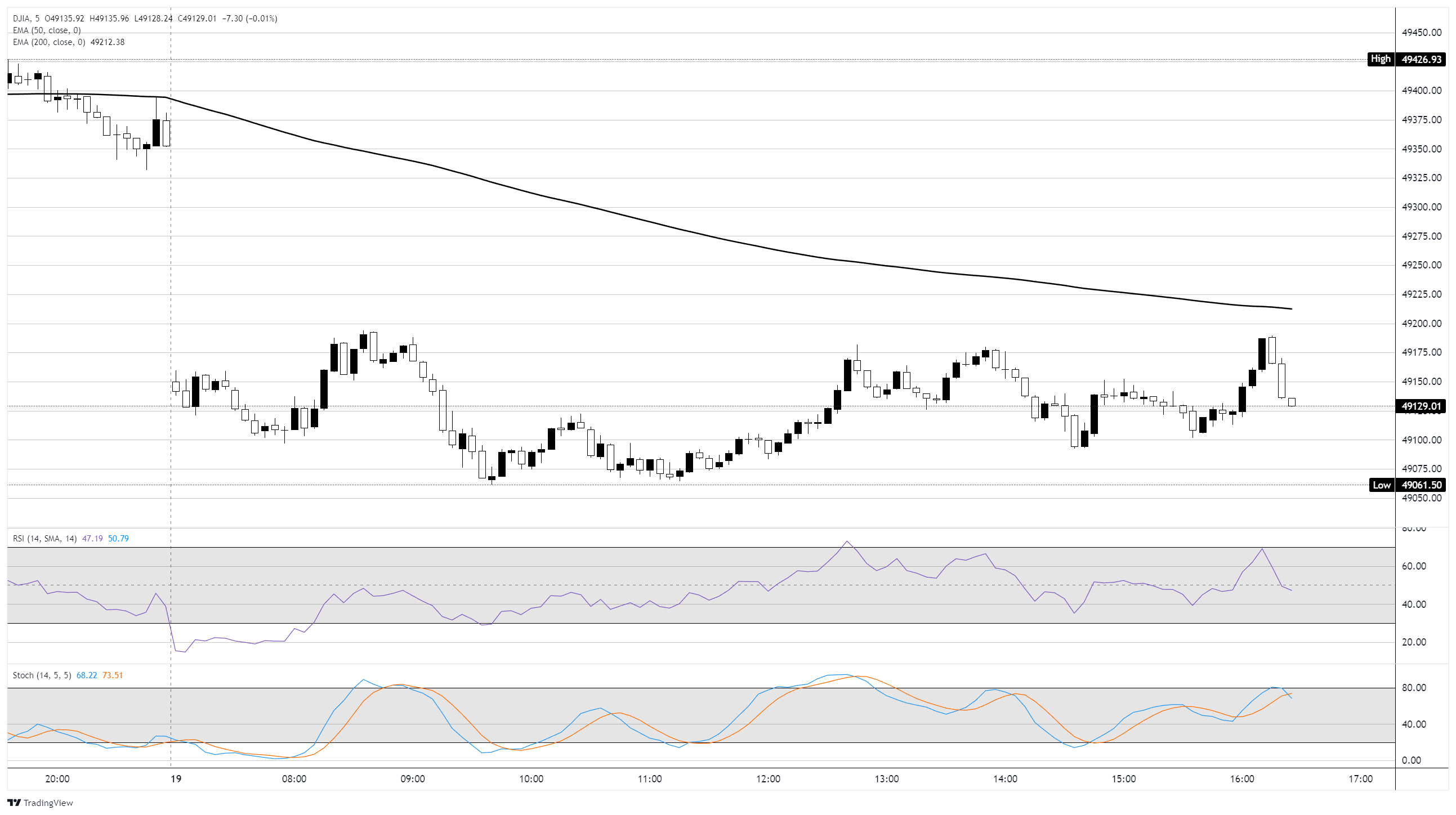
Dow Jones 5-minute chart
Tariffs FAQs
Tariffs are customs duties levied on certain merchandise imports or a category of products. Tariffs are designed to help local producers and manufacturers be more competitive in the market by providing a price advantage over similar goods that can be imported. Tariffs are widely used as tools of protectionism, along with trade barriers and import quotas.
Although tariffs and taxes both generate government revenue to fund public goods and services, they have several distinctions. Tariffs are prepaid at the port of entry, while taxes are paid at the time of purchase. Taxes are imposed on individual taxpayers and businesses, while tariffs are paid by importers.
There are two schools of thought among economists regarding the usage of tariffs. While some argue that tariffs are necessary to protect domestic industries and address trade imbalances, others see them as a harmful tool that could potentially drive prices higher over the long term and lead to a damaging trade war by encouraging tit-for-tat tariffs.
During the run-up to the presidential election in November 2024, Donald Trump made it clear that he intends to use tariffs to support the US economy and American producers. In 2024, Mexico, China and Canada accounted for 42% of total US imports. In this period, Mexico stood out as the top exporter with $466.6 billion, according to the US Census Bureau. Hence, Trump wants to focus on these three nations when imposing tariffs. He also plans to use the revenue generated through tariffs to lower personal income taxes.

يعتمد أكثر من مليون مستخدم على FXStreet للحصول على بيانات سوقية لحظية، وأدوات رسوم بيانية، ورؤى خبراء، وأخبار الفوركس. يساعد تقويمهم الاقتصادي الشامل والندوات التعليمية عبر الويب المتداولين على البقاء على اطلاع واتخاذ قرارات محسوبة. لدى FXStreet فريق يضم حوالي 60 محترفًا موزعين بين مقر برشلونة ومناطق عالمية مختلفة.
اقرأ المزيد








