Middle East Conflict Escalates Again: Houthi Involvement Boosts Safe-Haven Demand — Can Gold Regain Upward Momentum?
In the short term, gold volatility has intensified, while in the long term it continues to benefit from geopolitical uncertainty. Commerzbank has raised its year-end price target to $5,000. Overall, the expansion of the Middle East conflict has increased risk premiums and reinforced gold’s safe-haven appeal, but tightening macroeconomic expectations remain a near-term constraint.
Meanwhile, U.S. military activity is also escalating. Washington has deployed two waves of thousands of Marines to the Middle East, with the first group arriving aboard amphibious assault ships around March 28. The Pentagon is also planning to deploy thousands of troops from the 82nd Airborne Division. U.S. officials are preparing for the possibility of a prolonged ground operation in Iran, although final approval rests with President Trump. In response, Iran has issued strong warnings, with its armed forces stating that the residences of U.S. and Israeli military and political leaders could become legitimate targets.

The involvement of Houthi forces has opened a new front and directly threatened global energy transportation. The Strait of Hormuz is already effectively blocked, handling roughly one-fifth of global oil and LNG shipments. If Houthi operations expand, the Bab el-Mandeb Strait — a key gateway to the Suez Canal — could become the next target. Elevated oil prices and rising costs of commodities such as fertilizers are rapidly feeding into the global economy, intensifying inflation concerns.
U.S. economic data reflects growing pressure. The March consumer confidence index fell to a three-month low. According to CME’s FedWatch tool, traders have fully priced out the possibility of Federal Reserve rate cuts in 2026 and are even beginning to price in the likelihood of rate hikes later in the year. U.S. Treasury yields have moved higher across the curve, with the 10-year yield reaching its highest level since July and the 30-year yield approaching 5%. The U.S. dollar index has also strengthened, supported by both safe-haven demand and tightening expectations, and is on track for its strongest monthly gain in nearly a year. Meanwhile, equity markets have declined for a fifth consecutive week, with technology and consumer discretionary sectors under particular pressure.
In such an environment, gold — as a traditional safe-haven asset — would typically receive strong support. However, the actual price action has been more complex. Dip-buying briefly pushed gold up nearly 3%, but prices pulled back again to around $4,470 on Monday morning. A stronger dollar and rising inflation expectations are weighing on rate-cut prospects and pressuring gold, while geopolitical uncertainty continues to provide support, resulting in choppy price movements.
Commerzbank has raised its year-end gold forecast from $4,900 to $5,000, expecting that the Iran conflict may conclude in the spring, potentially allowing the Federal Reserve to resume rate cuts. However, in the near term, market sentiment remains driven by both geopolitical developments and macroeconomic factors.
Market Interpretation:
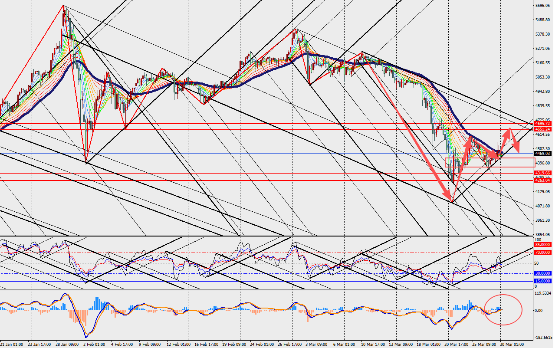
On the 4-hour chart, gold is showing a pullback within a consolidation phase, with MACD lines and volume bars contracting near the zero axis. This week, key U.S. data releases — including ISM manufacturing and services PMIs, February retail sales, and the March nonfarm payroll report — along with remarks from Federal Reserve Chair Powell, will be critical in assessing inflation trends and economic resilience, and will play a decisive role in shaping gold’s direction.