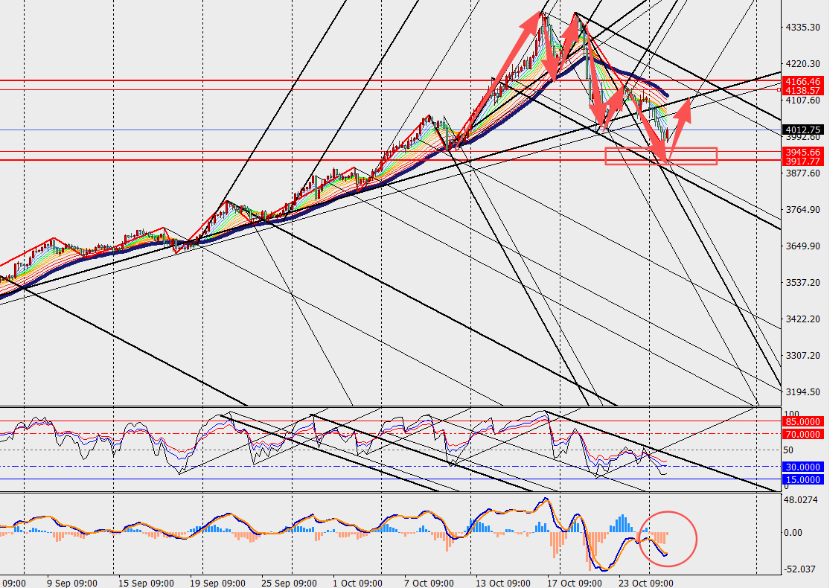
NVIDIA’s Recent Expansion Moves Accelerate, Share Price Breaks Out Again!
As of October 2025, NVIDIA (NASDAQ: NVDA) remains at the heart of the global wave in artificial intelligence and high-performance computing (HPC), showing strong momentum in technological innovation, industry partnerships, market performance, and strategic positioning.
Technology
At its GTC conference in Washington, NVIDIA unveiled a technological framework billed as “the first new computing model in sixty years,” highlighting deeper integration of the new Blackwell architecture with the CUDA platform. This architecture further cements NVIDIA’s dominance in general-purpose computing and AI training.

The company also announced, together with the U.S. Department of Energy and Oracle, two supercomputers—“Solstice” and “Equinox”—equipped with 100,000 and 10,000 Blackwell GPUs respectively, with total compute power reaching 2,200 exaflops. This not only showcases NVIDIA’s technological prowess but also establishes its leadership in government research and large-scale AI infrastructure.
Meanwhile, through software stacks such as Megatron-Core and TensorRT, the company is expanding support for Agentic AI (AI models with autonomous capabilities), further deepening its software-ecosystem moat.
Partnerships
NVIDIA has been highly active recently. Most notably, it made a $1 billion strategic investment in Nokia (a 2.9% stake). The two parties will jointly advance AI-native wireless network infrastructure for the 6G era. Through this collaboration, NVIDIA’s Aerial RAN platform will become a key component of AI-driven communications technology.
The company is also increasing its presence in aerospace, automotive, and industrial edge AI, launching the PhysicsNeMo physics-simulation framework and the next-generation IGX “Thor” robotics processor for high-precision industrial and medical robotics applications.
Market and Financial Performance
In October, NVIDIA’s stock rose about 5%, adding roughly $230 billion in market value and pushing it close to the $5 trillion threshold, making it one of the most valuable tech firms globally. Multiple investment banks raised their price targets, citing the company’s unassailable lead in AI chips. NVIDIA disclosed that its current AI-chip order backlog has reached $500 billion, reflecting strong downstream demand and market confidence.
However, analysts also note that a massive order book does not mean it will all convert to revenue in the short term. Actual results will still depend on production, supply chain capacity, export controls, and the competitive landscape. In particular, amid escalating U.S.–China trade restrictions, NVIDIA’s growth prospects in the China market face some uncertainty.
Outlook
NVIDIA is actively moving beyond the label of “GPU maker,” transforming into a comprehensive AI-infrastructure and systems-integration platform. By integrating hardware (Blackwell GPUs), software (the CUDA ecosystem), systems (DGX and SuperPOD servers), and services (AI factories and partner networks), the company is building end-to-end control over the AI value chain. The collaborations with Nokia and the DOE-Oracle projects indicate a strategic shift from pure chip sales to a focus on infrastructure and ecosystem deployment.
Conclusion
NVIDIA’s multiple advances have reinforced its leading position in the global race to build AI infrastructure. Technological innovation, strategic partnerships, and market enthusiasm are jointly powering its growth potential. At the same time, a lofty valuation, geopolitical risks, and supply-chain challenges make execution the key test ahead. Over the long term, NVIDIA is still viewed as a central force in the AI industry, with a development trajectory that will profoundly shape the future global tech landscape.