

Bank of Japan expected to hold rates amid Iran war-driven inflation fears
- The Bank of Japan is expected to keep rates on hold, but a hike is not off the table.
- Uncertainty spurring from the Middle East war will take its toll on the decision.
- Macro fundamentals back the case for additional rate hikes in Japan.
The Bank of Japan (BoJ) will announce its monetary policy decision on Tuesday, at around 3:00 GMT. The BoJ is widely expected to deliver a hawkish hold, keeping the benchmark interest rate unchanged at 0.75% while also hinting at a willingness to hike rates. The latest change in interest rates took place in December, when BoJ officials hiked by 25 basis points (bps)

Japanese policymakers are between a rock and a hard place: The Middle East war is a global source of uncertainty, while the local macro puts pressure on policymakers to act promptly.
Hotter-than-expected inflation and a tightening labor market hint at faster interest rate hikes, which run counter to the BoJ officials' views.
In the meantime, the Middle East war continues. Hopes for a quick resolution fade as time goes by, with the war about to turn two months old.
What to expect from the BoJ interest rate decision?
According to the latest available data, the Consumer Price Index (CPI) rose 1.5% YoY in March, up from 1.3% in February and above the 1.4% anticipated by market players. Core annual inflation, which excludes volatile food and energy prices, rose to 1.8%, up from the expected 1.5%. Meanwhile, the Unemployment Rate stood at 2.6% in February.
If the BoJ could base monetary policy solely on these data, policymakers should pull the trigger in this meeting. However, the ongoing crisis in the Middle East paints a different picture. Rising Oil prices and persistent supply disruptions are expected to have a profound and prolonged impact on inflation worldwide. Japan is no exception. That opens the door for a surprise interest rate hike, although we are talking about Japan, and surprises are not usually in their script.
Policymakers are well aware of the situation. In a press conference in Washington following the 20-G meeting, BoJ Governor Kazuo Ueda noted that higher Oil prices “pose both upside risks to prices and downside risks to the economy, making policy responses difficult.”
Ueda added: “Developments in the Middle East will be a crucial factor (for the BoJ's policy decision), but the outlook remains quite uncertain." Finally, he repeated the central bank’s commitment to price stability: “We will take the most appropriate response to achieve our 2% price target in a sustainable and stable way.”
Governor Ueda will offer a press conference following the rate announcement, as usual. And while market participants anticipate a hawkish lean, the focus will be on how hawkish Japanese policymakers are willing to be in such an uncertain environment.
How could the Bank of Japan's monetary policy decision affect USD/JPY?
Heading into the announcement, market participants expect the BoJ to hold its fire but deliver at least 50 bps rate hikes through 2026. The monetary policy Board is likely to keep rates on hold in its April meeting, not because it is the right decision, but to prevent a market shock. Policymakers are likely to anticipate additional rates coming, which will not be a big surprise.
There are two quite hawkish scenarios. The first would be the BoJ actually triggering a rate hike. The second would be to directly pre-announce a rate hike at the next monetary policy meeting. Furthermore, if officials hint at worries about growth, something that so far they have avoided, the case for additional rate hikes will increase, and hence, boost demand for the Japanese Yen (JPY). The odds for any of those happening are quite limited.
A dovish announcement is off the table, given the ongoing Middle East war.
Valeria Bednarik, Chief Analyst at FXStreet, notes: “The USD/JPY pair trades in quite a limited range just below 160.00 since early April, driven by sentiment related to the Persian Gulf crisis. Speculative interest is looking at the US Dollar (USD) as the preferred safe-haven, with optimism boosting demand for the Greenback, and pessimism leading to USD sell-offs. The BoJ announcement, unless a surprise, is likely to have a limited impact on the pair.”
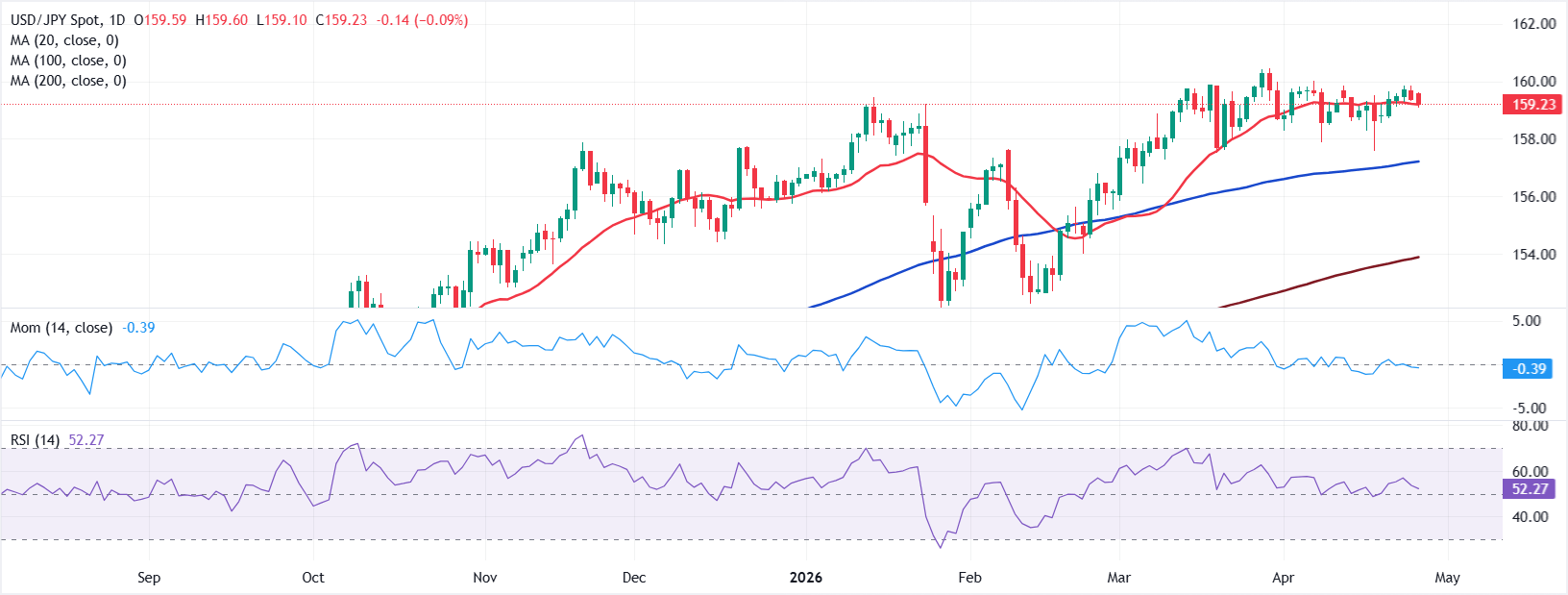
Bednarik adds: “From a technical point of view, the USD/JPY pair is neutral. In the daily chart, the pair develops around a flat 20-day Simple Moving Average (SMA), which has been unable to find a way since early April. The 100- and 200-day SMAs keep heading higher, far below the current level, in line with the former dominant bullish trend. At the same time, the pair develops not far below its 2026 peak in the 160.40 region. Finally, technical indicators head marginally lower within neutral levels, far from providing a clear directional clue. The pair could fall with a hawkish announcement, with a break below 159.00 opening the door for a test of the 158.40 region. Below the latter, the slide could continue towards 157.90. As previously noted, 160.00 provides resistance in the case of sudden JPY weakness, with additional gains aiming to retest the year high.”
Economic Indicator
BoJ Interest Rate Decision
The Bank of Japan (BoJ) announces its interest rate decision after each of the Bank’s eight scheduled annual meetings. Generally, if the BoJ is hawkish about the inflationary outlook of the economy and raises interest rates it is bullish for the Japanese Yen (JPY). Likewise, if the BoJ has a dovish view on the Japanese economy and keeps interest rates unchanged, or cuts them, it is usually bearish for JPY.
Read more.Next release: Tue Apr 28, 2026 03:00
Frequency: Irregular
Consensus: 0.75%
Previous: 0.75%
Source: Bank of Japan
Japanese Yen FAQs
The Japanese Yen (JPY) is one of the world’s most traded currencies. Its value is broadly determined by the performance of the Japanese economy, but more specifically by the Bank of Japan’s policy, the differential between Japanese and US bond yields, or risk sentiment among traders, among other factors.
One of the Bank of Japan’s mandates is currency control, so its moves are key for the Yen. The BoJ has directly intervened in currency markets sometimes, generally to lower the value of the Yen, although it refrains from doing it often due to political concerns of its main trading partners. The BoJ ultra-loose monetary policy between 2013 and 2024 caused the Yen to depreciate against its main currency peers due to an increasing policy divergence between the Bank of Japan and other main central banks. More recently, the gradually unwinding of this ultra-loose policy has given some support to the Yen.
Over the last decade, the BoJ’s stance of sticking to ultra-loose monetary policy has led to a widening policy divergence with other central banks, particularly with the US Federal Reserve. This supported a widening of the differential between the 10-year US and Japanese bonds, which favored the US Dollar against the Japanese Yen. The BoJ decision in 2024 to gradually abandon the ultra-loose policy, coupled with interest-rate cuts in other major central banks, is narrowing this differential.
The Japanese Yen is often seen as a safe-haven investment. This means that in times of market stress, investors are more likely to put their money in the Japanese currency due to its supposed reliability and stability. Turbulent times are likely to strengthen the Yen’s value against other currencies seen as more risky to invest in.














