

British Pound holds 1.3400 as Fed’s decision looms
- US-Iran MOU signing keeps oil lower, easing inflation pressure.
- Softer ADP hiring points to cooling private-sector labor demand.
- BoE and Fed decisions headline a loaded policy week.
The Pound Sterling holds firm above the 1.3400 level on Tuesday as the US Dollar recovers some ground, even as geopolitical tensions ease following the US-Iran peace agreement. At the time of writing, the GBP/USD trades with minimal losses of 0.03%
GBP/USD steadies as traders weigh truce and central-bank risks
Recent news revealed that the US-Iran Memorandum of Understanding (MOU) would be signed on Friday in Burgentock, Switzerland, according to the Swiss Foreign Ministry. Meanwhile, market participants continued to cheer the agreement between Washington and Tehran, pushing Oil prices lower, while the Greenback remains steady ahead of the Federal Reserve’s monetary policy decision.

The US central bank is expected to keep interest rates unchanged, though traders would be dissecting the Summary of Economic Projections (SEP). In it, policymakers express their views about economic growth, inflation, but most importantly, monetary policy. The so-called “dot-plot” will be revealed and is expected to show a hawkish tilt sparked by the jump in energy prices.
Data from the US showed the ADP Employment Change 4-week average, which showed that private companies hired 25K people, below the previous print of 29K, indicating a slowdown in hiring.
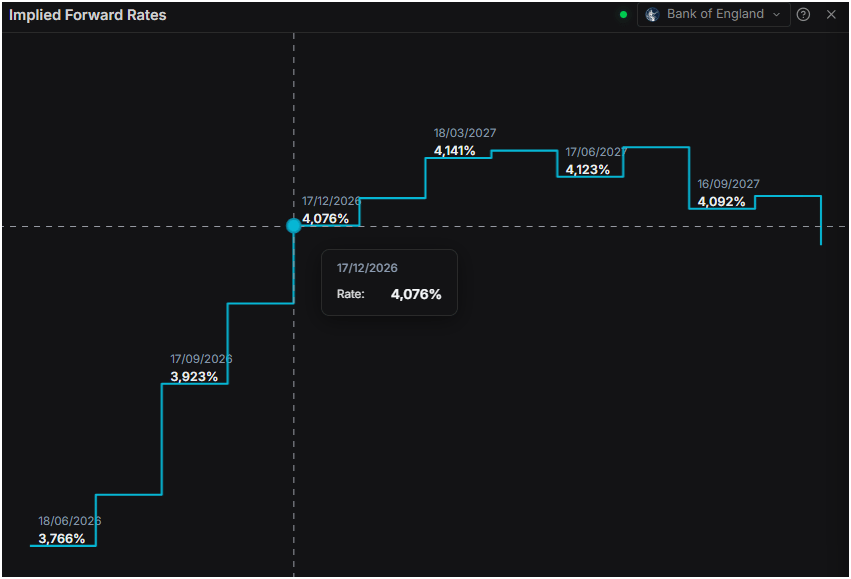
Across the pond, the UK economic schedule will feature inflation and jobs data, ahead of the Bank of England’s (BoE) monetary policy decision. The BoE is expected to hold the Bank Rate at 3.75%. Despite this, money markets expect the UK central bank, led by Andrew Bailey, to tighten by 33 basis points, even though there’s a truce agreement between the US and Iran.
GBP/USD Price Forecast: Technical outlook
In the daily chart, GBP/USD trades at 1.3425, keeping a mildly bearish near-term tone as spot holds beneath the cluster of key technical references. The latest reading of the Moving Average Triple (simple 50-, 100- and 200-day moving averages) at 1.3475 sits above price, suggesting the broader trend still caps recoveries, while the reclaimed downward resistance trend line around 1.3553 remains a more distant ceiling. Momentum is neutral-to-soft, with the 14-day Relative Strength Index hovering just below the 50 line, hinting that upside attempts may lack conviction unless buyers can force a clear break of overhead levels.
On the topside, immediate resistance appears near the former rising support trend line now projected around 1.3428, with stronger supply expected at the grouped simple moving averages around 1.3475. A sustained move above that barrier would expose the descending resistance trend line near 1.3553. With no clear nearby structural supports derived from the provided levels, any retreat from current prices would leave the pair vulnerable to fresh lows, and only a decisive recovery above the moving-average cluster would start to ease the current bearish bias.
(The technical analysis of this story was written with the help of an AI tool.)
Pound Sterling FAQs
The Pound Sterling (GBP) is the oldest currency in the world (886 AD) and the official currency of the United Kingdom. It is the fourth most traded unit for foreign exchange (FX) in the world, accounting for 12% of all transactions, averaging $630 billion a day, according to 2022 data. Its key trading pairs are GBP/USD, also known as ‘Cable’, which accounts for 11% of FX, GBP/JPY, or the ‘Dragon’ as it is known by traders (3%), and EUR/GBP (2%). The Pound Sterling is issued by the Bank of England (BoE).
The single most important factor influencing the value of the Pound Sterling is monetary policy decided by the Bank of England. The BoE bases its decisions on whether it has achieved its primary goal of “price stability” – a steady inflation rate of around 2%. Its primary tool for achieving this is the adjustment of interest rates. When inflation is too high, the BoE will try to rein it in by raising interest rates, making it more expensive for people and businesses to access credit. This is generally positive for GBP, as higher interest rates make the UK a more attractive place for global investors to park their money. When inflation falls too low it is a sign economic growth is slowing. In this scenario, the BoE will consider lowering interest rates to cheapen credit so businesses will borrow more to invest in growth-generating projects.
Data releases gauge the health of the economy and can impact the value of the Pound Sterling. Indicators such as GDP, Manufacturing and Services PMIs, and employment can all influence the direction of the GBP. A strong economy is good for Sterling. Not only does it attract more foreign investment but it may encourage the BoE to put up interest rates, which will directly strengthen GBP. Otherwise, if economic data is weak, the Pound Sterling is likely to fall.
Another significant data release for the Pound Sterling is the Trade Balance. This indicator measures the difference between what a country earns from its exports and what it spends on imports over a given period. If a country produces highly sought-after exports, its currency will benefit purely from the extra demand created from foreign buyers seeking to purchase these goods. Therefore, a positive net Trade Balance strengthens a currency and vice versa for a negative balance.














