

Canada Unemployment Rate expected to remain at 6.7% in April
- The Canadian Unemployment Rate is seen holding steady in April.
- The BoC is expected to stay put at its June 10 meeting.
- The Canadian Dollar remains on the defensive vs the Greenback this week.
Statistics Canada will release its Labour Force Survey on Friday, and markets are bracing for quite a steady print. The Unemployment Rate is expected to remain at 6.7% in April, while the Employment Change is forecast to increase by 15K following a 14.1K gain in the previous month.
Despite the tone of the report, the bar for a change of direction by the Bank of Canada (BoC) should remain pretty high. Indeed, the central bank is expected to maintain its steady hand at its June 10 gathering, following four consecutive “on hold” decisions.

At its latest event, the BoC signalled an upbeat medium-term outlook for economic growth while revising inflation higher for the current year. In addition, Governor Tiff Macklem delivered a cautious message at his press conference, keeping the data-dependent stance well in place while leaving the door open to higher rates in case energy prices remain elevated.
So far, market participants expect around 45 basis points of tightening by the bank by year-end.
What can we expect from the next Canadian Unemployment Rate print?
Consensus among analysts sees Canada’s Unemployment Rate at 6.7% last month. Additionally, investors forecast the economy will add around 15K jobs in April, a tad higher than March’s 14.1K gain. It is worth recalling that Average Hourly Wages rose at an annualised 5.1% in March (from 4.9%), pointing to sticky wage inflation.
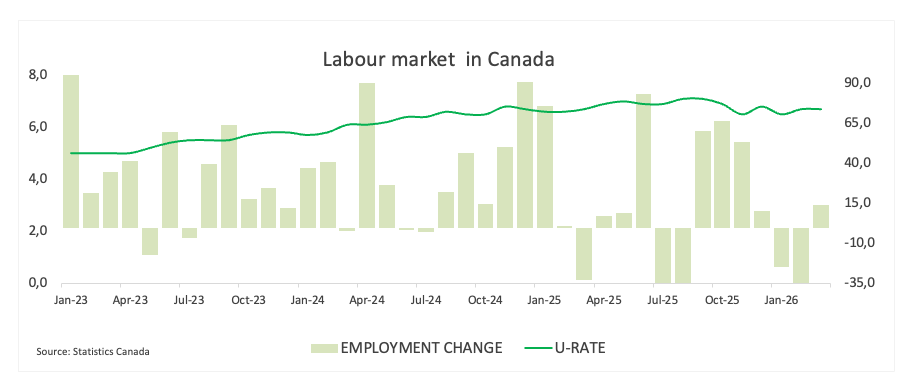
When is the Canada Unemployment Rate released, and how could it affect USD/CAD?
All eyes in Canada will be on Friday’s release of the jobs report, due at 12:30 GMT. A stronger print could give the Canadian Dollar (CAD) a quick lift, but don’t expect fireworks.
USD/CAD has been on a steady uptrend this week, almost entirely to the tune of developments from the Middle East and dynamics around the US Dollar (USD).
Pablo Piovano, Senior Analyst at FXStreet, points out that USD/CAD has been edging higher in the last few days, reclaiming the 1.3600 barrier and approaching 1.3650. Further up comes the weekly top at 1.3714 (April 24), an area reinforced by the provisional 55-day and 100-day SMAs around 1.3720. Further north emerges the always relevant 200-day SMA near 1.3815.
On the flip side, he highlights initial support at the May floor of 1.3549 (May 1), seconded by the March base at 1.3525 (March 9), the February valley at 1.3504 (February 11) and the 2026 bottom at 1.3481 (January 30).
“Momentum favours extra declines,” he adds, noting that the Relative Strength Index (RSI) is hovering near 43 and the Average Directional Index (ADX) just over 24 suggests the underlying trend appears to be gathering traction.
Economic Indicator
Unemployment Rate
The Unemployment Rate, released by Statistics Canada, is the number of unemployed workers divided by the total civilian labor force as a percentage. It is a leading indicator for the Canadian Economy. If the rate is up, it indicates a lack of expansion within the Canadian labor market and a weakening of the Canadian economy. Generally, a decrease of the figure is seen as bullish for the Canadian Dollar (CAD), while an increase is seen as bearish.
Read more.Last release: Fri Apr 10, 2026 12:30
Frequency: Monthly
Actual: 6.7%
Consensus: 6.8%
Previous: 6.7%
Source: Statistics Canada
Employment FAQs
Labor market conditions are a key element to assess the health of an economy and thus a key driver for currency valuation. High employment, or low unemployment, has positive implications for consumer spending and thus economic growth, boosting the value of the local currency. Moreover, a very tight labor market – a situation in which there is a shortage of workers to fill open positions – can also have implications on inflation levels and thus monetary policy as low labor supply and high demand leads to higher wages.
The pace at which salaries are growing in an economy is key for policymakers. High wage growth means that households have more money to spend, usually leading to price increases in consumer goods. In contrast to more volatile sources of inflation such as energy prices, wage growth is seen as a key component of underlying and persisting inflation as salary increases are unlikely to be undone. Central banks around the world pay close attention to wage growth data when deciding on monetary policy.
The weight that each central bank assigns to labor market conditions depends on its objectives. Some central banks explicitly have mandates related to the labor market beyond controlling inflation levels. The US Federal Reserve (Fed), for example, has the dual mandate of promoting maximum employment and stable prices. Meanwhile, the European Central Bank’s (ECB) sole mandate is to keep inflation under control. Still, and despite whatever mandates they have, labor market conditions are an important factor for policymakers given its significance as a gauge of the health of the economy and their direct relationship to inflation.














