

Dow Jones Industrial Average rallies over 1% on Iran deal hopes
- The Dow Jones Industrial Average climbed 1.1% as reports surfaced of a near-deal between the US and Iran.
- Oil prices tumbled 5% as traders unwound geopolitical risk premiums tied to the Strait of Hormuz.
- AMD soared 15% after a strong Q1 beat and upbeat Q2 guidance lifted the broader chipmaker sector.
- ADP private payrolls topped expectations ahead of Friday's Nonfarm Payrolls release.
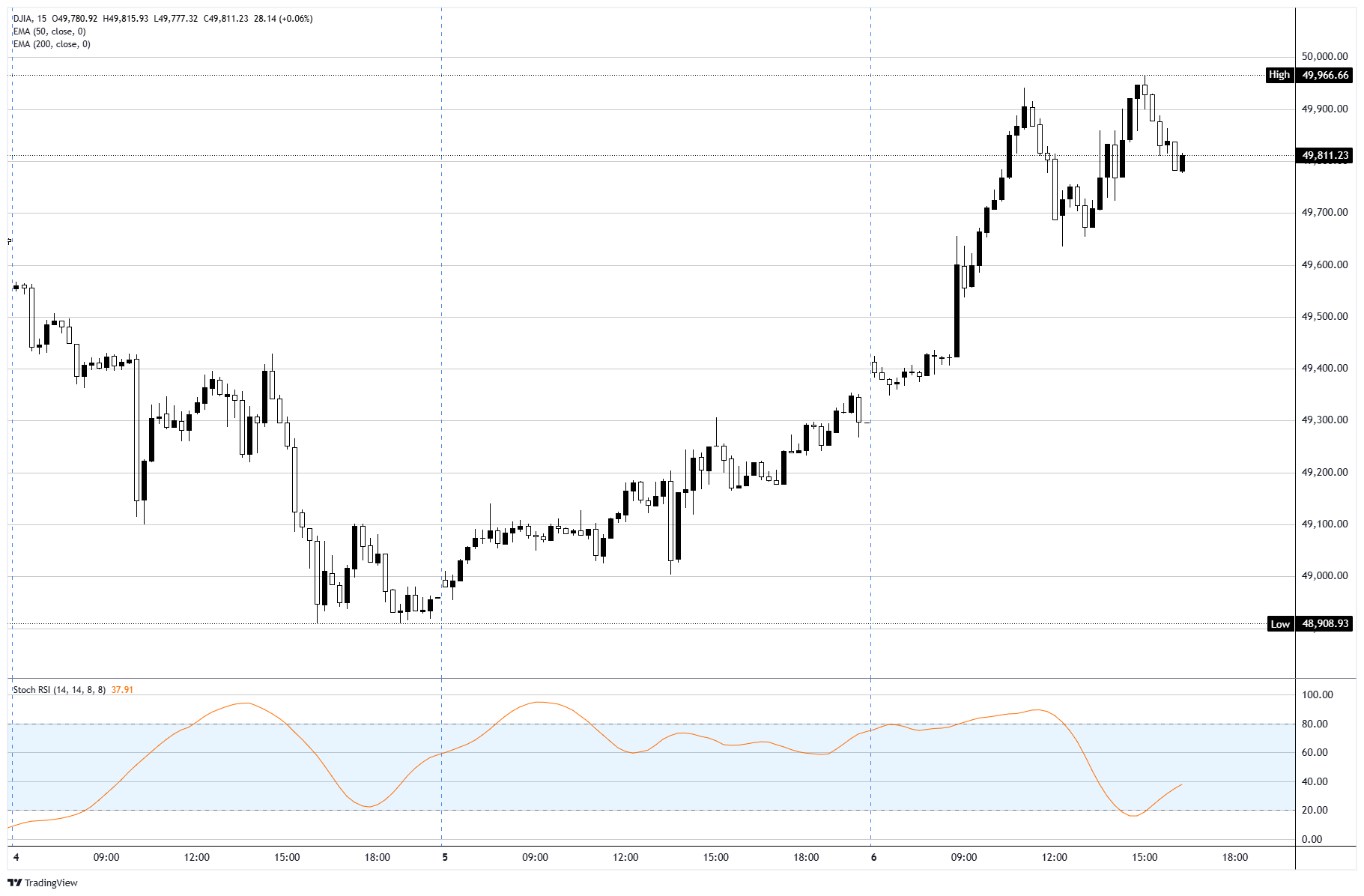
US equities pushed higher on Wednesday as risk appetite returned on signs that the US-Iran conflict could be heading toward a broader resolution. The Dow Jones Industrial Average (DJIA) added roughly 540 points to close above 49,800 after testing levels near 50,000 intraday. The S&P 500 also gained 1.1%, while the Nasdaq Composite outperformed with a 1.5% advance, propelled by a sharp rally in semiconductors.

Risk-on as US-Iran edge toward agreement
The rally kicked into gear after Axios reported, citing sources, that Washington and Tehran were closing in on a deal that would include a moratorium on Iranian nuclear enrichment. An Iranian foreign ministry spokesperson confirmed to CNBC that Iran was evaluating the US proposal. The headlines build on the existing ceasefire that has held in recent sessions, suggesting markets are now pricing in the possibility of a more durable framework. Equities pared some gains late in the session after President Donald Trump tempered expectations on Truth Social, calling Iranian agreement "a big assumption" and warning that bombing would resume "at a much higher level and intensity" if talks collapsed. The DJIA still finished comfortably in the green, though off the session highs near 50,000.
Oil tumbles as Strait of Hormuz risk fades
Crude took a heavy hit as traders moved to unwind the geopolitical premium that had built up during the conflict. West Texas Intermediate (WTI) futures dropped 5% to trade above $96 per barrel, while Brent fell 5% to trade above $103. Trump said late Tuesday he was pausing "Project Freedom," the US plan to escort shipping through the Strait of Hormuz, citing "Great Progress" toward a final agreement with Iran. The combination of de-escalation headlines and reduced shipping risk gave energy bears the green light to press lower.
AMD earnings ignite chipmaker rally
Advanced Micro Devices (AMD) surged 15% after delivering a Q1 beat on both the top and bottom lines and pairing it with an upbeat Q2 outlook. The print reignited bullish sentiment across the semiconductor complex, with the VanEck Semiconductor ETF (SMH) jumping 3% and Intel (INTC) climbing nearly 2%. The chip strength was the primary driver behind the Nasdaq's outperformance and added another data point for the AI-earnings narrative that has been propping up index-level expectations.
ADP beats but Fed commentary leans hawkish
On the data front, ADP Employment Change for April came in at 109K, topping the 99K consensus and nearly doubling March's revised 61K print. The reading offers a constructive setup ahead of Friday's Nonfarm Payrolls (NFP) report, where consensus sits at 60K. Federal Reserve (Fed) commentary, however, leaned hawkish, with Fed's Musalem delivering remarks rated 7.0 on the hawkish scale against a 6.0 average, while Fed's Goolsbee was also on the docket. The mixed signal kept Treasury yields supported even as equities pushed higher.
Climbing a wall of worry
RBC Capital Markets' Lori Calvasina told CNBC's "Closing Bell: Overtime" that stocks appear to be "climbing a wall of worry," noting that AI-related upward earnings revisions continue to provide a buffer for S&P 500 EPS. With Iran headlines still capable of swinging both ways and a busy Fed speaker calendar through Friday culminating in NFP and the University of Michigan (UoM) sentiment release, traders will be watching whether the DJIA can sustain its push toward the 50,000 milestone or whether the late-session fade signals exhaustion near the highs.
Dow Jones 15-minute chart
Dow Jones FAQs
The Dow Jones Industrial Average, one of the oldest stock market indices in the world, is compiled of the 30 most traded stocks in the US. The index is price-weighted rather than weighted by capitalization. It is calculated by summing the prices of the constituent stocks and dividing them by a factor, currently 0.152. The index was founded by Charles Dow, who also founded the Wall Street Journal. In later years it has been criticized for not being broadly representative enough because it only tracks 30 conglomerates, unlike broader indices such as the S&P 500.
Many different factors drive the Dow Jones Industrial Average (DJIA). The aggregate performance of the component companies revealed in quarterly company earnings reports is the main one. US and global macroeconomic data also contributes as it impacts on investor sentiment. The level of interest rates, set by the Federal Reserve (Fed), also influences the DJIA as it affects the cost of credit, on which many corporations are heavily reliant. Therefore, inflation can be a major driver as well as other metrics which impact the Fed decisions.
Dow Theory is a method for identifying the primary trend of the stock market developed by Charles Dow. A key step is to compare the direction of the Dow Jones Industrial Average (DJIA) and the Dow Jones Transportation Average (DJTA) and only follow trends where both are moving in the same direction. Volume is a confirmatory criteria. The theory uses elements of peak and trough analysis. Dow’s theory posits three trend phases: accumulation, when smart money starts buying or selling; public participation, when the wider public joins in; and distribution, when the smart money exits.
There are a number of ways to trade the DJIA. One is to use ETFs which allow investors to trade the DJIA as a single security, rather than having to buy shares in all 30 constituent companies. A leading example is the SPDR Dow Jones Industrial Average ETF (DIA). DJIA futures contracts enable traders to speculate on the future value of the index and Options provide the right, but not the obligation, to buy or sell the index at a predetermined price in the future. Mutual funds enable investors to buy a share of a diversified portfolio of DJIA stocks thus providing exposure to the overall index.














