

Gold dives as Hormuz clash boosts the US Dollar
- US defensive strikes in Iran sour risk appetite across markets.
- WTI falls below $95, easing some inflation-pressure concerns.
- Traders eye Core PCE after consumer confidence weakens.
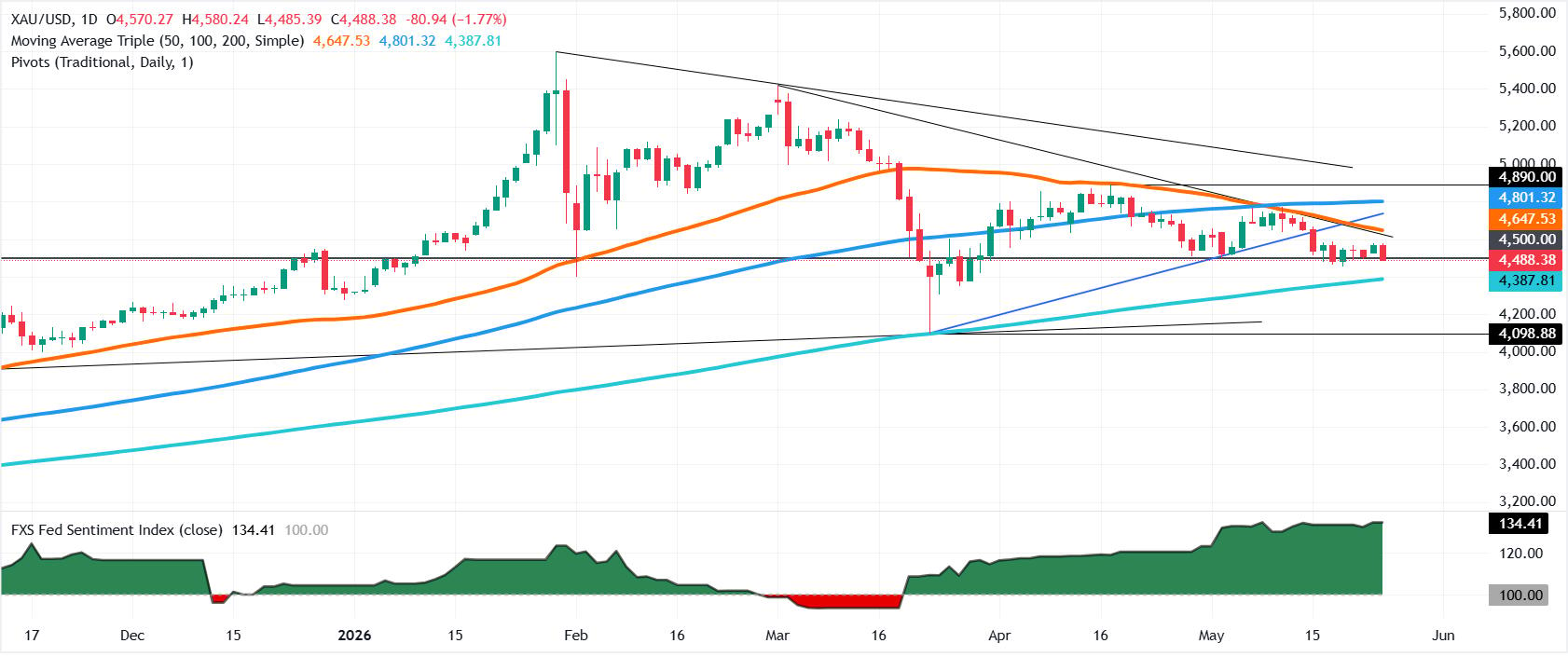
Gold (XAU/USD) price tumbles more than 1.60% on Tuesday as the US Dollar (USD) strengthens on renewed haven demand following US strikes in southern Iran. At the time of writing, XAU/USD trades below the $4,500 mark after reaching a daily high of $4,580.
XAU/USD falls as US-Iran tensions drive investors into USD
Military activity resumed in southern Iran, as Tehran claimed that the US broke the ceasefire deal. However, Washington argued that they conducted defensive attacks aimed at destroying missile launchers and boats attempting to lay mines in the Strait of Hormuz.
US Secretary of State Marco Rubio poured cold water on risk appetite, saying that reaching a deal could “take a few days.”
US equities pared their gains as risk appetite turned sour, pushing investors towards the safety of the US Dollar, which, according to the US Dollar Index (DXY), is up 0.17%. The DXY, which measures the Greenback's performance against other currencies, is at 99.17.
Oil prices extended their decline, with West Texas Intermediate (WTI) crude falling 2.75% to $94.34 per barrel. Easing inflation concerns were also reflected in US Treasury yields, with the policy-sensitive two-year note slipping nearly four basis points to 4.074%.
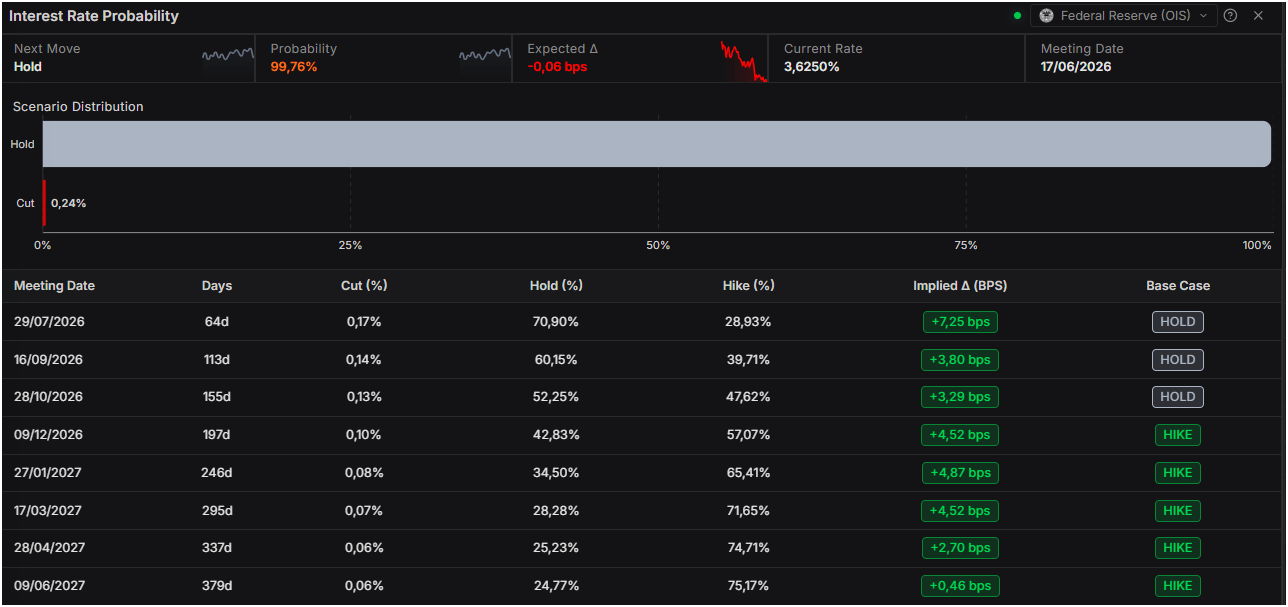
Money markets had priced in a 58% chance of a Federal Reserve (Fed) rate hike towards the end of the year. For the June meeting, traders priced in a 99% chance for a hold on Kevin Warsh's first meeting as the Fed Chair.
Data from the US showed that rising living costs are weighing on households, as the Conference Board’s Consumer Confidence Index fell to 93.1 in May, though it still beat economists’ forecast of 92, according to Bloomberg’s poll. The survey highlighted growing consumer anxiety, with two-thirds of respondents reporting reduced spending due to higher prices.
On Monday, Nikkei reported that Washington and Tehran reached a deal to extend the ongoing ceasefire for 60 days. The agreement revealed that Iran would clear mines from the Strait of Hormuz within 30 days, restore passage for all ships, and end transit fees. Nuclear talks would resume during the 60-day ceasefire, while Washington would gradually ease sanctions on Iranian assets.
This week’s US economic calendar will focus on housing figures, Durable Goods Orders, the second reading of Q1 2026 GDP, labor market data, and the Core Personal Consumption Expenditures (PCE) Price Index, the Federal Reserve’s preferred inflation gauge.
XAU/USD technical outlook: Gold tumbles below $4,500 sellers target $4,300
Gold fell under the $4,500 threshold, poised to test $4,453, the recent cycle low, which, if broken, could push the yellow metal towards the 200-day Simple Moving Average (SMA) at $4,387.
The Relative Strength Index (RSI) suggests further downside as it approaches oversold territory.
On the other hand, for a bullish recovery, buyers must reclaim the $4,500 mark before testing the $4,550 psychological level. A breach of the latter will expose the $4,600 figure, before challenging the 50-day SMA at $4,647.
Gold FAQs
Gold has played a key role in human’s history as it has been widely used as a store of value and medium of exchange. Currently, apart from its shine and usage for jewelry, the precious metal is widely seen as a safe-haven asset, meaning that it is considered a good investment during turbulent times. Gold is also widely seen as a hedge against inflation and against depreciating currencies as it doesn’t rely on any specific issuer or government.
Central banks are the biggest Gold holders. In their aim to support their currencies in turbulent times, central banks tend to diversify their reserves and buy Gold to improve the perceived strength of the economy and the currency. High Gold reserves can be a source of trust for a country’s solvency. Central banks added 1,136 tonnes of Gold worth around $70 billion to their reserves in 2022, according to data from the World Gold Council. This is the highest yearly purchase since records began. Central banks from emerging economies such as China, India and Turkey are quickly increasing their Gold reserves.
Gold has an inverse correlation with the US Dollar and US Treasuries, which are both major reserve and safe-haven assets. When the Dollar depreciates, Gold tends to rise, enabling investors and central banks to diversify their assets in turbulent times. Gold is also inversely correlated with risk assets. A rally in the stock market tends to weaken Gold price, while sell-offs in riskier markets tend to favor the precious metal.
The price can move due to a wide range of factors. Geopolitical instability or fears of a deep recession can quickly make Gold price escalate due to its safe-haven status. As a yield-less asset, Gold tends to rise with lower interest rates, while higher cost of money usually weighs down on the yellow metal. Still, most moves depend on how the US Dollar (USD) behaves as the asset is priced in dollars (XAU/USD). A strong Dollar tends to keep the price of Gold controlled, whereas a weaker Dollar is likely to push Gold prices up.














