

Gold retreats from two-week highs amid USD, yields rebound after Trump remarks
- Gold retreats from two-week highs as Trump signals continued military action in Iran.
- US Dollar and Treasury yields rebound sharply, weighing on XAU/USD.
- Technically, XAU/USD forms a bearish flag on the 4-hour chart as momentum weakens.
Gold (XAU/USD) trades on the back foot on Thursday, snapping a four-day rally as initial optimism that the US-Israel war with Iran could end soon faded after US President Donald Trump signaled continued military action in his address to the nation.
At the time of writing, XAU/USD is trading around $4,612, down nearly 3.0% on the day, pulling back from a two-week high near $4,800.

Trump’s remarks lift USD, yields as Oil rebounds
President Trump said the US is “on track to complete all of America’s military objectives shortly — very shortly,” while warning that Washington would “hit them extremely hard over the next two to three weeks” and “bring them back to the stone ages.” Trump added that discussions are ongoing, stating, “We have all the cards; they have none.”
In response, markets turned risk-averse, with the US Dollar (USD) and US Treasury yields rebounding sharply, weighing on Gold. At the same time, Oil prices resumed their upside as the reopening of the Strait of Hormuz remains a key issue.
Hawkish interest rate outlook remains a headwind for Gold
Rising inflation and growth risks linked to higher energy prices are prompting a more hawkish outlook from central banks, particularly the Federal Reserve (Fed), which is offsetting the metal’s appeal as a safe-haven asset.
The “higher-for-longer” interest rate narrative has remained a key headwind for the non-yielding metal since the Middle East war began, as higher rates increase the opportunity cost of holding Gold. According to the CME FedWatch Tool, markets widely expect the Fed to keep rates unchanged at 3.50%-3.75% this year, compared to earlier expectations of at least two rate cuts.
Fed officials struck a cautious tone this week, signaling that policymakers are in no rush to adjust interest rates despite rising inflation risks driven by energy prices.
St. Louis Fed President Alberto Musalem said on Wednesday that monetary policy is “well positioned” and should remain in place “for some time,” while noting that risks to both inflation and employment are skewed to the downside. He also described the economic outlook as “highly uncertain."
Kansas City Fed President Jeffrey Schmid said on Tuesday that the central bank must “follow through with policy actions to validate stable medium- and long-term inflation expectations.” Schmid added that “can’t assume inflation from higher oil prices will be transitory."
Technical analysis: XAU/USD forms a bearish flag on the 4-hour chart
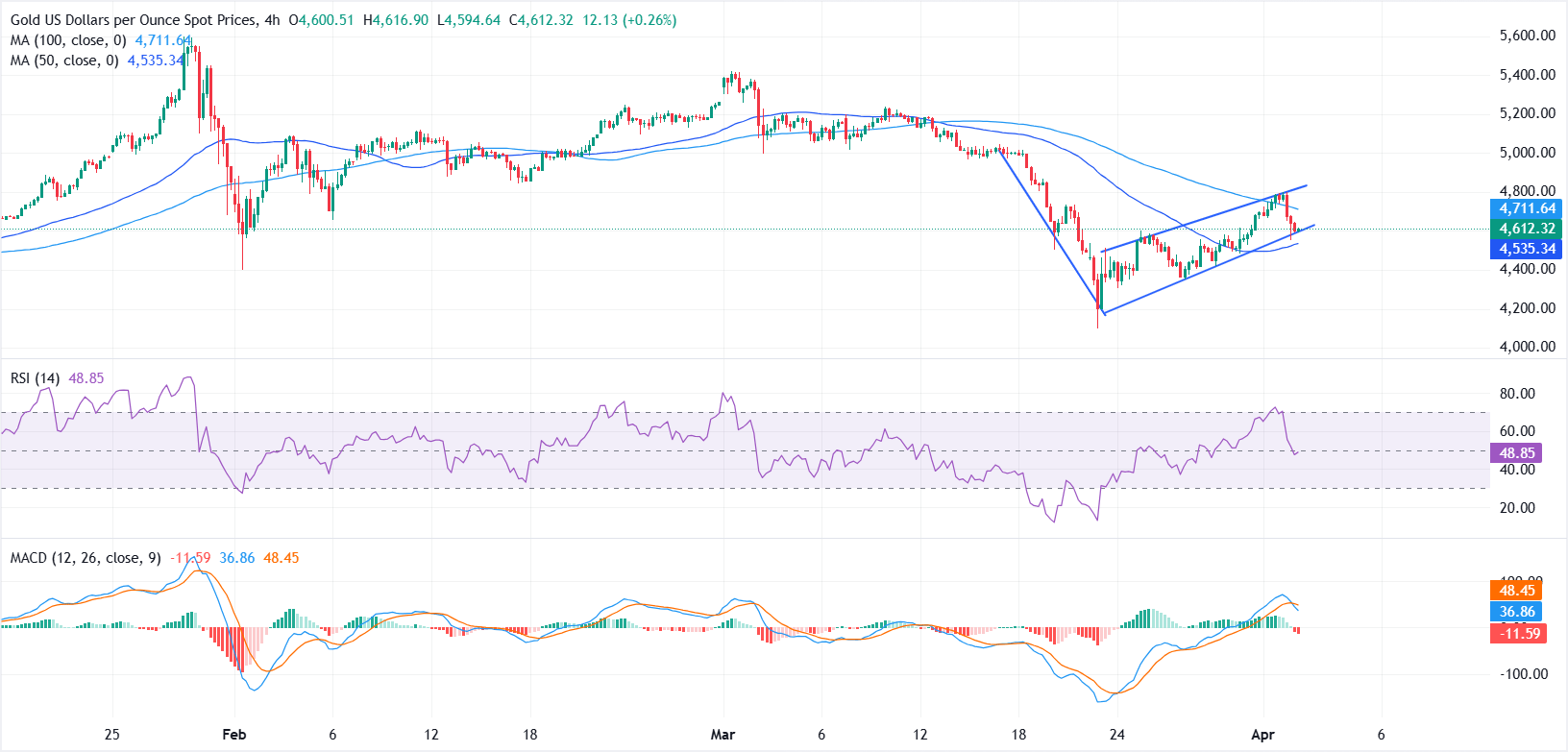
From a technical perspective, XAU/USD remains tilted to the downside in the near term. On the 4-hour chart, prices have failed to sustain a move above the 100-period Simple Moving Average (SMA) around $4,711, reinforcing a bearish bias.
Price action appears to be forming a bearish flag pattern, with price currently trading near the lower boundary after facing rejection from the upper trendline. Momentum deteriorates as the Relative Strength Index (RSI) retreats toward the 50 line from overbought territory, while the Moving Average Convergence Divergence (MACD) histogram turns slightly negative as the MACD line crosses below the signal line, reinforcing fading upside momentum.
Immediate support is seen around the $4,600 level, followed by the 50-period SMA near $4,535. A break below this zone could open the door for further downside toward the $4,200-$4,000 region.
On the upside, a move above the 100-period SMA around $4,711 and the $4,800 mark could pave the way for a test of the next resistance near $5,000.
Gold FAQs
Gold has played a key role in human’s history as it has been widely used as a store of value and medium of exchange. Currently, apart from its shine and usage for jewelry, the precious metal is widely seen as a safe-haven asset, meaning that it is considered a good investment during turbulent times. Gold is also widely seen as a hedge against inflation and against depreciating currencies as it doesn’t rely on any specific issuer or government.
Central banks are the biggest Gold holders. In their aim to support their currencies in turbulent times, central banks tend to diversify their reserves and buy Gold to improve the perceived strength of the economy and the currency. High Gold reserves can be a source of trust for a country’s solvency. Central banks added 1,136 tonnes of Gold worth around $70 billion to their reserves in 2022, according to data from the World Gold Council. This is the highest yearly purchase since records began. Central banks from emerging economies such as China, India and Turkey are quickly increasing their Gold reserves.
Gold has an inverse correlation with the US Dollar and US Treasuries, which are both major reserve and safe-haven assets. When the Dollar depreciates, Gold tends to rise, enabling investors and central banks to diversify their assets in turbulent times. Gold is also inversely correlated with risk assets. A rally in the stock market tends to weaken Gold price, while sell-offs in riskier markets tend to favor the precious metal.
The price can move due to a wide range of factors. Geopolitical instability or fears of a deep recession can quickly make Gold price escalate due to its safe-haven status. As a yield-less asset, Gold tends to rise with lower interest rates, while higher cost of money usually weighs down on the yellow metal. Still, most moves depend on how the US Dollar (USD) behaves as the asset is priced in dollars (XAU/USD). A strong Dollar tends to keep the price of Gold controlled, whereas a weaker Dollar is likely to push Gold prices up.














