

Gold surges as Middle East peace hopes crush Oil and the US Dollar
- Gold jumps over 3% on Wednesday as hopes for a US-Iran peace deal pressure Oil and the US Dollar.
- Falling Oil prices ease inflation concerns and revive Fed interest rate cut bets.
- Technically, XAU/USD gains bullish momentum above key SMAs on the 4-hour chart after rebounding from the $4,500 support zone.
Gold (XAU/USD) rallies on Wednesday as the US Dollar (USD) and Oil prices tumble on hopes that the United States and Iran could reach a deal to end the war in the Middle East. At the time of writing, XAU/USD is trading around $4,700, up nearly 3% on the day and hitting its highest level in over a week.

According to a report published by Axios, citing two US officials and two other sources familiar with the matter, Washington and Tehran are moving closer to a one-page memorandum of understanding (MOU) to end the war and establish a framework for more detailed nuclear negotiations.
The report said the proposed deal could include Iran pausing nuclear enrichment, while the US would lift sanctions and release billions of US Dollars in frozen Iranian funds. Both sides are also expected to end the blockade around the Strait of Hormuz.
However, officials cautioned that no final agreement has been reached yet, and the White House expects Iran to respond within the next 48 hours. Iran’s Foreign Ministry spokesperson also told CNBC that Tehran was evaluating Washington’s 14-point peace proposal.
This comes after US President Donald Trump said on Truth Social that Washington has paused its military “Project Freedom” operation due to “great progress” toward a “complete and final agreement” with Iran.
In reaction to the latest optimism, Oil prices plunged, with West Texas Intermediate (WTI) crude falling over 10% to trade around $88-$89 per barrel at the time of writing.
US Treasury yields also pulled back from recent highs as the sharp decline in crude Oil helped ease concerns over energy-driven inflation and tempered hawkish Federal Reserve (Fed) expectations that had been building recently. According to the CME FedWatch Tool, the probability of a rate cut at the September meeting rose to 19.9%, up sharply from 1.4% a week ago.
The shift in interest rate expectations, alongside a weaker US Dollar and falling Treasury yields, is helping Gold rebound after sustained selling pressure since the war began.
Traders now await further developments around the US-Iran negotiations, with any signs of a finalized agreement likely to push Gold higher, while a breakdown in talks could weigh on the precious metal again.
Attention also turns to upcoming US labor market data, with the ADP Employment Change report due later in the American session, followed by weekly Initial Jobless Claims on Thursday and the Nonfarm Payrolls (NFP) report on Friday.
Technical Analysis: Bulls take back control as XAU/USD rebounds from $4,500 support
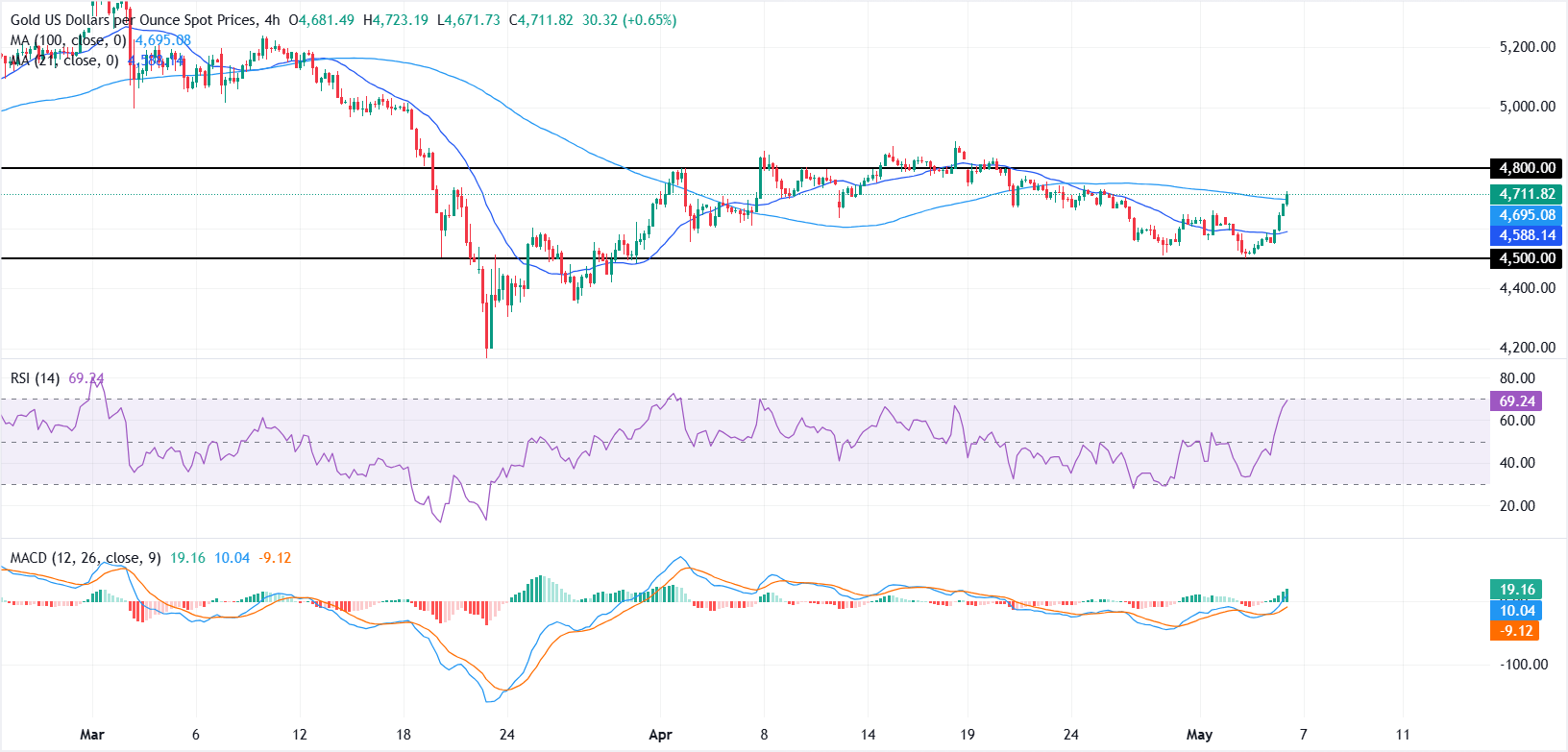
On the 4-hour chart, XAU/USD has turned bullish after bouncing from the $4,500 support zone and climbing above the 21-period and 100-period Simple Moving Averages (SMAs). The Relative Strength Index (RSI-14) near 69 suggests upside momentum remains strong, though Gold is approaching overbought territory.
Meanwhile, the Moving Average Convergence Divergence (MACD) remains firmly in positive territory, reinforcing the constructive near-term outlook. However, the sharp rally and stretched momentum conditions could leave the precious metal vulnerable to short-term consolidation or shallow pullbacks.
On the upside, the first resistance is seen near the horizontal barrier around $4,800, followed by the key psychological level at $5,000.
On the downside, immediate support is located at the 100-period SMA around $4,695, followed by the 21-period SMA near $4,588. Both levels could attract dip-buying interest if Gold corrects lower. A deeper pullback would shift focus back toward the key structural support at $4,500.
Gold FAQs
Gold has played a key role in human’s history as it has been widely used as a store of value and medium of exchange. Currently, apart from its shine and usage for jewelry, the precious metal is widely seen as a safe-haven asset, meaning that it is considered a good investment during turbulent times. Gold is also widely seen as a hedge against inflation and against depreciating currencies as it doesn’t rely on any specific issuer or government.
Central banks are the biggest Gold holders. In their aim to support their currencies in turbulent times, central banks tend to diversify their reserves and buy Gold to improve the perceived strength of the economy and the currency. High Gold reserves can be a source of trust for a country’s solvency. Central banks added 1,136 tonnes of Gold worth around $70 billion to their reserves in 2022, according to data from the World Gold Council. This is the highest yearly purchase since records began. Central banks from emerging economies such as China, India and Turkey are quickly increasing their Gold reserves.
Gold has an inverse correlation with the US Dollar and US Treasuries, which are both major reserve and safe-haven assets. When the Dollar depreciates, Gold tends to rise, enabling investors and central banks to diversify their assets in turbulent times. Gold is also inversely correlated with risk assets. A rally in the stock market tends to weaken Gold price, while sell-offs in riskier markets tend to favor the precious metal.
The price can move due to a wide range of factors. Geopolitical instability or fears of a deep recession can quickly make Gold price escalate due to its safe-haven status. As a yield-less asset, Gold tends to rise with lower interest rates, while higher cost of money usually weighs down on the yellow metal. Still, most moves depend on how the US Dollar (USD) behaves as the asset is priced in dollars (XAU/USD). A strong Dollar tends to keep the price of Gold controlled, whereas a weaker Dollar is likely to push Gold prices up.














