

Indian Rupee opens higher on renewed US-Iran deal optimism
- The Indian Rupee rises in the opening trade against the US Dollar as oil prices correct sharply.
- Oil prices tumble after media reports that the US and Iran have reached a 60-day MoU, pending President Trump’s approval.
- FIIs turned out to be net sellers on Wednesday.
The Indian Rupee (INR) opens on a positive note against the US Dollar (USD) on Friday after a holiday in India due to Bakri Id the previous day. The USD/INR pair drops to near 95.50 as falling oil prices due to renewed optimism on the United States (US)-Iran deal have strengthened the Indian Rupee.

As of writing, the WTI oil price trades 0.75% lower to near $87, close to the fresh monthly low of $86.29 posted on Thursday. Currencies from economies, such as India, which rely heavily on oil imports to meet their energy needs, tend to outperform when oil prices decline.
US-Iran agreement reaches endgame, Trump’s approval awaited
On Thursday, Axios reported that the US and Iran have reached an agreement over a 60-day Memorandum of Understanding (MoU), which includes “unrestricted” energy flow through the Strait of Hormuz, a critical passage for almost 20% of global energy supply, and the removal of the US blockade on Iranian sea ports. However, the agreement will remain under review by US President Donald Trump, and he will deliver his remarks in a couple of days. The MoU also includes Iran’s commitment not to pursue its nuclear ambitions.
Improved optimism about the US-Iran deal has resulted in a broad risk rally, which was diminished in the last few days due to the exchange of attacks between the US and Iran. On late Wednesday, Iran’s Islamic Revolutionary Guard Corps (IRGC) said that it struck US military bases in retaliation for Washington’s attacks near Bandar Abbas airport.
FIIs continue to dump their stake in Indian stock market
On Wednesday, Foreign Institutional Investors (FIIs) turned out to be net sellers, offloading their stake worth Rs. 1,042.70 crore. Overseas investors continued to be cautious about holding their investments in the Indian stock market, as elevated oil prices have raised concerns over India Inc.’s projected earnings and diminished the government’s spending capacity.
Also, soaring global Artificial Intelligence (AI) trade due to a significant increase in earnings of semiconductors, chip-manufacturing and platform companies has diminished the appeal of Indian stocks in the global market.
Lower US Dollar also hurts USD/INR pair
A sharp decline in the US Dollar as the appeal of safe-haven assets has diminished due to renewed hopes of the US-Iran deal has also weighed on the USD/INR pair. At press time, the US Dollar Index (DXY), which tracks the Greenback’s value against six major currencies, trades 0.1% higher to near 99.10, but corrected sharply on Thursday from its over seven-week high of 99.54.
Going forward, market expectations toward the Federal Reserve’s (Fed) monetary policy outlook will be the key driver of the US Dollar.
Technical Analysis: USD/INR falls to near 20-day EMA
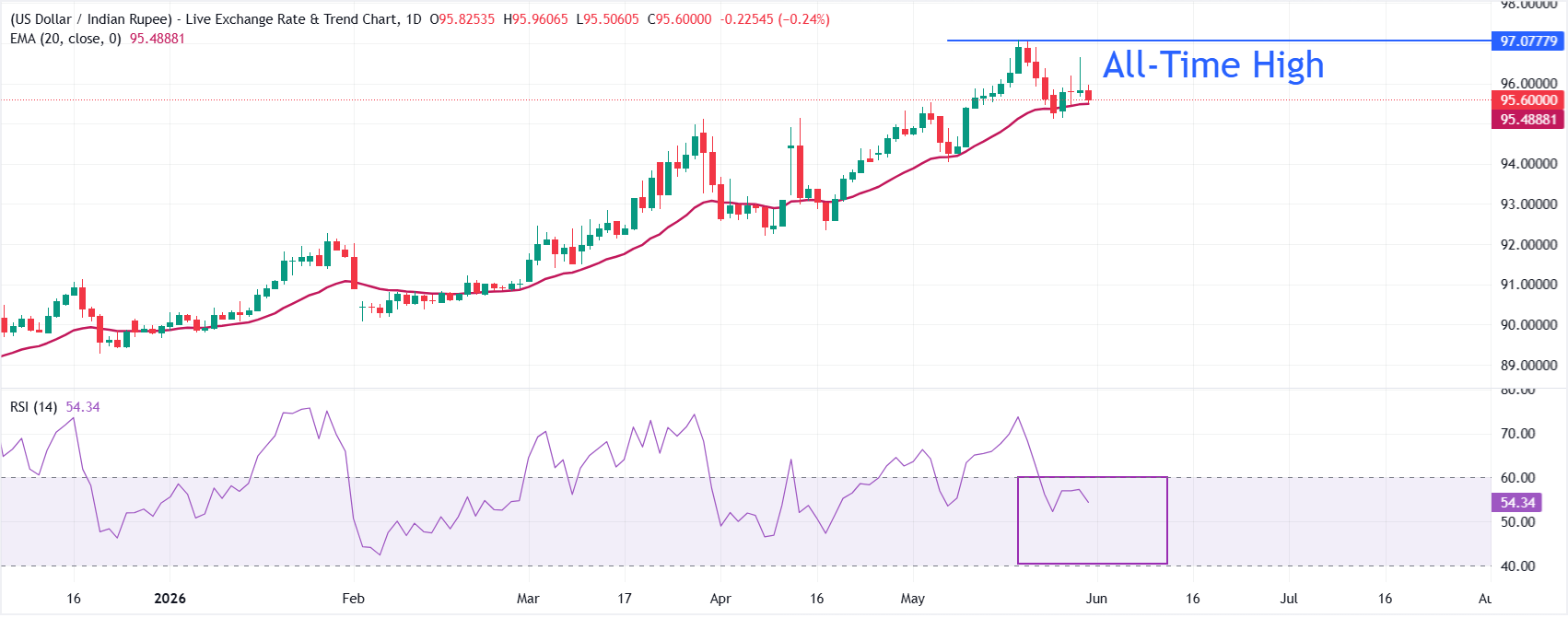
USD/INR trades lower at around 95.50. The pair has corrected to near the 20-day exponential moving average (EMA) at 95.48, indicating that the near-term trend has become uncertain.
The Relative Strength Index (RSI) shifts into the 40.00-60.00 zone after failing to hold above 60.00, which indicates that the bullish momentum has concluded; however, the bullish bias remains intact.
On the downside, initial support is seen at the 20-day EMA around 95.49, with the current session low and prior closes reinforcing this area as a short-term floor. A daily close back below this moving average would hint at fading upside pressure and a potential downside move toward 95.00. Looking up, the pair could aim to revisit the all-time high of 97.09 if it manages to advance above 96.00.
(The technical analysis of this story was written with the help of an AI tool.)
Indian Rupee FAQs
The Indian Rupee (INR) is one of the most sensitive currencies to external factors. The price of Crude Oil (the country is highly dependent on imported Oil), the value of the US Dollar – most trade is conducted in USD – and the level of foreign investment, are all influential. Direct intervention by the Reserve Bank of India (RBI) in FX markets to keep the exchange rate stable, as well as the level of interest rates set by the RBI, are further major influencing factors on the Rupee.
The Reserve Bank of India (RBI) actively intervenes in forex markets to maintain a stable exchange rate, to help facilitate trade. In addition, the RBI tries to maintain the inflation rate at its 4% target by adjusting interest rates. Higher interest rates usually strengthen the Rupee. This is due to the role of the ‘carry trade’ in which investors borrow in countries with lower interest rates so as to place their money in countries’ offering relatively higher interest rates and profit from the difference.
Macroeconomic factors that influence the value of the Rupee include inflation, interest rates, the economic growth rate (GDP), the balance of trade, and inflows from foreign investment. A higher growth rate can lead to more overseas investment, pushing up demand for the Rupee. A less negative balance of trade will eventually lead to a stronger Rupee. Higher interest rates, especially real rates (interest rates less inflation) are also positive for the Rupee. A risk-on environment can lead to greater inflows of Foreign Direct and Indirect Investment (FDI and FII), which also benefit the Rupee.
Higher inflation, particularly, if it is comparatively higher than India’s peers, is generally negative for the currency as it reflects devaluation through oversupply. Inflation also increases the cost of exports, leading to more Rupees being sold to purchase foreign imports, which is Rupee-negative. At the same time, higher inflation usually leads to the Reserve Bank of India (RBI) raising interest rates and this can be positive for the Rupee, due to increased demand from international investors. The opposite effect is true of lower inflation.














