

Tether aids US law enforcement in freezing $344M in USDT linked to illicit activity
- Tether has frozen $344 million across two addresses in coordination with OFAC and US law enforcement.
- The freeze was executed after the addresses were identified, preventing further movement of funds.
- Tether’s total freezes rise to $4.4 billion, with CEO Paolo Ardoino saying the stablecoin is not a safe haven for illicit activity.
Tether, the issuer of the largest stablecoin, USDT, announced on Thursday that it aided the Office of Foreign Assets Control (OFAC) and United States (US) law enforcement in freezing $344 million across two addresses.
USDT not safe haven for illicit activity – Paolo Ardoino
Tether said the freeze was executed after the US government shared information that helped to identify the addresses, preventing further movement of funds. The addresses had been blacklisted due to ties to unlawful activities.
“When wallets are identified as connected to sanctions evasion, criminal networks, or other illicit activity, Tether can move to restrict those assets,” Tether stated in a press release.
Paolo Ardoino, Tether’s CEO, said that “USDT is not a safe haven for illicit activity,” emphasizing that the company works hand in hand with law enforcement and governments worldwide to restrict assets linked to criminal networks, wallets evading sanctions, or other fraudulent activities.
Tether added that it is actively working with over 340 law enforcement agencies across 65 countries. So far, the company’s cooperation has aided more than 2,300 cases globally, which include over 1,200 pursued by US authorities. In total, Tether has frozen more than $4.4 billion in assets, including over $2.1 billion tied to US law enforcement.
Transactions on public blockchains allow investigators and issuers to trace the flow of funds. With this trail, transactions and wallets can be flagged while assets are frozen, stopping further movement.
Crypto crime hit record highs in 2025
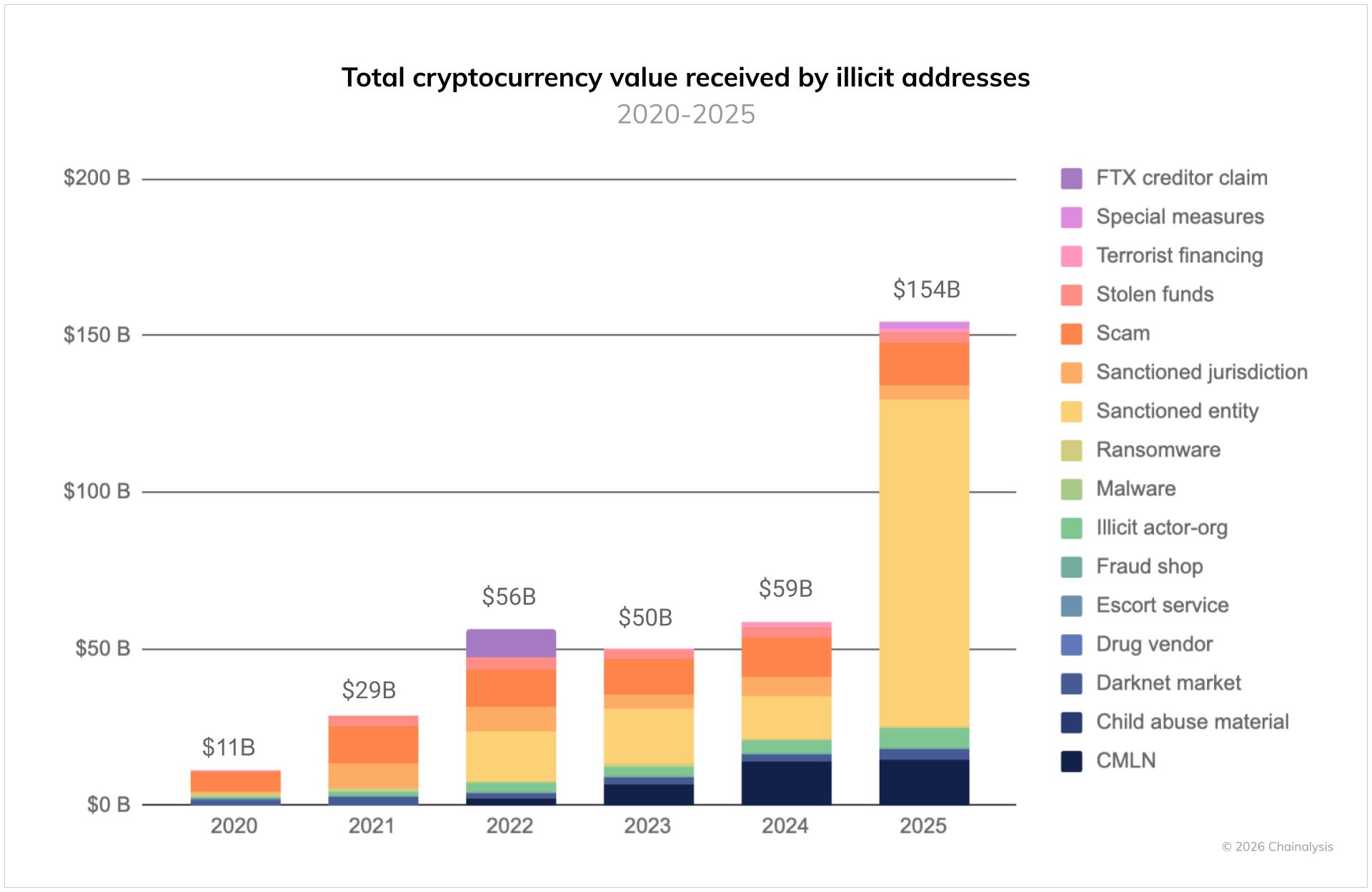
Illicit cryptocurrency addresses received over $154 billion in 2025, representing a staggering 161% YoY increase, largely driven by a drastic surge in the value of assets held by sanctioned entities, according to a Chainalysis report published in January.
“But even if the value received by sanctioned entities were flat YoY, 2025 would still mark a record year for crypto crime, as activity increased across most illicit categories,” the Chainalysis report states.
Stablecoins have grown to become dominant players in illicit transactions, accounting for at least 84% of fraudulent transaction volume. The trend mirrors broader ecosystem patterns, as more transactions in the industry are increasingly concentrated in stablecoins due to the practical benefits they offer, including transferability, lower volatility and broader utility.
Bitcoin, altcoins, stablecoins FAQs
Bitcoin is the largest cryptocurrency by market capitalization, a virtual currency designed to serve as money. This form of payment cannot be controlled by any one person, group, or entity, which eliminates the need for third-party participation during financial transactions.
Altcoins are any cryptocurrency apart from Bitcoin, but some also regard Ethereum as a non-altcoin because it is from these two cryptocurrencies that forking happens. If this is true, then Litecoin is the first altcoin, forked from the Bitcoin protocol and, therefore, an “improved” version of it.
Stablecoins are cryptocurrencies designed to have a stable price, with their value backed by a reserve of the asset it represents. To achieve this, the value of any one stablecoin is pegged to a commodity or financial instrument, such as the US Dollar (USD), with its supply regulated by an algorithm or demand. The main goal of stablecoins is to provide an on/off-ramp for investors willing to trade and invest in cryptocurrencies. Stablecoins also allow investors to store value since cryptocurrencies, in general, are subject to volatility.
Bitcoin dominance is the ratio of Bitcoin's market capitalization to the total market capitalization of all cryptocurrencies combined. It provides a clear picture of Bitcoin’s interest among investors. A high BTC dominance typically happens before and during a bull run, in which investors resort to investing in relatively stable and high market capitalization cryptocurrency like Bitcoin. A drop in BTC dominance usually means that investors are moving their capital and/or profits to altcoins in a quest for higher returns, which usually triggers an explosion of altcoin rallies.














