

USD/CHF Price Forecast: Downside bias holds below 0.7850
作者 Vishal Chaturvedi
發布日期: 2 Feb 2026 | 修改日期: 2 Feb 2026


熱門文章

The Swiss Franc (CHF) trades on the back foot against the US Dollar (USD) on Monday, as the nomination of former Federal Reserve (Fed) Governor Kevin Warsh as the next Fed Chair helps the Greenback recover from four-year lows.
- USD/CHF extends its rebound as markets reassess the Fed outlook after Kevin Warsh is nominated as the next Fed Chair.
- Technically, the pair remains fragile below the 0.7850 resistance zone despite a short-term bounce from the 0.7600 area.
- Momentum stays soft, with RSI still below 50, suggesting the rebound remains corrective for now.
The Swiss Franc (CHF) trades on the back foot against the US Dollar (USD) on Monday, as the nomination of former Federal Reserve (Fed) Governor Kevin Warsh as the next Fed Chair helps the Greenback recover from four-year lows.
At the time of writing, USD/CHF is trading around 0.7790, extending gains for a second straight day after sliding to its lowest level since August 2011 last week.
Traders are now reassessing the Fed’s monetary policy outlook, as Warsh is generally regarded as an inflation hawk, prompting markets to scale back fears of aggressive rate cuts under political pressure.
This marks a clear shift from earlier concerns that US President Donald Trump’s nominee could tilt the central bank toward a more dovish policy path, given the President’s repeated calls for lower interest rates.
Against this backdrop, investors are rotating back into the Greenback amid improving near-term sentiment. The US Dollar Index (DXY), which tracks the Greenback's value against a basket of six major currencies, is trading around 97.41, up nearly 0.30% on the day.
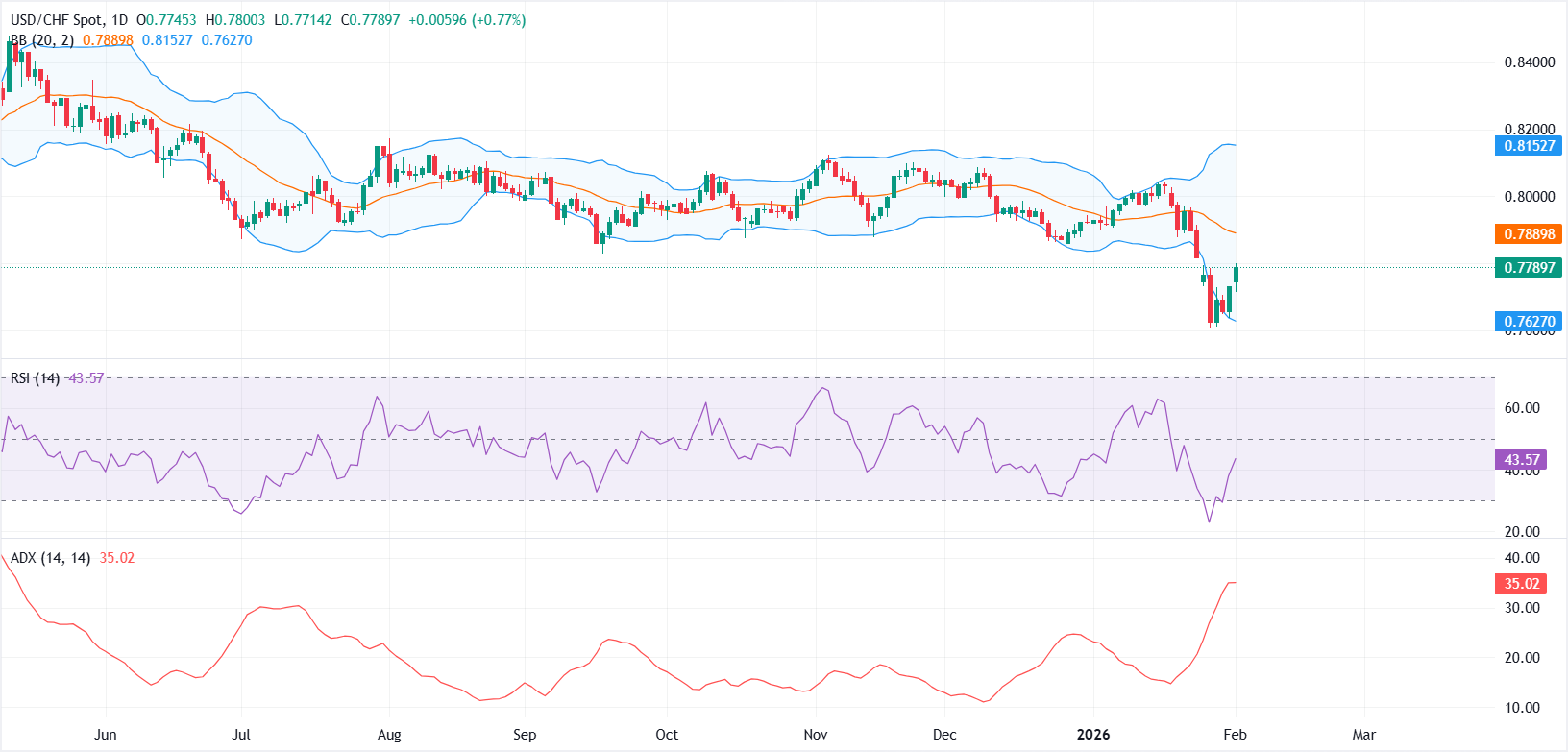
From a technical perspective, USD/CHF remains vulnerable to further downside after breaking a multi-month support zone near 0.7850 last week. The sell-off was accompanied by a clear expansion in the Bollinger Bands, pointing to rising volatility.
That said, the very near-term bias has stabilised after buyers stepped in around the 0.7600 psychological level, triggering a modest rebound. The Relative Strength Index (RSI) stands near 43, recovering from near-oversold territory, but it remains below the 50 threshold, signalling that upside momentum is still weak.
On the upside, a sustained recovery looks capped unless the pair can reclaim the 0.7850 area. A clear break above this former support would expose the mid-Bollinger band near 0.7889 as the next upside target.
On the downside, immediate support is seen at the 0.7700 round level, followed by the lower Bollinger band near 0.7627.
Trend conditions remain firm, with the Average Directional Index (ADX) around 35, suggesting that the broader move still favours sellers despite the current corrective bounce.
US Dollar FAQs
The US Dollar (USD) is the official currency of the United States of America, and the ‘de facto’ currency of a significant number of other countries where it is found in circulation alongside local notes. It is the most heavily traded currency in the world, accounting for over 88% of all global foreign exchange turnover, or an average of $6.6 trillion in transactions per day, according to data from 2022. Following the second world war, the USD took over from the British Pound as the world’s reserve currency. For most of its history, the US Dollar was backed by Gold, until the Bretton Woods Agreement in 1971 when the Gold Standard went away.
The most important single factor impacting on the value of the US Dollar is monetary policy, which is shaped by the Federal Reserve (Fed). The Fed has two mandates: to achieve price stability (control inflation) and foster full employment. Its primary tool to achieve these two goals is by adjusting interest rates. When prices are rising too quickly and inflation is above the Fed’s 2% target, the Fed will raise rates, which helps the USD value. When inflation falls below 2% or the Unemployment Rate is too high, the Fed may lower interest rates, which weighs on the Greenback.
In extreme situations, the Federal Reserve can also print more Dollars and enact quantitative easing (QE). QE is the process by which the Fed substantially increases the flow of credit in a stuck financial system. It is a non-standard policy measure used when credit has dried up because banks will not lend to each other (out of the fear of counterparty default). It is a last resort when simply lowering interest rates is unlikely to achieve the necessary result. It was the Fed’s weapon of choice to combat the credit crunch that occurred during the Great Financial Crisis in 2008. It involves the Fed printing more Dollars and using them to buy US government bonds predominantly from financial institutions. QE usually leads to a weaker US Dollar.
Quantitative tightening (QT) is the reverse process whereby the Federal Reserve stops buying bonds from financial institutions and does not reinvest the principal from the bonds it holds maturing in new purchases. It is usually positive for the US Dollar.

超過一百萬用戶依賴 FXStreet 獲取即時市場數據、圖表工具、專家洞見與外匯新聞。其全面的經濟日曆與教育網路研討會協助交易者保持資訊領先、做出審慎決策。FXStreet 擁有約 60 人的團隊,分布於巴塞隆納總部及全球各地。
閱讀更多








