

USD/INR extends its advance as oil prices rise further
- The Indian Rupee continues to underperform against the US Dollar amid rising oil prices.
- US President Trump warns of extending the blockade on Iranian sea ports.
- The Fed is expected to leave interest rates unchanged.
The Indian Rupee (INR) extends its decline against the US Dollar (USD) on Wednesday. The USD/INR pair rallies further to near 94.75, as oil prices have extended their advance, following comments from United States (US) officials on late Tuesday that President Donald Trump has instructed aides to prepare for an extended blockade of Iran, The Wall Street Journal (WSJ) reported.
At the press time, the WTI Oil price trades flat around $97.00 but gained sharply in the late Tuesday’s session to near $99.50, the highest level seen in almost three weeks.

Currencies from economies, such as India, which rely heavily on oil imports to meet their energy needs, tend to underperform in a high oil price environment.
Trump prefers squeezing oil flows from Iran than bombing its territory again
The WSJ report showed the US President Trump has stated that the continuation of the blockade of Iranian sea ports is a preferred measure to push Tehran on the back foot in negotiating terms for a permanent ceasefire than bombing Iranian territory again.
The continuous US blockade on Iran means the prolonged closure of the Strait of Hormuz, a vital passage for almost 20% of global energy supply.
FIIs keep offloading their stake in Indian stock market
Overseas investors have emerged as net sellers for the seventh straight trading day on Tuesday, and have offloaded their stake worth Rs. 20,395.08 crore. Foreign Institutional Investors (FIIs) worry that “higher-for-longer” oil prices would be a major drag on India Inc.’s earnings projections by hitting their margins and will also diminish households’ spending power.
Investors shift focus to the Fed policy
On Wednesday, the major trigger for global markets will be the Federal Reserve’s (Fed) monetary policy announcement at 18:00 GMT, in which the central bank is expected to leave interest rates unchanged in the range of 3.50%-3.75%.
The Fed is expected to warn of upside inflation and downside economic risks amid escalated energy prices. This will be the last Fed policy meeting by Jerome Powell as Chairman. Investors will pay close attention to Fed Chair Powell’s speech to get fresh cues on the US interest rate outlook.
Technical Analysis: USD/INR approaches all-time high above 95.00
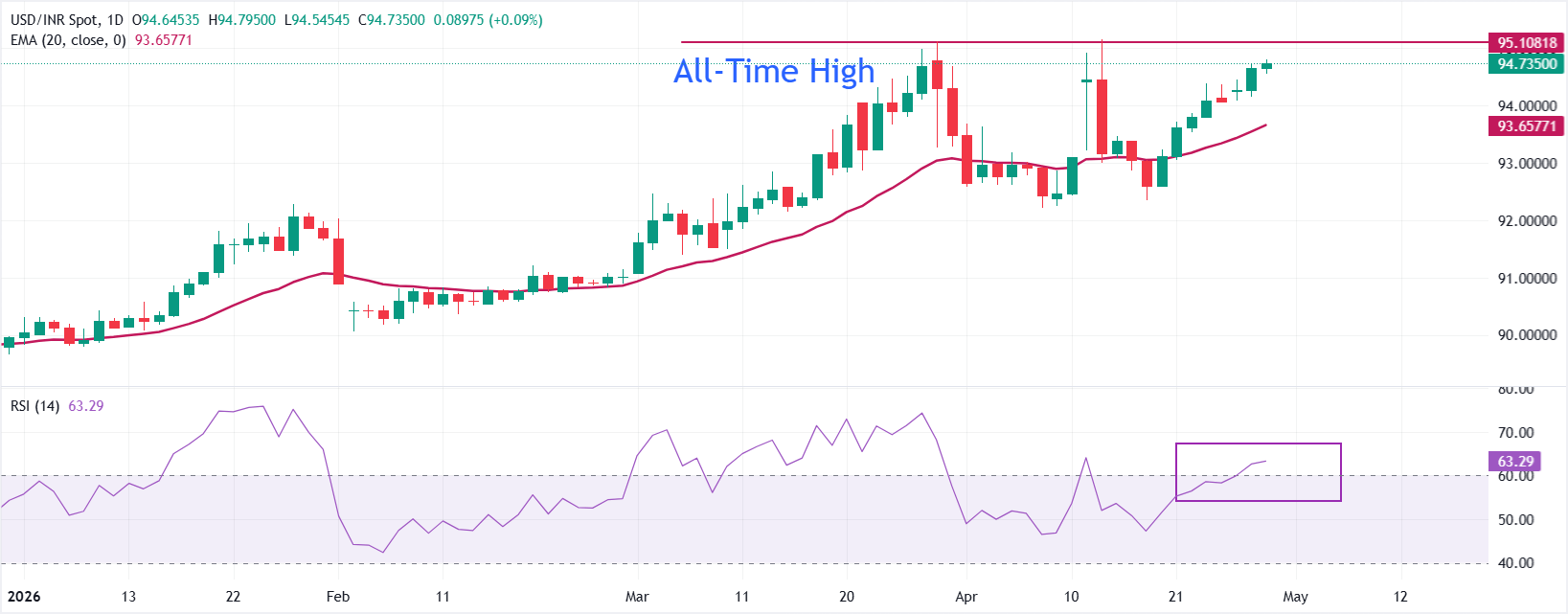
USD/INR trades higher at around 94.75 in the opening session on Wednesday. The pair holds a bullish near-term bias as spot remains above the 20-day exponential moving average (EMA) at roughly 93.66, keeping the recent advance supported.
The Relative Strength Index (RSI) around 63 suggests firm but not yet overbought upside momentum, reinforcing the constructive tone while leaving room for additional gains.
On the downside, immediate support is seen at the 20-day EMA near 93.66. As long as USD/INR defends this moving average, dips are likely to attract buying interest, and the broader uptrend is expected to stay intact. Looking up, the spot is expected to revisit the all-time high slightly above 95.00.
(The technical analysis of this story was written with the help of an AI tool.)
Indian Rupee FAQs
The Indian Rupee (INR) is one of the most sensitive currencies to external factors. The price of Crude Oil (the country is highly dependent on imported Oil), the value of the US Dollar – most trade is conducted in USD – and the level of foreign investment, are all influential. Direct intervention by the Reserve Bank of India (RBI) in FX markets to keep the exchange rate stable, as well as the level of interest rates set by the RBI, are further major influencing factors on the Rupee.
The Reserve Bank of India (RBI) actively intervenes in forex markets to maintain a stable exchange rate, to help facilitate trade. In addition, the RBI tries to maintain the inflation rate at its 4% target by adjusting interest rates. Higher interest rates usually strengthen the Rupee. This is due to the role of the ‘carry trade’ in which investors borrow in countries with lower interest rates so as to place their money in countries’ offering relatively higher interest rates and profit from the difference.
Macroeconomic factors that influence the value of the Rupee include inflation, interest rates, the economic growth rate (GDP), the balance of trade, and inflows from foreign investment. A higher growth rate can lead to more overseas investment, pushing up demand for the Rupee. A less negative balance of trade will eventually lead to a stronger Rupee. Higher interest rates, especially real rates (interest rates less inflation) are also positive for the Rupee. A risk-on environment can lead to greater inflows of Foreign Direct and Indirect Investment (FDI and FII), which also benefit the Rupee.
Higher inflation, particularly, if it is comparatively higher than India’s peers, is generally negative for the currency as it reflects devaluation through oversupply. Inflation also increases the cost of exports, leading to more Rupees being sold to purchase foreign imports, which is Rupee-negative. At the same time, higher inflation usually leads to the Reserve Bank of India (RBI) raising interest rates and this can be positive for the Rupee, due to increased demand from international investors. The opposite effect is true of lower inflation.













