

USD/INR recovers as Iran denies involvement in negotiations with US
- The Indian Rupee falls back to near 94.30 against the US Dollar after a strong recovery move on Monday.
- The US Dollar gains as Iran pushes back hopes of a resolution of the war in the Middle East.
- Investors await the flash India/US private sector PMI data for March.
The Indian Rupee (INR) opens lower against the US Dollar (USD) on Tuesday after a strong recovery move the previous day. The USD/INR pair recovers to near 94.28 from the immediate low of 93.30 as the US Dollar gains ground after a steep retracement on Monday, which was driven by the announcement from United States (US) President Donald Trump that he has postponed scheduled military strikes on Iranian power plants for five days.

US Dollar’s recovery supports USD/INR
As of writing, the US Dollar Index (DXY), which tracks the Greenback’s value against six major currencies, trades 0.25% higher to near 99.40 after recovering from the weekly low of 98.88 posted the previous day.
The US Dollar recoups over half of its previous day’s losses as Iran has denied any involvement in negotiations with the US over resolving hostilities in the Middle East.
On Monday, US President Trump announced that he has instructed the Department of War to hold scheduled military attacks on Iran’s power plants for five days, citing that Washington is having “very good and productive conversations” with Tehran regarding a complete and total resolution of hostilities in the Middle East.
The US Dollar has outperformed strongly in the past few weeks due to an increase in demand for safe-haven assets amid Middle East conflicts and surging energy prices, which have discouraged traders from betting on the Federal Reserve’s (Fed) interest rate cuts this year.
Market experts believe that higher energy prices due to oil supply disruption are expected to stay longer as the damage to energy infrastructure in Gulf economies amid the war is unlikely to be repaired soon, signaling persistent firmness in the US Dollar. “The war has resulted in lasting damage to infrastructure, so even if it's over soon, energy prices may well remain higher,” analysts at Capital Economics said.
FIIs selling remains major drag on Indian Rupee
The continuous outflow of foreign funds from the Indian stock market is consistently hurting the Indian Rupee. So far in March, Foreign Institutional Investors (FIIs) have remained net sellers on all trading days and offloaded their stake worth Rs. 97,195.12 crore.
On the domestic front, India's preliminary private sector Purchasing Managers Index (PMI) data for March has come in lower due to a slowdown in business activities in both the manufacturing and the services sectors. India's flash Composite PMI has arrived at 56.9, lower than 58.9 in February.
"Output growth eased across both manufacturing and services as the energy shock unfolds. Softer domestic demand weighed on new orders, which rose at the slowest pace in more than three years, despite a record surge in new export orders. Cost pressures intensified, but companies are absorbing part of the increase by squeezing margins," Pranjul Bhandari, Chief India Economist at HSBC, said.
Technical Analysis: USD/INR aims to revisit all-time high of 94.60
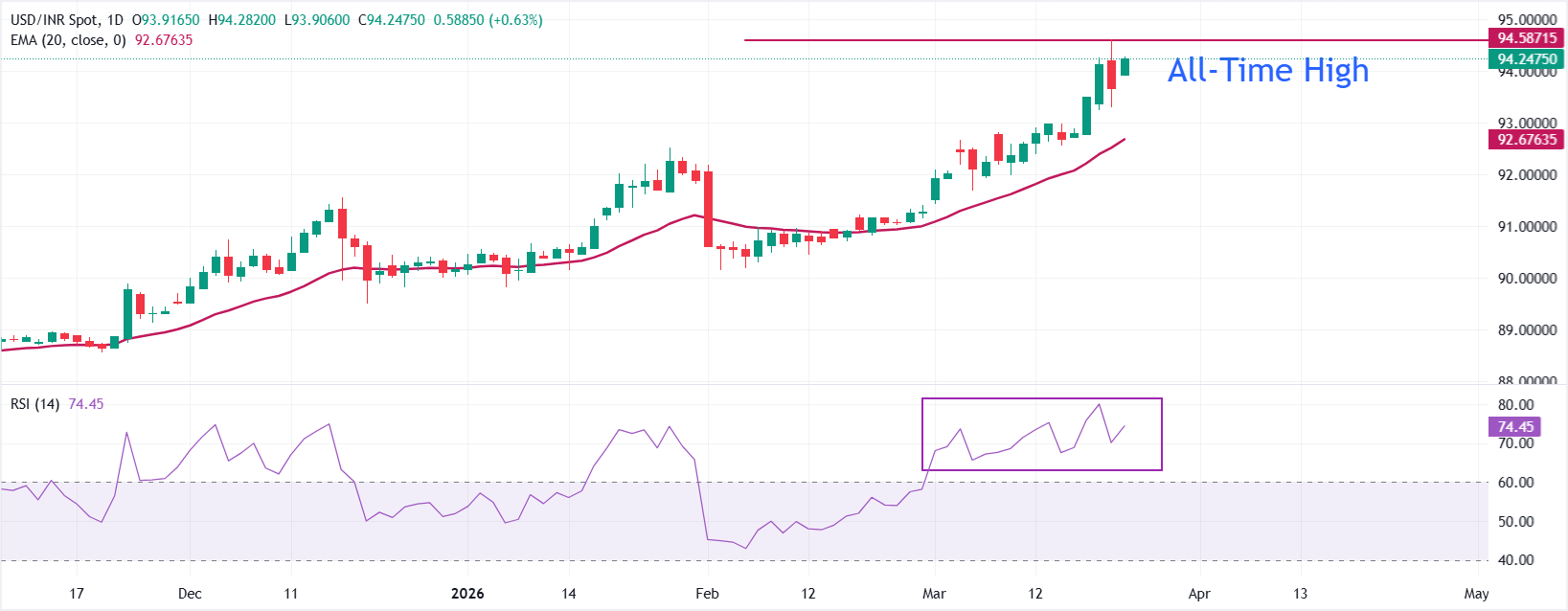
USD/INR trades higher at around 94.28 at the press time. The near-term bias is bullish as price extends above the rising 20-day Exponential Moving Average (EMA), confirming a short-term uptrend.
Momentum remains firm with the 14-day Relative Strength Index (RSI) holding in overbought territory above 70, showing strong buying pressure and limited evidence of exhaustion so far. The sequence of higher closes and the sustained distance above the 20-day EMA underline dip-buying interest on minor pullbacks.
Initial support is at the 20-day EMA near 92.70, where a break would expose secondary support around 92.00. Deeper weakness would target 91.40, aligning with a prior consolidation band. On the upside, immediate resistance emerges at 94.50, with a break opening the way toward 95.20 as the next bullish objective. As long as price holds above 92.70, the upside structure remains intact and pullbacks are expected to be shallow.
(The technical analysis of this story was written with the help of an AI tool.)
Indian Rupee FAQs
The Indian Rupee (INR) is one of the most sensitive currencies to external factors. The price of Crude Oil (the country is highly dependent on imported Oil), the value of the US Dollar – most trade is conducted in USD – and the level of foreign investment, are all influential. Direct intervention by the Reserve Bank of India (RBI) in FX markets to keep the exchange rate stable, as well as the level of interest rates set by the RBI, are further major influencing factors on the Rupee.
The Reserve Bank of India (RBI) actively intervenes in forex markets to maintain a stable exchange rate, to help facilitate trade. In addition, the RBI tries to maintain the inflation rate at its 4% target by adjusting interest rates. Higher interest rates usually strengthen the Rupee. This is due to the role of the ‘carry trade’ in which investors borrow in countries with lower interest rates so as to place their money in countries’ offering relatively higher interest rates and profit from the difference.
Macroeconomic factors that influence the value of the Rupee include inflation, interest rates, the economic growth rate (GDP), the balance of trade, and inflows from foreign investment. A higher growth rate can lead to more overseas investment, pushing up demand for the Rupee. A less negative balance of trade will eventually lead to a stronger Rupee. Higher interest rates, especially real rates (interest rates less inflation) are also positive for the Rupee. A risk-on environment can lead to greater inflows of Foreign Direct and Indirect Investment (FDI and FII), which also benefit the Rupee.
Higher inflation, particularly, if it is comparatively higher than India’s peers, is generally negative for the currency as it reflects devaluation through oversupply. Inflation also increases the cost of exports, leading to more Rupees being sold to purchase foreign imports, which is Rupee-negative. At the same time, higher inflation usually leads to the Reserve Bank of India (RBI) raising interest rates and this can be positive for the Rupee, due to increased demand from international investors. The opposite effect is true of lower inflation.














