

Trade The World
Dow Jones Industrial Average sets new all-time high led by banking and healthcare sectors
作者 Joshua Gibson
發布日期: 13 Nov 2025 | 修改日期: 13 Nov 2025


POPULAR ARTICLES
The Dow Jones Industrial Average (DJIA) caught a firm bid on Wednesday, driving into fresh record highs as investors eased back from overexposure to the AI tech rally and moved deeper into more traditional investing mainstays, primarily major banks and healthcare stocks.
- The Dow Jones found new all-time highs on Wednesday.
- Banking and healthcare stocks are leading the charge.
- Congress is expected to vote on a resolution to fund the US government through January.
The Dow Jones Industrial Average (DJIA) caught a firm bid on Wednesday, driving into fresh record highs as investors eased back from overexposure to the AI tech rally and moved deeper into more traditional investing mainstays, primarily major banks and healthcare stocks.
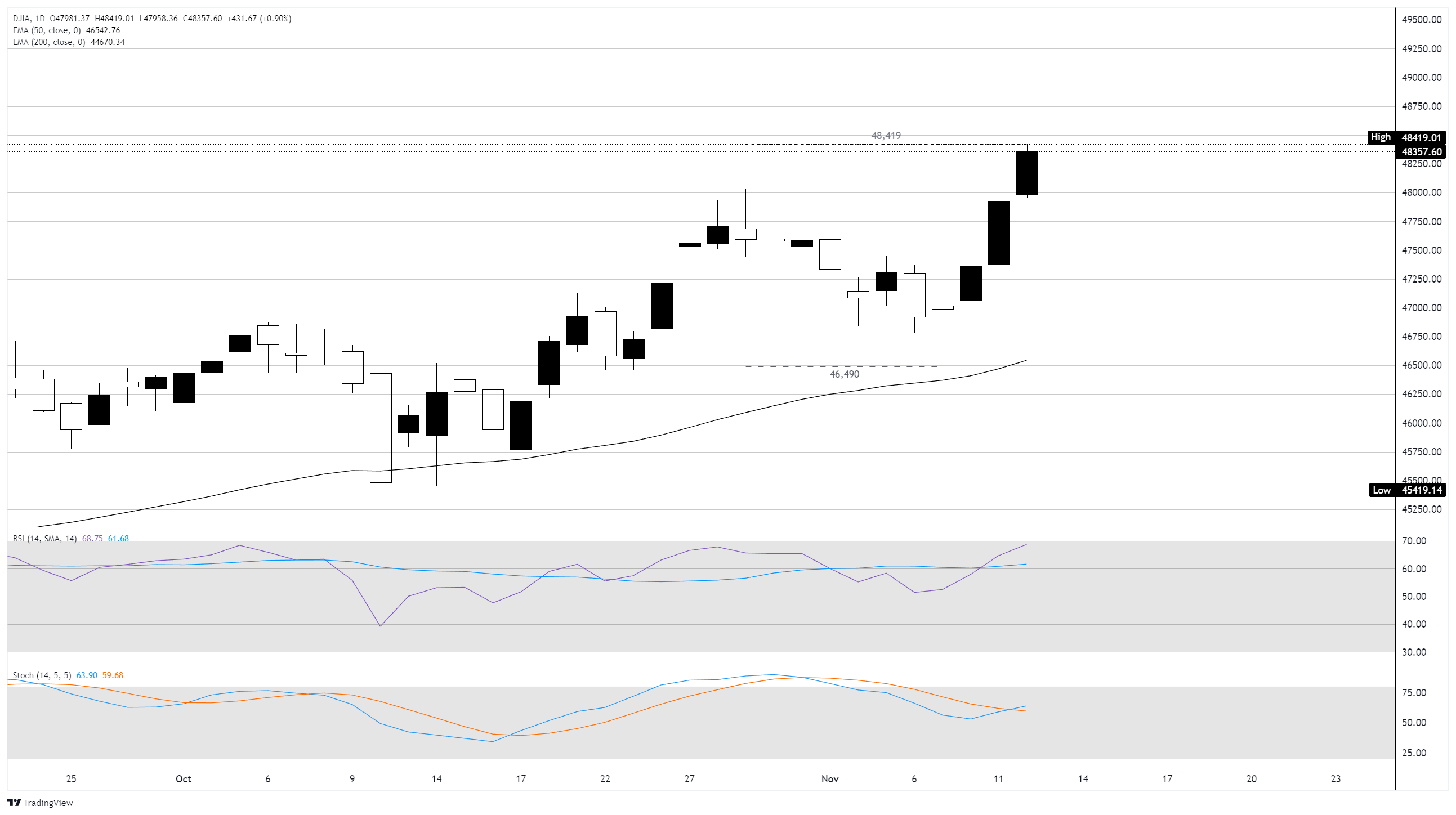
The Dow Jones rose around 430 points at its peak, setting a new intraday high of 48,419 as the tech-light major index gets a boost from traders piling back into traditional investments. The Dow is now up around 4% over a four-day period after falling to 46,490 in a mild pullback from the last record swing high near the 48,000 handle.
Banking stocks push the Dow higher
The financial sector bolstered the Dow Jones, with investor favorites such as Goldman Sachs (GS), JPMorgan (JPM), and credit card company American Express (AXP) all rising to record highs. Materials and construction also added a further boost, with building darling Caterpillar (CAT) climbing as well.
Investors continue to grow leery about revenue prospects within the AI space, despite eye-watering valuations for shovel sellers during the LLM data gold rush. Advanced Micro Designs (AMD) CEO Lisa Siu claimed that she could see total AI tech demand climbing to $1 trillion per year by 2030, a lofty investment and expenditure goal for an industry where most, if not all, of the revenue is contained entirely within data center suppliers.
Short-term resolution is better than no resolution
The US government continues to grind closer toward a short-term resolution to the longest federal government shutdown in American history. A temporary stopgap bill that would fund the US government through January passed in the Senate this week, and the bill is expected to be voted on by the lower House of Representatives as soon as 19:00 EST Wednesday or 03:00 GMT Thursday.
Dow Jones daily chart
Fed FAQs
Monetary policy in the US is shaped by the Federal Reserve (Fed). The Fed has two mandates: to achieve price stability and foster full employment. Its primary tool to achieve these goals is by adjusting interest rates. When prices are rising too quickly and inflation is above the Fed’s 2% target, it raises interest rates, increasing borrowing costs throughout the economy. This results in a stronger US Dollar (USD) as it makes the US a more attractive place for international investors to park their money. When inflation falls below 2% or the Unemployment Rate is too high, the Fed may lower interest rates to encourage borrowing, which weighs on the Greenback.
The Federal Reserve (Fed) holds eight policy meetings a year, where the Federal Open Market Committee (FOMC) assesses economic conditions and makes monetary policy decisions. The FOMC is attended by twelve Fed officials – the seven members of the Board of Governors, the president of the Federal Reserve Bank of New York, and four of the remaining eleven regional Reserve Bank presidents, who serve one-year terms on a rotating basis.
In extreme situations, the Federal Reserve may resort to a policy named Quantitative Easing (QE). QE is the process by which the Fed substantially increases the flow of credit in a stuck financial system. It is a non-standard policy measure used during crises or when inflation is extremely low. It was the Fed’s weapon of choice during the Great Financial Crisis in 2008. It involves the Fed printing more Dollars and using them to buy high grade bonds from financial institutions. QE usually weakens the US Dollar.
Quantitative tightening (QT) is the reverse process of QE, whereby the Federal Reserve stops buying bonds from financial institutions and does not reinvest the principal from the bonds it holds maturing, to purchase new bonds. It is usually positive for the value of the US Dollar.

FXStreet
超過一百萬用戶依賴 FXStreet 獲取即時市場數據、圖表工具、專家洞見與外匯新聞。其全面的經濟日曆與教育網路研討會協助交易者保持資訊領先、做出審慎決策。FXStreet 擁有約 60 人的團隊,分布於巴塞隆納總部及全球各地。
Read More








