

Trade The World
EUR/USD steady as investors flock to Dollar during US shutdown
作者 Christian Borjon Valencia
發布日期: 3 Oct 2025 | 修改日期: 3 Oct 2025


POPULAR ARTICLES

EUR/USD remains steady during the North American session on Thursday, yet registering back-to-back bearish days as the US Dollar strengthens amid the ongoing government shutdown and the absence of US economic data releases like Initial Jobless Claims. The pair trades at 1.1719, down 0.09%.
- EUR/USD dives as Dollar gains ground as US government shutdown halts key economic data releases.
- Dallas Fed Logan flags inflation trending higher, warns of risks, while the labor market shows further signs of cooling.
- Eurozone unemployment unexpectedly rises to 6.3%, adding pressure to ECB outlook as growth risks remain tilted lower.
EUR/USD remains steady during the North American session on Thursday, yet registering back-to-back bearish days as the US Dollar strengthens amid the ongoing government shutdown and the absence of US economic data releases like Initial Jobless Claims. The pair trades at 1.1719, down 0.09%.
Shared currency struggles for direction as traders eye ISM Services PMI and Fed speakers with NFP data likely delayed
Wall Street is poised to end the day in the green despite the lack of progress to reopen the US government. Data from Challenger, Gray and Christmas revealed that companies are expected to hire over 30,000 fewer people in September, as the labor market continues to cool down.
Dallas Federal Reserve (Fed) President Lorie Logan was hawkish, stating that inflation is above target and trending upward. Despite this, she recognized the risks on both sides of the dual mandate, adding that the labor market is cooling.
Given the backdrop, investors seem confident that the Fed will slash rates at the October 29 meeting, with odds standing at 96%, as revealed by the Prime Market Terminal interest rate probability tool.
In the meantime, the US Nonfarm Payrolls report is expected to be delayed, leaving traders adrift for the Institute of Supply Management (ISM) Services PMI for September and Fed officials crossing the wires.
Across the pond, Eurostat revealed that the Unemployment Rate rose from 6.2% in July to 6.3% in August, above estimates.
Daily market movers: EUR/USD slides on Fed’s Logan hawkish comments, Dollar strength
- US employers announced 54,064 job cuts in September, down from 85,979 in August, according to Challenger, Gray & Christmas. Andy Challenger, senior Vice President at the firm, noted: “Right now, we’re dealing with a stagnating labor market, cost increases, and a transformative new technology.”
- Job openings in the US showed the labor market is slowing, yet vacancies rose from 7.21 million to 7.23 million in August. Digging into the data, the hiring rate edged down to 3.2%, the lowest level since June 2024, while layoffs remained at a low level.
- Bloomberg revealed that the US Supreme Court dismissed US President Donald Trump's order to oust Federal Reserve Governor Lisa Cook and allowed her to remain in her position at least until January, when the court is expected to hear Trump's arguments.
- ECB committee member, Martins Kazaks, reiterated that the bank's interest rates are at a "very appropriate level" and that they should remain unchanged unless further shocks occur.
Technical outlook: EUR/USD steadies at around 1.1710 awaiting a fresh catalyst
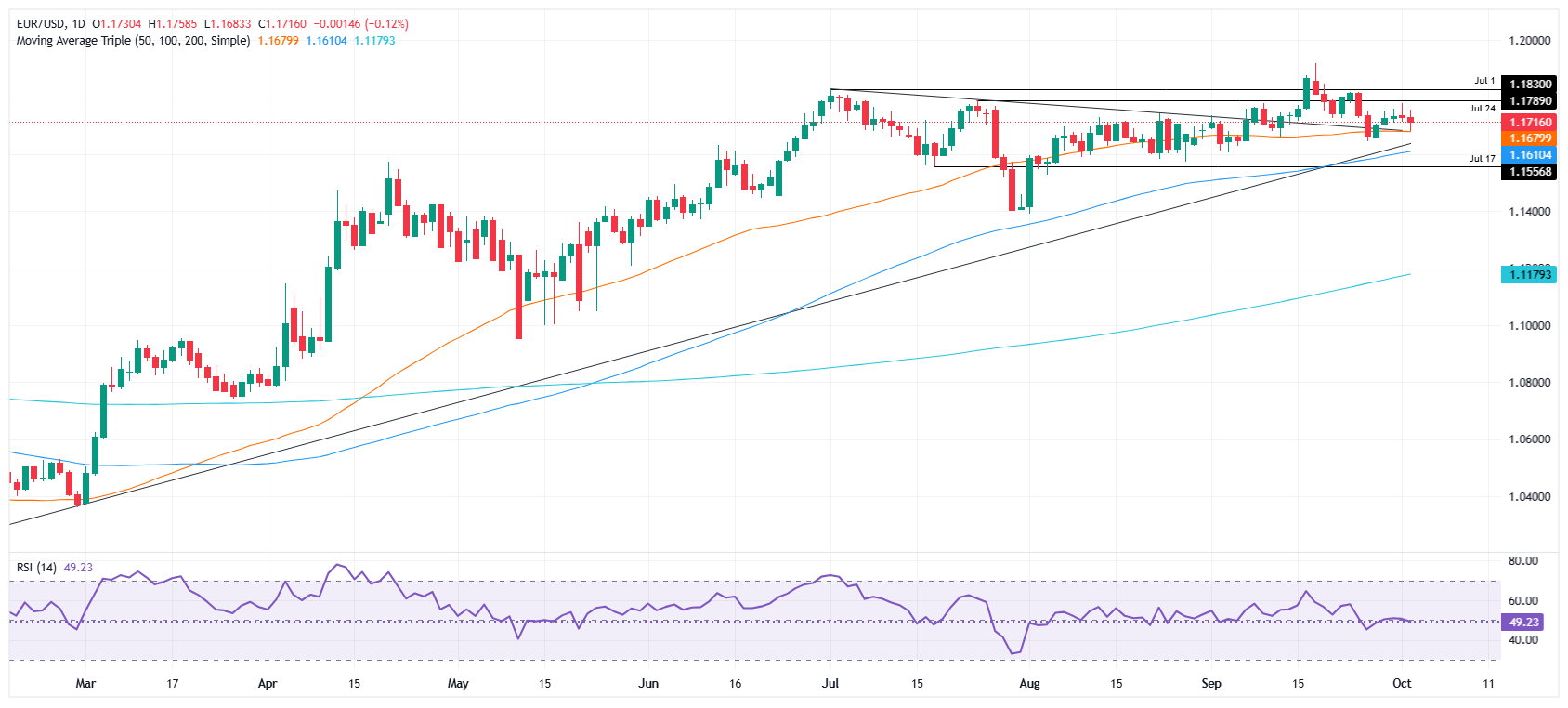
EUR/USD has remained steady above the 1.1700 figure during the last four trading days, yet it has failed to clear 1.1750, which could open the door for further gains. The Relative Strength Index (RSI) shows signs of being flattish near the 50 neutral level.
If EUR/USD clears 1.1740, the next resistance would be 1.1800, ahead of the yearly high of 1.1918. Conversely, a drop below 1.1700 would expose 1.1650, before challenging the 100-day SMA at 1.1610.
ECB FAQs
The European Central Bank (ECB) in Frankfurt, Germany, is the reserve bank for the Eurozone. The ECB sets interest rates and manages monetary policy for the region. The ECB primary mandate is to maintain price stability, which means keeping inflation at around 2%. Its primary tool for achieving this is by raising or lowering interest rates. Relatively high interest rates will usually result in a stronger Euro and vice versa. The ECB Governing Council makes monetary policy decisions at meetings held eight times a year. Decisions are made by heads of the Eurozone national banks and six permanent members, including the President of the ECB, Christine Lagarde.
In extreme situations, the European Central Bank can enact a policy tool called Quantitative Easing. QE is the process by which the ECB prints Euros and uses them to buy assets – usually government or corporate bonds – from banks and other financial institutions. QE usually results in a weaker Euro. QE is a last resort when simply lowering interest rates is unlikely to achieve the objective of price stability. The ECB used it during the Great Financial Crisis in 2009-11, in 2015 when inflation remained stubbornly low, as well as during the covid pandemic.
Quantitative tightening (QT) is the reverse of QE. It is undertaken after QE when an economic recovery is underway and inflation starts rising. Whilst in QE the European Central Bank (ECB) purchases government and corporate bonds from financial institutions to provide them with liquidity, in QT the ECB stops buying more bonds, and stops reinvesting the principal maturing on the bonds it already holds. It is usually positive (or bullish) for the Euro.

FXStreet
超過一百萬用戶依賴 FXStreet 獲取即時市場數據、圖表工具、專家洞見與外匯新聞。其全面的經濟日曆與教育網路研討會協助交易者保持資訊領先、做出審慎決策。FXStreet 擁有約 60 人的團隊,分布於巴塞隆納總部及全球各地。
Read More








