

Trade The World
WTI Price Forecast: Sees immediate support near $55 amid US-Venezuela clash
作者 Sagar Dua
發布日期: 7 Jan 2026 | 修改日期: 7 Jan 2026


POPULAR ARTICLES

West Texas Intermediate (WTI), futures on NYMEX, trade 1.15% lower to near $56.00 during the late Asian trading session on Wednesday.
- The Oil price is under pressure on hopes that Venezuela’s Oil industry restructuring will increase global crude production.
- Investors await the US NFP data for fresh cues on the US interest rate outlook.
- The Oil price continues to stay below the 20-day EMA.
West Texas Intermediate (WTI), futures on NYMEX, trade 1.15% lower to near $56.00 during the late Asian trading session on Wednesday. The Oil price is under pressure as THE pledge from United States (US) President Donald Trump to restructure Venezuela’s Oil industry after Washington’s military action in the economy has raised hopes of increased global crude production.
Technically, higher Oil production in a steady demand environment weighs on the price.
On Monday, US President Trump announced that he will ask domestic Oil companies to support rebuilding Venezuela’s Oil infrastructure and will sell IT in global markets. Amid the US military action in Venezuela, they also captured President Nicolas Maduro over drug-trafficking charges.
Going forward, the major trigger for the Oil price will be the US Nonfarm Payrolls (NFP) for December, which will be released on Friday. The US official employment data will influence market expectations for the Federal Reserve’s (Fed) monetary policy outlook. Lower interest rates by the Fed bode well for the Oil price.
WTI technical analysis
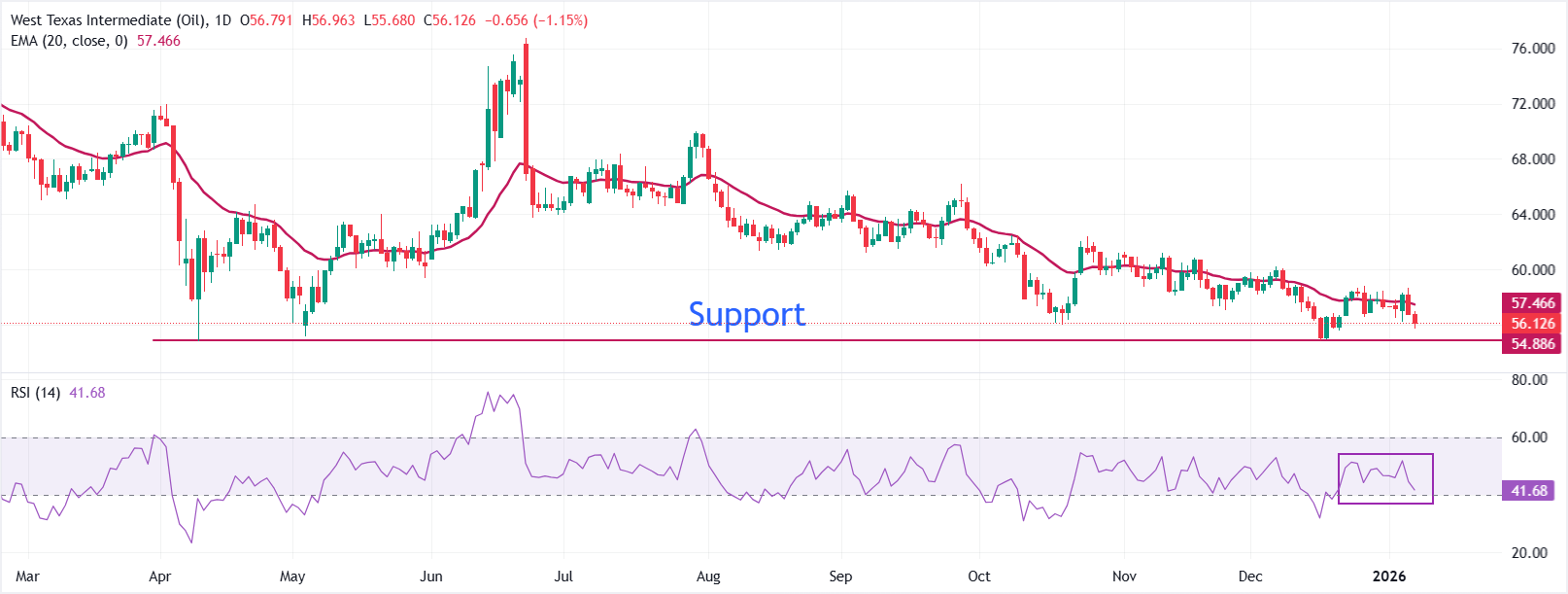
WTI US Oil trades lower at around $56.10 on Wednesday. The 14-day Relative Strength Index (RSI) at 41.68 points to weak momentum without an oversold signal.
The 20-day Exponential Moving Average (EMA) at $57.47 slopes lower and caps rebounds, keeping the bias bearish. With price holding beneath the falling average, rallies would remain corrective, and could go for a deeper retracement towards the psychological level of $50.00 after breaking below the immediate support of $55.00.
On the contrary, a daily close of the price above this 20-day EMA would shift the tone toward balance, and pave the way for an adavncement towards the December high around $60.00.
(The technical analysis of this story was written with the help of an AI tool.)
WTI Oil FAQs
WTI Oil is a type of Crude Oil sold on international markets. The WTI stands for West Texas Intermediate, one of three major types including Brent and Dubai Crude. WTI is also referred to as “light” and “sweet” because of its relatively low gravity and sulfur content respectively. It is considered a high quality Oil that is easily refined. It is sourced in the United States and distributed via the Cushing hub, which is considered “The Pipeline Crossroads of the World”. It is a benchmark for the Oil market and WTI price is frequently quoted in the media.
Like all assets, supply and demand are the key drivers of WTI Oil price. As such, global growth can be a driver of increased demand and vice versa for weak global growth. Political instability, wars, and sanctions can disrupt supply and impact prices. The decisions of OPEC, a group of major Oil-producing countries, is another key driver of price. The value of the US Dollar influences the price of WTI Crude Oil, since Oil is predominantly traded in US Dollars, thus a weaker US Dollar can make Oil more affordable and vice versa.
The weekly Oil inventory reports published by the American Petroleum Institute (API) and the Energy Information Agency (EIA) impact the price of WTI Oil. Changes in inventories reflect fluctuating supply and demand. If the data shows a drop in inventories it can indicate increased demand, pushing up Oil price. Higher inventories can reflect increased supply, pushing down prices. API’s report is published every Tuesday and EIA’s the day after. Their results are usually similar, falling within 1% of each other 75% of the time. The EIA data is considered more reliable, since it is a government agency.
OPEC (Organization of the Petroleum Exporting Countries) is a group of 12 Oil-producing nations who collectively decide production quotas for member countries at twice-yearly meetings. Their decisions often impact WTI Oil prices. When OPEC decides to lower quotas, it can tighten supply, pushing up Oil prices. When OPEC increases production, it has the opposite effect. OPEC+ refers to an expanded group that includes ten extra non-OPEC members, the most notable of which is Russia.

FXStreet
超過一百萬用戶依賴 FXStreet 獲取即時市場數據、圖表工具、專家洞見與外匯新聞。其全面的經濟日曆與教育網路研討會協助交易者保持資訊領先、做出審慎決策。FXStreet 擁有約 60 人的團隊,分布於巴塞隆納總部及全球各地。
Read More








