[TMGM Financial Breakfast] Are War-Driven Headwinds for Gold Fading? Institutions See Potential Rebound
Amundi (Amundi Asset Management) argues that the inflationary impact of the Iran conflict is likely to be temporary. While energy shocks have pushed prices higher in the short term, they do not represent a sustained inflation trend. As a result, the bearish factors weighing on gold may already be largely priced in, increasing the likelihood of a reversal.
Currently, U.S. headline inflation has risen to a two-year high of 3.3%, while core inflation has moderated to 2.6%. This suggests that inflation remains under control and is unlikely to force central banks into maintaining an aggressively hawkish stance.

Gold demand is not solely driven by U.S. interest rates. Prices have already declined about 15% from their January peak, indicating that much of the negative news has been absorbed by the market.
At the same time, central banks in emerging markets continue to diversify their reserves by reducing exposure to the U.S. dollar and increasing gold holdings. This long-term trend provides strong underlying support for gold prices.
In addition, rising global sovereign debt levels and growing concerns over private credit liquidity are boosting demand for hard assets as safe havens.
Although some countries may temporarily sell gold reserves to stabilize their currencies during periods of heightened volatility, such actions are tactical and do not undermine gold’s strategic role as a hedge against systemic risk, currency depreciation, and policy uncertainty.
Markets may be underestimating the long-term risks associated with prolonged geopolitical tensions. The near-stagnation of traffic through the Strait of Hormuz continues to constrain oil supply, with broader economic impacts expected to unfold gradually.
While U.S. equities continue to hit record highs, stagflation risks — a combination of slowing growth and rising prices — may not be fully priced in. Rising costs could pressure corporate earnings, potentially forcing the Federal Reserve to maintain tighter policy.
In a supply-constrained environment, liquidity easing may not effectively address inflation, and weakening demand could become inevitable. This combination of stagnation and persistent inflation could provide sustained support for gold in the long run.
Central bank behavior regarding gold has become increasingly divergent.
Russia, facing significant fiscal deficits and seeking to rebalance its reserves, has been gradually reducing its gold holdings. In March, it sold an additional 6.5 tons, bringing total reductions this year to 22 tons. However, this represents only about a 1% decrease in overall reserves.
In contrast, Poland has significantly increased its gold holdings. The National Bank of Poland raised its target from 550 tons to 700 tons and added another 11.2 tons in March, bringing total reserves to 581.6 tons. Notably, Poland’s gold reserves have already surpassed those of the European Central Bank, highlighting strong demand even at elevated price levels.
Market Interpretation
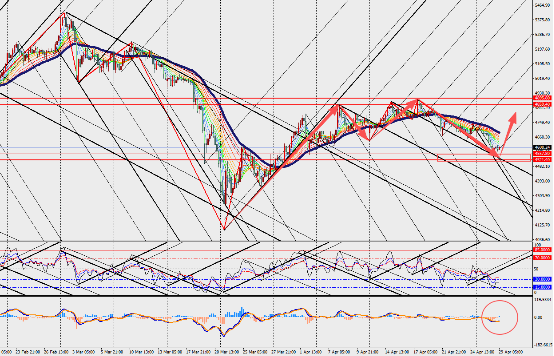
On the four-hour chart, gold appears to be stabilizing after its recent decline, with MACD lines and volume bars expanding below the zero axis.
Markets widely expect the Federal Reserve to keep interest rates unchanged at this week’s policy meeting. Attention will shift to Fed Chair Jerome Powell’s press conference, where his comments on inflation trends and future policy direction will likely play a decisive role in shaping short-term gold price movements.
Overall, while short-term pressures persist, structural factors and evolving macro risks suggest that gold may still have room to resume its upward trend.