

Trading
Erkunden Sie eine breite Palette von Märkten mit wettbewerbsfähigen Preisen, tiefer Liquidität und fortschrittlichen Trading-Tools.
Mehr erfahren 
Plattform
Handeln Sie nahtlos mit TMGMs leistungsstarker Plattform, die für Geschwindigkeit, Präzision und ein überlegenes Trading-Erlebnis entwickelt wurde.
Mehr erfahren Trading-Plattform
Akademie
Lernen Sie die Grundlagen des Tradings mit anfängerfreundlichen Ressourcen, einschließlich Leitfäden, Webinaren und Markteinblicken.
Mehr erfahren Nachrichten & Analyse
Erhalten Sie Echtzeit-Markt-Updates und Expertenanalysen, um Trading-Gelegenheiten voraus zu sein
Mehr erfahren Nachrichten & Analyse
Über uns
Erfahren Sie, was TMGM auszeichnet — unsere globale Präsenz, regulatorische Stärke und unser Engagement für Innovation im Trading.
Mehr erfahren Warum TMGM wählen
[TMGM Financial Breakfast] Signs of U.S.–Iran Reconciliation Emerge as Gold Surges Above $4,700
On Wednesday, gold prices rose more than 2% intraday after U.S. President Donald Trump suggested that a peace agreement with Iran may be within reach. The comments helped ease market fears surrounding inflation.
Trump stated on Tuesday that, given the progress made toward a comprehensive agreement between the U.S. and Iran, he would temporarily suspend naval escort operations aimed at securing shipping routes through the Strait of Hormuz. U.S. Secretary of State Marco Rubio confirmed the same day that Operation Epic Fury had ended, adding that Washington hoped to avoid any further escalation.

Earlier, the U.S. Defense Secretary also noted that the ceasefire agreement initiated about a month ago remains in place. Meanwhile, Iranian Foreign Minister Araghchi signaled that negotiations are making progress.
The reduction in geopolitical risk premiums helped push oil prices lower, which itself is supportive for gold. Previously, the U.S. had confirmed that despite some small-scale clashes earlier in the week, the fragile ceasefire agreement with Iran remained effective.
However, if there are any signs of renewed escalation between the two countries, gold could see profit-taking pressure, with short-term speculators potentially unwinding recent net long positions.
A weaker U.S. dollar has also played an important role in the rebound of precious metals. Dollar depreciation lowers the cost of dollar-denominated metals for holders of other currencies, thereby supporting demand.
At the same time, the relationship between oil prices and inflation expectations continues to reshape market dynamics. High oil prices typically fuel inflation and increase the likelihood of central bank rate hikes. Although gold is traditionally viewed as an inflation hedge, rising interest rates tend to increase the attractiveness of yield-bearing assets, reducing gold’s relative appeal.
Trump’s conciliatory comments effectively interrupted this chain reaction.
Market attention is now turning toward key economic data later this week. Investors are awaiting the U.S. nonfarm payrolls report to assess whether the U.S. economy remains strong enough for the Federal Reserve to maintain its current interest-rate stance.
Market Interpretation
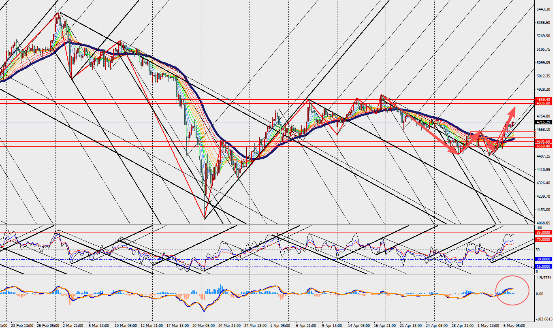
On the four-hour chart, gold is showing a rebound within a range-bound pattern, while MACD lines and volume bars above the zero axis are beginning to contract.
Risks related to economic growth, deteriorating geopolitical relations, currency volatility, and downside risks in equity markets are expected to continue supporting gold’s role as a portfolio diversification tool.
However, for gold to break to new highs in the short term, broader institutional capital inflows may be required to offset the seasonal weakness and softer retail demand currently limiting momentum.
BELIEBTE ARTIKEL
1US Dollar: Stronger as Fed hike path extends – MUFG2Euro: Fair value drop points to downside against US Dollar – ING3Euro weakens against Canadian Dollar amid German political turmoil, higher oil prices4NZD/USD Price Forecast: Upside attempts likely to be tested at 0.5800 5Coinbase opens IPO allocations to US retail investors6British Pound: Oversold slide nears 1.3335 against US Dollar – UOB7United States Dollar Index gathers strength to near 100.50 on hawkish Fed signals8Brent: Diplomatic hopes support pullback – Deutsche Bank9Experts agree: Sustained Japanese Yen weakness is likely to trigger another intervention
LIVE-KURSE


ALLES ÜBER INDICATORS
Was ist ein dreifach exponentieller gleitender Durchschnitt: Wie er funktioniert & wie man ihn handelt
Death Cross: Verstehen Sie das Signal und seine Erfolgsbilanz
Doppelter exponentieller gleitender Durchschnitt: Funktionsweise & Anwendung
Was ist ein Golden Cross? Entstehung und Trading-Leitfaden
EMA vs. SMA: Was ist der Unterschied und welche ist besser?
Exponentieller gleitender Durchschnitt (EMA): Formel, Einstellungen & Strategien
Die 5 besten Unterstützungs- und Widerstandsindikatoren
Was ist der RSI, der Relative Strength Index
Trend-Trading: Die 4 wichtigsten Indikatoren, die Sie kennen müssen
Jetzt loslegen!
Registrieren Sie sich und erhalten Sie in weniger als 3 Minuten Zugang zu den globalen Märkten

Verbinden Sie sich mit uns









Kontakte
Telefon: +61 2 8036 8388
Fax: +61 2 8036 8388
E-Mail: support@tmgm.com



Die auf dieser Website bereitgestellten Informationen sind ausschließlich allgemeiner Natur und stellen keine persönliche Finanzberatung dar. Bevor Sie auf Grundlage von Informationen auf dieser Website handeln, sollten Sie die Eignung dieser Informationen im Hinblick auf Ihre Ziele, Ihre finanzielle Situation und Ihre Bedürfnisse prüfen. Investitionen in CFDs und FX-Margin-Kontrakte sind mit erheblichen Risiken verbunden und nicht für alle Anleger geeignet. Sie können mehr als Ihre ursprüngliche Einzahlung verlieren. Sie besitzen weder das zugrunde liegende Vermögenswert noch haben Sie ein Interesse daran. Wir empfehlen Ihnen, unabhängigen Rat einzuholen und sicherzustellen, dass Sie die damit verbundenen Risiken vor dem Handel vollständig verstehen. Es ist wichtig, dass Sie das Offenlegungsdokument lesen und berücksichtigen, bevor Sie ein auf der Website aufgeführtes Produkt erwerben. Die auf dieser Website angebotenen Informationen und Werbeanzeigen sind nicht für die Nutzung durch Personen in Ländern oder Rechtsordnungen bestimmt, in denen eine solche Nutzung gegen lokale Gesetze und Vorschriften verstoßen würde. Die auf dieser Website angebotenen Produkte und Dienstleistungen sind nicht für Einwohner der Vereinigten Staaten, Malaysias und Thailands bestimmt.
TMGM ist in verschiedenen Gerichtsbarkeiten autorisiert und reguliert.
Trademax Australia Limited, handelnd als TMGM, wird von der Australian Securities and Investments Commission (ASIC) reguliert, AFSL Nr. 436416 und befindet sich in Level 28, One International Tower, 100 Barangaroo Avenue, 2000 Sydney, NSW Australien.
E-Mail: support@tmgm.com.au
Trademax Global Limited, handelnd als TMGM, ist von der Vanuatu Financial Services Commission (VFSC) autorisiert und reguliert, Registrierungsnummer 40356 und registriert unter 1276, Kumul Highway, Port Vila, Vanuatu, Republik Vanuatu.
E-Mail: support@tmgm.com
Die Trademax Global Markets (SE) Limited, tätig unter dem Namen TMGM, ist durch die Financial Services Authority (FSA) der Seychellen autorisiert und reguliert, Lizenznummer SD224. Das Unternehmen ist registriert im Büro Nr. 13, Providence Estate ABIS Centre, Mahé, Seychellen.
E-Mail: support@tmgm.com
Trademax Global Markets (International) Pty Ltd, handelnd als TMGM, ist von der Financial Services Commission, Mauritius (FSC) autorisiert und reguliert mit der Lizenznummer GB22201012 und registriert unter 33, Edith Cavell Street C/o IQ EQ Fund Services (Mauritius) Ltd Port Louis, 11324 Mauritius.
E-Mail: support@tmgm.com
Copyright © TMGM. Alle Rechte vorbehalten