

Bitcoin Price Forecast: BTC struggles as institutional demand remains weak
- Bitcoin remains under pressure, trading at $62,700 on Wednesday after falling 2% the previous day.
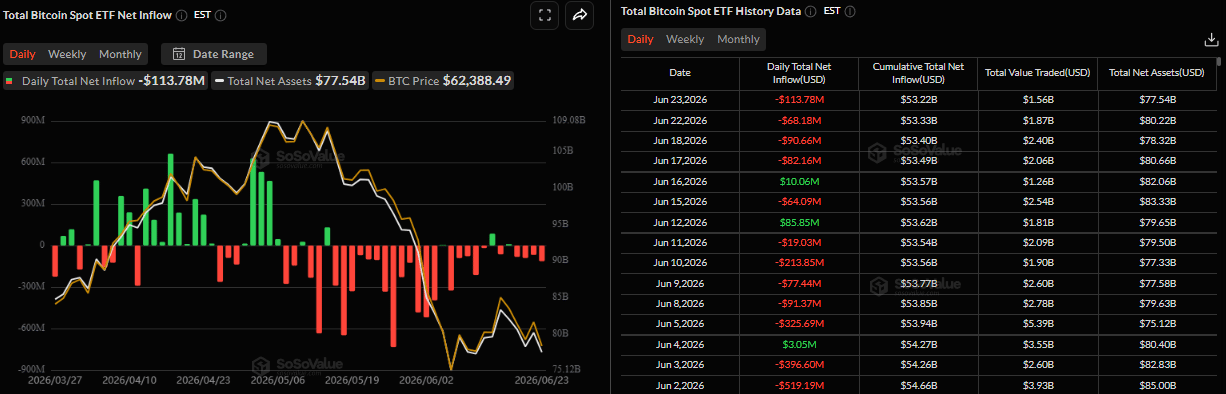
- US-listed spot ETF recorded an outflow of $113.78 million on Tuesday, extending a broader trend of institutional selling.
- Derivatives positioning remains largely unchanged, signaling a cautious, hands-off approach among BTC traders and limiting the prospects of recovery.
Bitcoin (BTC) remains under pressure, trading around $62,700 on Wednesday after losing 2% the previous day. Persistent institutional selling, with spot Exchange Traded Funds (ETFs) recording outflows on Tuesday, continues to weigh on BTC. In addition, activity on the Chicago Mercantile Exchange (CME) remains subdued, suggesting a cautious stance among traders, capping the Crypto King’s recovery prospects.

Institutional outflows persist
Institutional demand continues to weaken so far this week. SoSoValue data show that spot BTC ETFs recorded an outflow of $113.78 million on Tuesday, following a $68.18 million outflow on Monday. If these outflows intensify over the coming days, BTC could see a deeper correction.
Derivatives traders remain in a hands-off environment
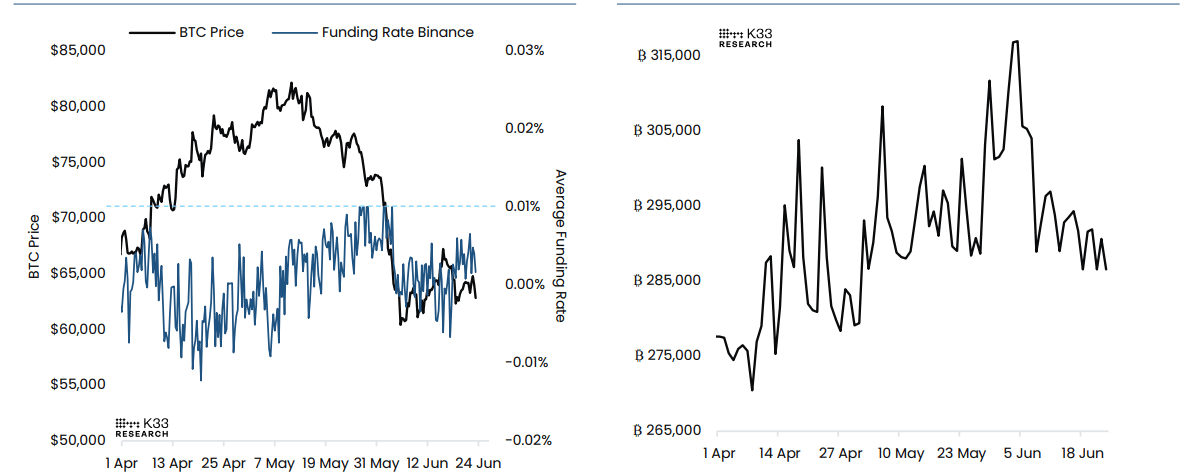
A K33 Research report on Tuesday stated that the CME data continues to reflect a passive, hands-off environment, with no notable deviations from the trends observed throughout the year.
The annualized BTC futures basis has risen modestly to 5%. Still, it remains subdued, while open interest fell 4,730 BTC over the past week to 101,655 BTC, putting CME on track to reach its lowest open interest since October 2023 following this week’s June expiry.
Meanwhile, funding rates ticked higher over the weekend, briefly reaching 5% annualized, the highest level since June 4, suggesting a modest re-emergence of speculative long positioning.
“However, both positioning and overall activity remain muted, with no material shift from the passive market conditions that have characterized much of the year,” said the K33 Research analyst.
Bitcoin Price Forecast: Weakening momentum indicators
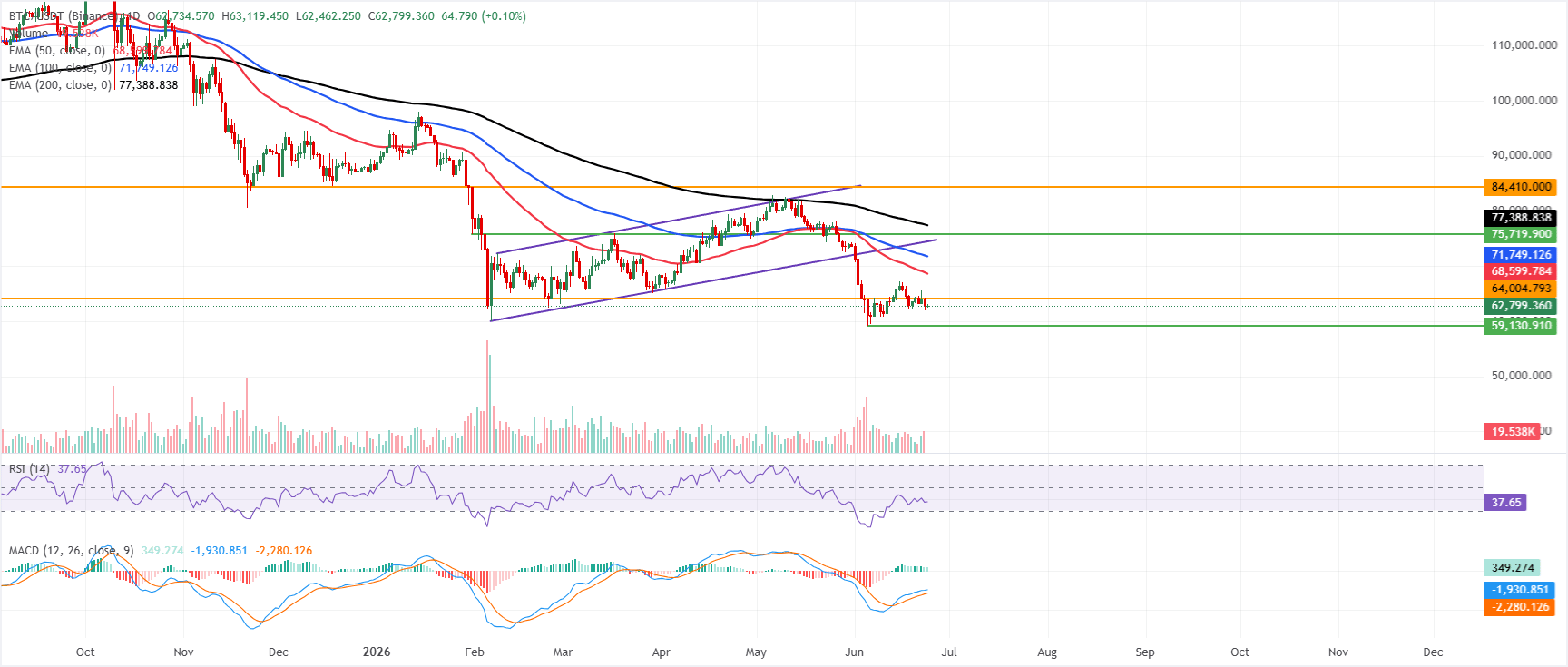
Bitcoin price trades at $62,700 on Wednesday, maintaining a bearish near-term bias as it remains well below the 50-day, 100-day, and 200-day Exponential Moving Averages (EMAs) at roughly $68,599, $71,749, and $77,388, respectively.
The dense cap formed by these overhead EMAs suggests that bounces are likely to be sold into, even as the Relative Strength Index (RSI) stabilizes in mildly oversold territory near 37 and the Moving Average Convergence Divergence (MACD) indicator remains in positive territory, hinting at fading downside momentum rather than a clear bullish reversal.
On the topside, initial resistance is seen at the horizontal level around $64,004, with further barriers at the 50-day EMA near $68,599 and then the 100-day EMA at $71,749; a sustained break above this EMA cluster would be needed to ease the prevailing downside pressure, while the 200-day EMA near $77,388 and the prior horizontal resistance at $84,410 remain medium-term caps.
On the downside, the next notable support is the psychological level at $60,000, and a daily close below this area would expose additional weakness toward lower psychological levels, keeping the broader structure under bearish control.
(The technical analysis of this story was written with the help of an AI tool.)
Bitcoin, altcoins, stablecoins FAQs
Bitcoin is the largest cryptocurrency by market capitalization, a virtual currency designed to serve as money. This form of payment cannot be controlled by any one person, group, or entity, which eliminates the need for third-party participation during financial transactions.
Altcoins are any cryptocurrency apart from Bitcoin, but some also regard Ethereum as a non-altcoin because it is from these two cryptocurrencies that forking happens. If this is true, then Litecoin is the first altcoin, forked from the Bitcoin protocol and, therefore, an “improved” version of it.
Stablecoins are cryptocurrencies designed to have a stable price, with their value backed by a reserve of the asset it represents. To achieve this, the value of any one stablecoin is pegged to a commodity or financial instrument, such as the US Dollar (USD), with its supply regulated by an algorithm or demand. The main goal of stablecoins is to provide an on/off-ramp for investors willing to trade and invest in cryptocurrencies. Stablecoins also allow investors to store value since cryptocurrencies, in general, are subject to volatility.
Bitcoin dominance is the ratio of Bitcoin's market capitalization to the total market capitalization of all cryptocurrencies combined. It provides a clear picture of Bitcoin’s interest among investors. A high BTC dominance typically happens before and during a bull run, in which investors resort to investing in relatively stable and high market capitalization cryptocurrency like Bitcoin. A drop in BTC dominance usually means that investors are moving their capital and/or profits to altcoins in a quest for higher returns, which usually triggers an explosion of altcoin rallies.














