

EUR/USD Price Forecast: Needs breakout above 1.1825 for a fresh rally
- EUR/USD turns sideways after rallying to near 1.1825, awaiting the resumption of US-Iran talks.
- US President Trump says that Iran is ready to hand over its uranium enrichment.
- ECB’s Villeroy pushes back prospects of an interest rate hike in policy announcement on April 30.
The EUR/USD pair trades subduedly near 1.1777 during the Asian trading session on Friday. The major currency pair has turned sideways after a two-week-long rally to near 1.1825 as investors await the announcement of another round of talks between the United States (US) and Iran.

S&P 500 futures are flat in the Asian trade after rising 0.26% to 7,041 on Thursday, reflecting a quiet but broadly upbeat market mood. The US Dollar Index (DXY), which tracks the Greenback’s value against six major currencies, trades marginally higher around 98.25, but looks set for a second weekly loss.
While neither the US nor Iran has announced any timeframe for the second round of talks, President Donald Trump expressed confidence, in a press briefing on Thursday, that Iran is willing to give up its uranium enrichment and surrender its nuclear ambitions. Trump also said, “We're very close to a deal with Iran,” while warning that military actions against Tehran would resume if a deal is not closed.
On the domestic front, European Central Bank (ECB) policymaker and governor of the Bank of France François Villeroy de Galhau has pushed back hopes of an interest rate hike in the policy meeting later this month. “Focus on April hike is premature,” he said in an interview with CNBC on Thursday.
EUR/USD technical analysis
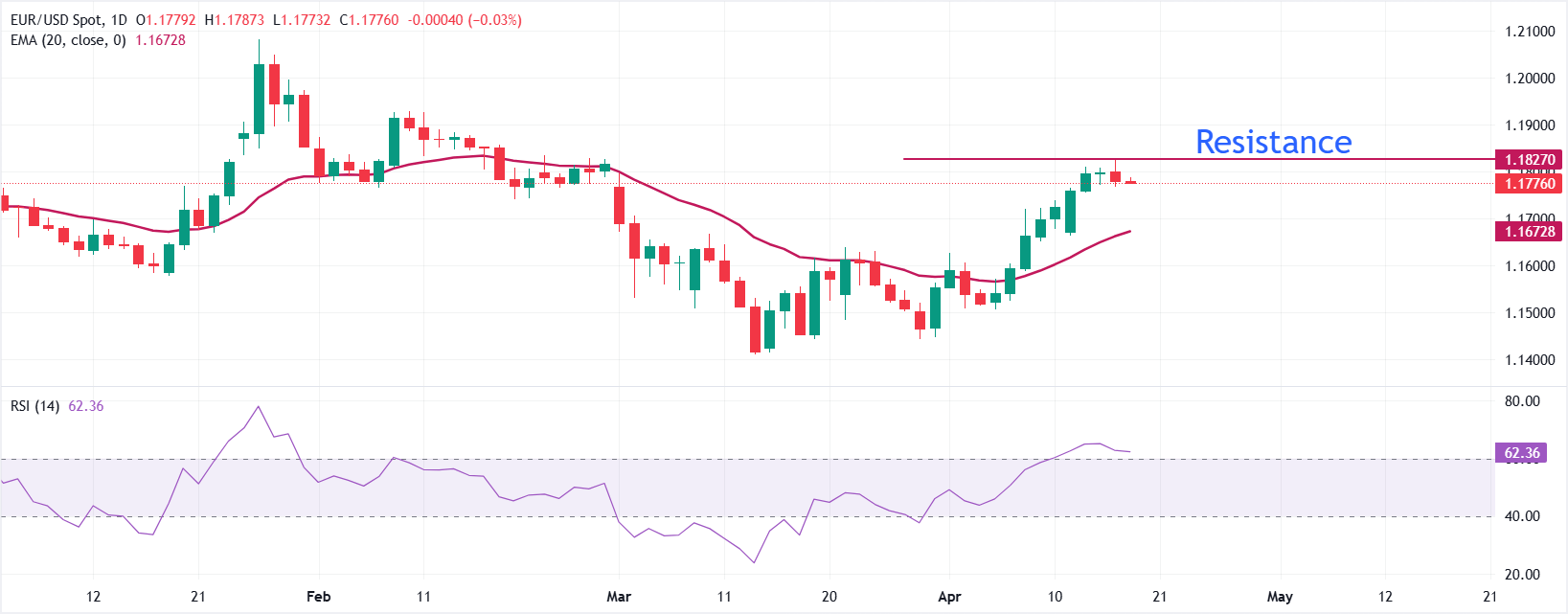
EUR/USD trades flat at around 1.1777 in the Asian trade. The pair holds a constructive near-term bullish bias as spot remains above the 20-day exponential moving average (EMA) at 1.1673, keeping recent upside progress intact after rebounding from the mid-1.15s. Momentum conditions are supportive, with the 14-day Relative Strength Index hovering around 62, suggesting persistent buying interest without yet signaling extreme overbought conditions.
On the downside, initial support is defined by the 20-day EMA at 1.1673, where a break would weaken the current advance and expose a deeper pullback toward the recent mid-1.15 consolidation area. As long as buyers defend this dynamic floor, the path of least resistance remains higher, leaving the pair biased to probe above the April 16 high of 1.1825 and extend the recovery toward the February high of 1.1929.
(The technical analysis of this story was written with the help of an AI tool.)
Risk sentiment FAQs
In the world of financial jargon the two widely used terms “risk-on” and “risk off'' refer to the level of risk that investors are willing to stomach during the period referenced. In a “risk-on” market, investors are optimistic about the future and more willing to buy risky assets. In a “risk-off” market investors start to ‘play it safe’ because they are worried about the future, and therefore buy less risky assets that are more certain of bringing a return, even if it is relatively modest.
Typically, during periods of “risk-on”, stock markets will rise, most commodities – except Gold – will also gain in value, since they benefit from a positive growth outlook. The currencies of nations that are heavy commodity exporters strengthen because of increased demand, and Cryptocurrencies rise. In a “risk-off” market, Bonds go up – especially major government Bonds – Gold shines, and safe-haven currencies such as the Japanese Yen, Swiss Franc and US Dollar all benefit.
The Australian Dollar (AUD), the Canadian Dollar (CAD), the New Zealand Dollar (NZD) and minor FX like the Ruble (RUB) and the South African Rand (ZAR), all tend to rise in markets that are “risk-on”. This is because the economies of these currencies are heavily reliant on commodity exports for growth, and commodities tend to rise in price during risk-on periods. This is because investors foresee greater demand for raw materials in the future due to heightened economic activity.
The major currencies that tend to rise during periods of “risk-off” are the US Dollar (USD), the Japanese Yen (JPY) and the Swiss Franc (CHF). The US Dollar, because it is the world’s reserve currency, and because in times of crisis investors buy US government debt, which is seen as safe because the largest economy in the world is unlikely to default. The Yen, from increased demand for Japanese government bonds, because a high proportion are held by domestic investors who are unlikely to dump them – even in a crisis. The Swiss Franc, because strict Swiss banking laws offer investors enhanced capital protection.














