

Gold Price Forecast: XAU/USD bulls remain capped below $4,600
- Gold maintains its near-term bullish tone, but remains capped below $4,600.
- A moderate appetite for risk is weighing on the US Dollar on Monday.
- Rumours that Trump might be pondering the end of the War in Iran have hurt the safe-haven USD.
Gold (XAU/USD) maintains a moderate bullish tone on Tuesday, extending its recovery from last week’s lows near $4,100, yet with resistance at the $4,600 area, holding upside attempts for now.
The precious metal is drawing some support from the pullback on US Treasury yields following comments by the US Federal Reserve (Fed) Chairman, Jerome Powell, who cooled hopes about immediate interest rate hikes, affirming that inflationary pressures remain “well anchored” despite the higher energy prices.
Apart from that, a report by the Wall Street Journal released earlier on Tuesday suggested that US President Donald Trump would have told his aides that he is willing to end the war soon, even if the Strait of Hormuz remains closed. This news has provided some risk relief, allowing European equities to rally and leaving the US Dollar index (DXY) stalled below a key resistance level.

Technical Analysis: Gold's correction might reach the $5,000 area
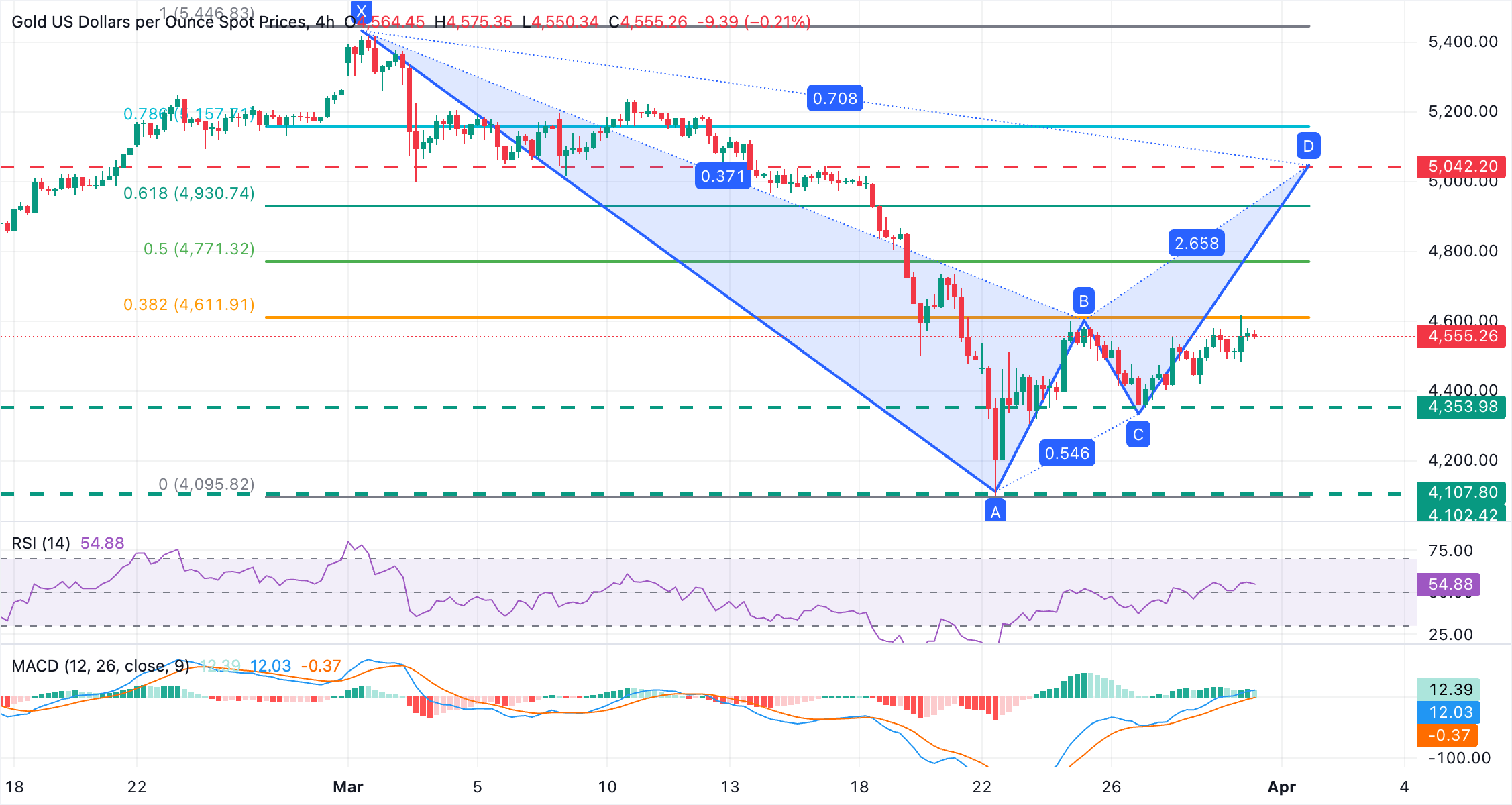
XAU/USD trades at $4,556.93 amid a modestly bullish near-term. The Relative Strength Index (RSI) in 4-hour charts hovers in the mid-50s, showing steady but not stretched upside momentum, while the Moving Average Convergence Divergence (MACD) holds in positive territory, suggesting buyers retain control even as momentum cools from earlier peaks.
Recent price action suggests that XAU/USD's downtrend might have hit a temporary bottom last week, with the higher low on Thursday pointing to a potential trend shift. Bearing this in mind, thw pair might be in the C-D leg of a Gartley pattern, targeting the $5,040 area, a previous support-turned-resistance on March 16 and 17. Before that, resistance is at the 38.2% Fibonacci retracement of the March sell-off, at the $4,600 area, and the March 20 high at the $4,735 area will challenge bulls.
A bearish reaction below the March 26 low, at $4,355, would cancel this view and bring the year-to-date low, at $4,100, back to the focus.
(The technical analysis of this story was written with the help of an AI tool.)
Gold FAQs
Gold has played a key role in human’s history as it has been widely used as a store of value and medium of exchange. Currently, apart from its shine and usage for jewelry, the precious metal is widely seen as a safe-haven asset, meaning that it is considered a good investment during turbulent times. Gold is also widely seen as a hedge against inflation and against depreciating currencies as it doesn’t rely on any specific issuer or government.
Central banks are the biggest Gold holders. In their aim to support their currencies in turbulent times, central banks tend to diversify their reserves and buy Gold to improve the perceived strength of the economy and the currency. High Gold reserves can be a source of trust for a country’s solvency. Central banks added 1,136 tonnes of Gold worth around $70 billion to their reserves in 2022, according to data from the World Gold Council. This is the highest yearly purchase since records began. Central banks from emerging economies such as China, India and Turkey are quickly increasing their Gold reserves.
Gold has an inverse correlation with the US Dollar and US Treasuries, which are both major reserve and safe-haven assets. When the Dollar depreciates, Gold tends to rise, enabling investors and central banks to diversify their assets in turbulent times. Gold is also inversely correlated with risk assets. A rally in the stock market tends to weaken Gold price, while sell-offs in riskier markets tend to favor the precious metal.
The price can move due to a wide range of factors. Geopolitical instability or fears of a deep recession can quickly make Gold price escalate due to its safe-haven status. As a yield-less asset, Gold tends to rise with lower interest rates, while higher cost of money usually weighs down on the yellow metal. Still, most moves depend on how the US Dollar (USD) behaves as the asset is priced in dollars (XAU/USD). A strong Dollar tends to keep the price of Gold controlled, whereas a weaker Dollar is likely to push Gold prices up.














