

Gold price rallies as Hormuz deal bets batter the US Dollar
- Hormuz reopening hopes drag WTI sharply below the $91 level.
- US Dollar weakness supports Gold despite firmer equity-market sentiment.
- Traders eye Core PCE, GDP and Fed speakers next.
Gold (XAU/USD) price edges up by over 1.30% on Monday amid thin trading due to the US Memorial Day holiday, yet sentiment remains positive as US equity futures are rising to new all-time highs, while the US Dollar dives. The XAU/USD pair trades at $4,570 after bouncing off daily lows of $4,519.

XAU/USD rises as a softer Dollar offsets thin holiday trading
Geopolitical headlines pushed the Greenback lower due to its positive correlation with Oil prices, with the US Dollar Index (DXY) down 0.32%. The DXY, which measures the performance of the American currency against six other currencies, dropped to near 99.00. The US crude Oil benchmark, WTI, is falling more than 6% to $91.00 per barrel, as US President Donald Trump said negotiations with Iran are “proceeding nicely.”
Negotiations between the US and Iran continued, and Nikkei reported that Iran would reopen the Strait of Hormuz, as Washington and Tehran reached a deal to extend a ceasefire for 60 days, pending approval from the Iranian Supreme Leader, Ayatollah Mojtaba Khamenei.
Under the deal, Iran would clear mines from the Strait of Hormuz within 30 days, restore passage for all ships, and end transit fees. Nuclear talks would resume during the 60-day ceasefire, while Washington would gradually ease sanctions on Iranian assets.
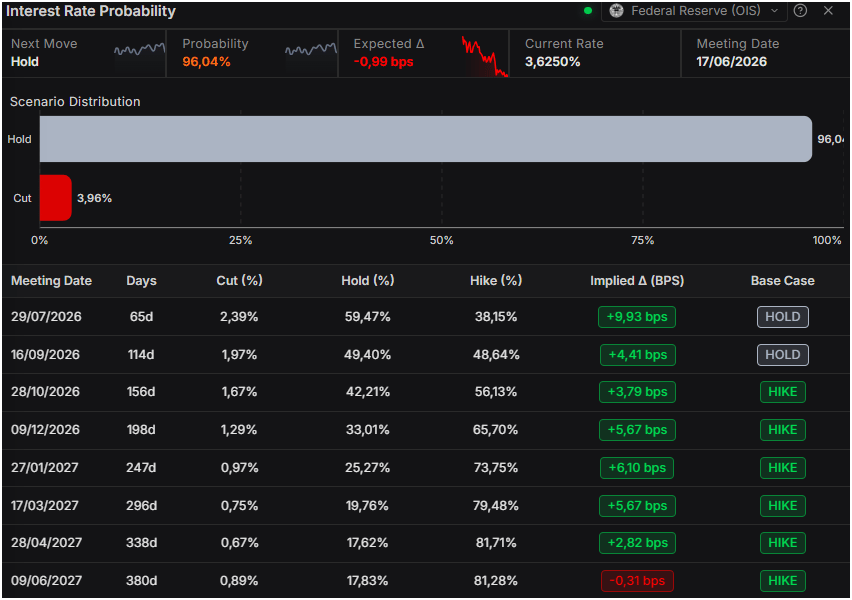
Recent headlines reduced the odds that the Federal Reserve (Fed) will raise rates in 2026, even though most board members said they’re leaning toward holding or raising rates amid inflationary pressures from the Middle East conflict.
The odds that the Fed will raise rates by December are at 50%, according to Prime Terminal data.
Last Friday, Fed Governor Christopher Waller said he does not support a rate change now but wants to remove the easing bias from the statement. He added that if inflation expectations move away from target, he “would not hesitate” to back a rate hike, calling rate-cut talk “crazy.”
This week, the US economic calendar highlights housing data, Durable Goods Orders, the second estimate of Q1 2026 GDP, jobs data, and the Fed’s preferred inflation measure, the Core Personal Consumption Expenditures (PCE) Price Index.
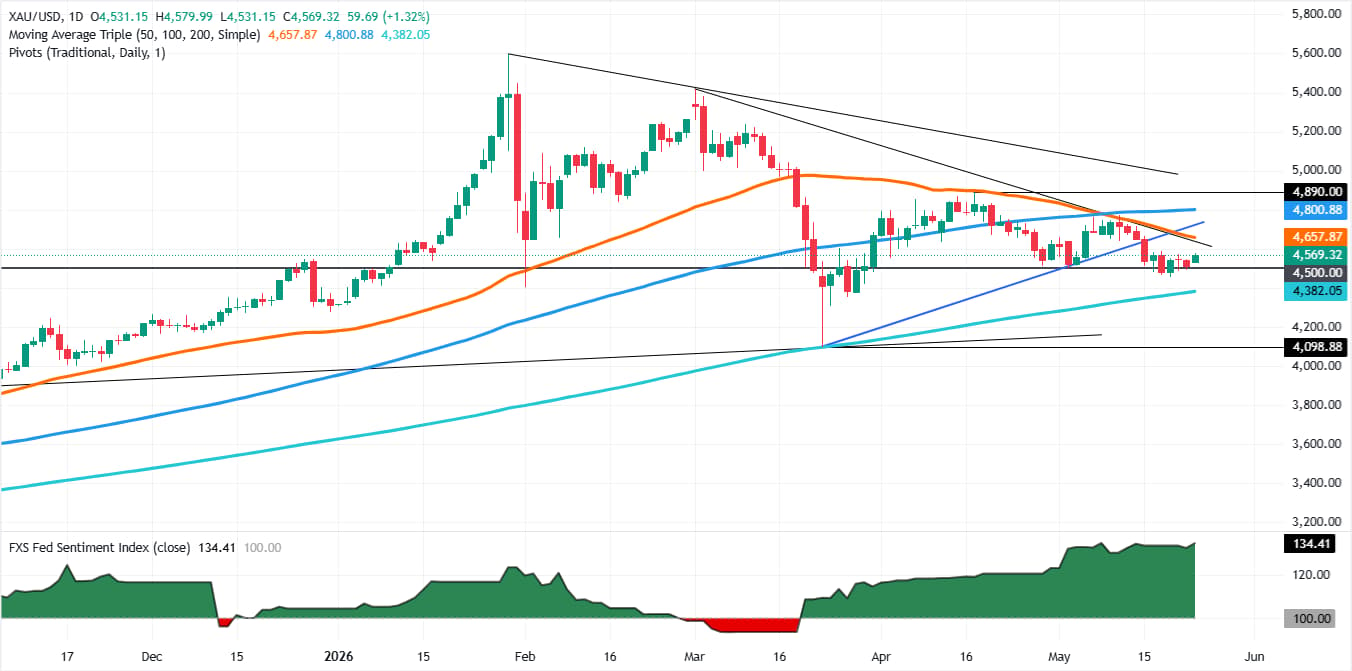
XAU/USD technical outlook: Gold tests higher prices, buyers eye $4,600
Gold appears to have found a floor near $4,450, clearing $4,500 and poised to challenge $4,600. The Relative Strength Index (RSI) remains bearish but is rising, indicating that buyers are gaining momentum.
If XAU/USD clears $4,600, the next stop would be the 20-day SMA at $4,603, followed by the 50-day SMA at $4,657. On further strength, the next stop would be the $4,700 mark.
Downwards, Gold’s first support is the $4,550 milestone. Once hurdled, the next stop would be the $4,500 mark, followed by the $4,450 psychological level. Below, the next key support levels are $4,400 and the 200-day SMA at $4,357.
Gold FAQs
Gold has played a key role in human’s history as it has been widely used as a store of value and medium of exchange. Currently, apart from its shine and usage for jewelry, the precious metal is widely seen as a safe-haven asset, meaning that it is considered a good investment during turbulent times. Gold is also widely seen as a hedge against inflation and against depreciating currencies as it doesn’t rely on any specific issuer or government.
Central banks are the biggest Gold holders. In their aim to support their currencies in turbulent times, central banks tend to diversify their reserves and buy Gold to improve the perceived strength of the economy and the currency. High Gold reserves can be a source of trust for a country’s solvency. Central banks added 1,136 tonnes of Gold worth around $70 billion to their reserves in 2022, according to data from the World Gold Council. This is the highest yearly purchase since records began. Central banks from emerging economies such as China, India and Turkey are quickly increasing their Gold reserves.
Gold has an inverse correlation with the US Dollar and US Treasuries, which are both major reserve and safe-haven assets. When the Dollar depreciates, Gold tends to rise, enabling investors and central banks to diversify their assets in turbulent times. Gold is also inversely correlated with risk assets. A rally in the stock market tends to weaken Gold price, while sell-offs in riskier markets tend to favor the precious metal.
The price can move due to a wide range of factors. Geopolitical instability or fears of a deep recession can quickly make Gold price escalate due to its safe-haven status. As a yield-less asset, Gold tends to rise with lower interest rates, while higher cost of money usually weighs down on the yellow metal. Still, most moves depend on how the US Dollar (USD) behaves as the asset is priced in dollars (XAU/USD). A strong Dollar tends to keep the price of Gold controlled, whereas a weaker Dollar is likely to push Gold prices up.














