

Indian Rupee holds onto gains on intensified US-Iran deal optimism
- The Indian Rupee trades firmly against the US Dollar at around 96.20 on firm hopes of the US-Iran deal.
- Iran remains adamant on holding uranium stockpiles and authority over the Strait of Hormuz.
- FIIs could continue paring stake in the Indian stock market due to the lack of AI-related stocks.
The Indian Rupee (INR) clings to Thursday’s gains against the US Dollar (USD) in the opening session on Friday. The USD/INR pair trades with caution near 96.20 as weakness in oil prices due to intensified optimism that the United States (US) and Iran will reach a deal soon has strengthened the Indian Rupee.

As of writing, the WTI Oil price trades 0.7% lower at around $96.27, closer to its weekly low of $94.94 posted on Thursday.
Currencies from economies, such as India, which rely heavily on oil imports to meet their energy needs, attract bids following a sharp correction in oil prices.
US-Iran prepare final draft of deal
On Thursday, the Iranian Labour News Agency (ILNA) reported that a final draft between Washington and Tehran has been reached with mediation from Pakistan, and a deal can be announced within the next few hours. These headlines led to a sharp recovery in riskier assets and weighed heavily on oil prices.
However, market participants are still concerned regarding whether a deal between the two sides will be reached, as Iran remained adamant about keeping the near-weapons-grade uranium stockpiles in Iran and the recognition of Tehran’s authority on the Strait of Hormuz.
US Secretary of State Marco Rubio has also confirmed that there had been "some good signs" in talks to end the Middle East war but differences remain over Tehran’s uranium stockpile and controls over the waterway.
FIIs emerge as net sellers for third day in a row
Overseas investors continue to dump their stakes in the Indian stock market amid concerns regarding India Inc.’s earnings projections, with oil prices still remaining elevated. On Thursday, Foreign Institutional Investors (FIIs) emerged as net sellers for the third straight trading day and offloaded their stake worth Rs. 1,891.21 crore.
Analysts at Bank of America (BofA) have stated that selling pressure from FIIs could continue till 2028, as foreign money is chasing Artificial Intelligence (AI)-linked plays elsewhere in Asia. The BofA has forecasted that India Inc.’s earnings growth could be about 8.5% in the current financial year, while markets in South Korea and Taiwan are projected to deliver stronger earnings growth.
US Dollar remains firm amid hawkish Fed bets
The US Dollar reflects broader strength even as oil prices have declined due to growing optimism on the US-Iran deal. At press time, the US Dollar Index (DXY), which gauges the Greenback’s value against six major currencies, ticks higher to near 99.25, not so far from its six-week high of 99.51.
The US Dollar remains broadly firm as traders are confident that the Federal Reserve (Fed) will not cut interest rates this year. According to the CME FedWatch tool, the odds of the Fed holding benchmark lending rates at their current levels or delivering at least one interest rate hike this year are 50.8% and 48.1%, respectively.
Technical Analysis: USD/INR corrects from all-time high of 97.00
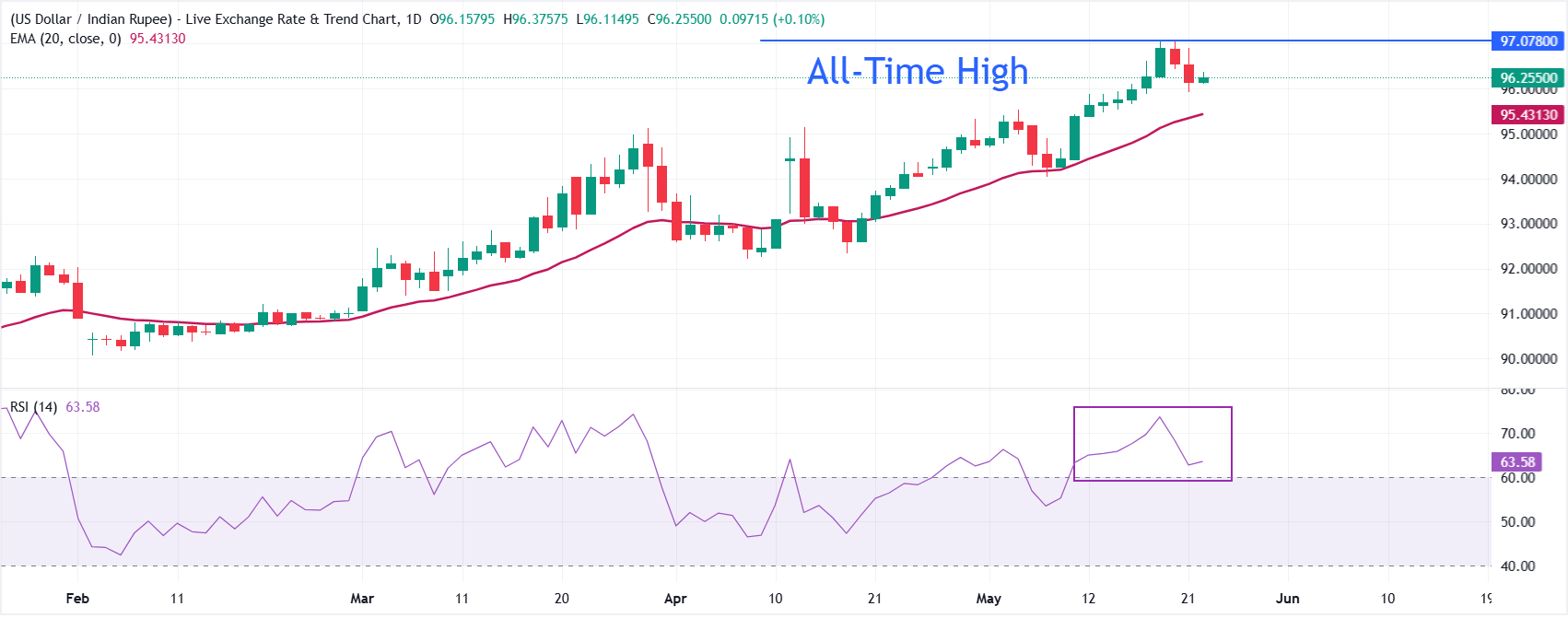
USD/INR trades cautiously at around 96.20 as of writing. However, the pair maintains a bullish near-term bias as it holds above the 20-day Exponential Moving Average (EMA) at 95.43, keeping the recent uptrend intact.
The 14-day Relative Strength Index cools down to 63.58 after turning overbought, suggesting buyers still have control, though upside momentum is not extreme.
On the downside, immediate support is seen at the 20-day EMA around 95.43, with the current spot level itself acting as a nearby pivot as long as daily closes remain above that moving average. A sustained break beneath the 20-day EMA would hint at a deeper corrective phase towards 95.00. Looking up, the pair could aim to test 98.00 if it manages a firm break above 97.00.
(The technical analysis of this story was written with the help of an AI tool.)
Indian Rupee FAQs
The Indian Rupee (INR) is one of the most sensitive currencies to external factors. The price of Crude Oil (the country is highly dependent on imported Oil), the value of the US Dollar – most trade is conducted in USD – and the level of foreign investment, are all influential. Direct intervention by the Reserve Bank of India (RBI) in FX markets to keep the exchange rate stable, as well as the level of interest rates set by the RBI, are further major influencing factors on the Rupee.
The Reserve Bank of India (RBI) actively intervenes in forex markets to maintain a stable exchange rate, to help facilitate trade. In addition, the RBI tries to maintain the inflation rate at its 4% target by adjusting interest rates. Higher interest rates usually strengthen the Rupee. This is due to the role of the ‘carry trade’ in which investors borrow in countries with lower interest rates so as to place their money in countries’ offering relatively higher interest rates and profit from the difference.
Macroeconomic factors that influence the value of the Rupee include inflation, interest rates, the economic growth rate (GDP), the balance of trade, and inflows from foreign investment. A higher growth rate can lead to more overseas investment, pushing up demand for the Rupee. A less negative balance of trade will eventually lead to a stronger Rupee. Higher interest rates, especially real rates (interest rates less inflation) are also positive for the Rupee. A risk-on environment can lead to greater inflows of Foreign Direct and Indirect Investment (FDI and FII), which also benefit the Rupee.
Higher inflation, particularly, if it is comparatively higher than India’s peers, is generally negative for the currency as it reflects devaluation through oversupply. Inflation also increases the cost of exports, leading to more Rupees being sold to purchase foreign imports, which is Rupee-negative. At the same time, higher inflation usually leads to the Reserve Bank of India (RBI) raising interest rates and this can be positive for the Rupee, due to increased demand from international investors. The opposite effect is true of lower inflation.













