

LayerZero Price Forecast: ZRO extends decline as network links KelpDAO’s $290M hack to Lazarus Group
- LayerZero slips to $1.630 amid bearish momentum indicators, with the MACD maintaining a sell signal.
- LayerZero attributes the KelpDAO’s $290 million exploit to the Lazarus Group.
- LayerZero confirmed that the exploit incident is limited to the KelpDAO rsETH configuration and has not spread to other assets or applications.
LayerZero (ZRO) is grinding lower, trading at $1.630 at the time of writing on Tuesday, weighed down by a dominant risk-off mood following KelpDAO’s exploit on Saturday. The path of least resistance points downward, as momentum indicators signal a strong bearish grip. Meanwhile, immediate support lies in the $1.400–$1.600 range, where traders could re-enter with new positions.

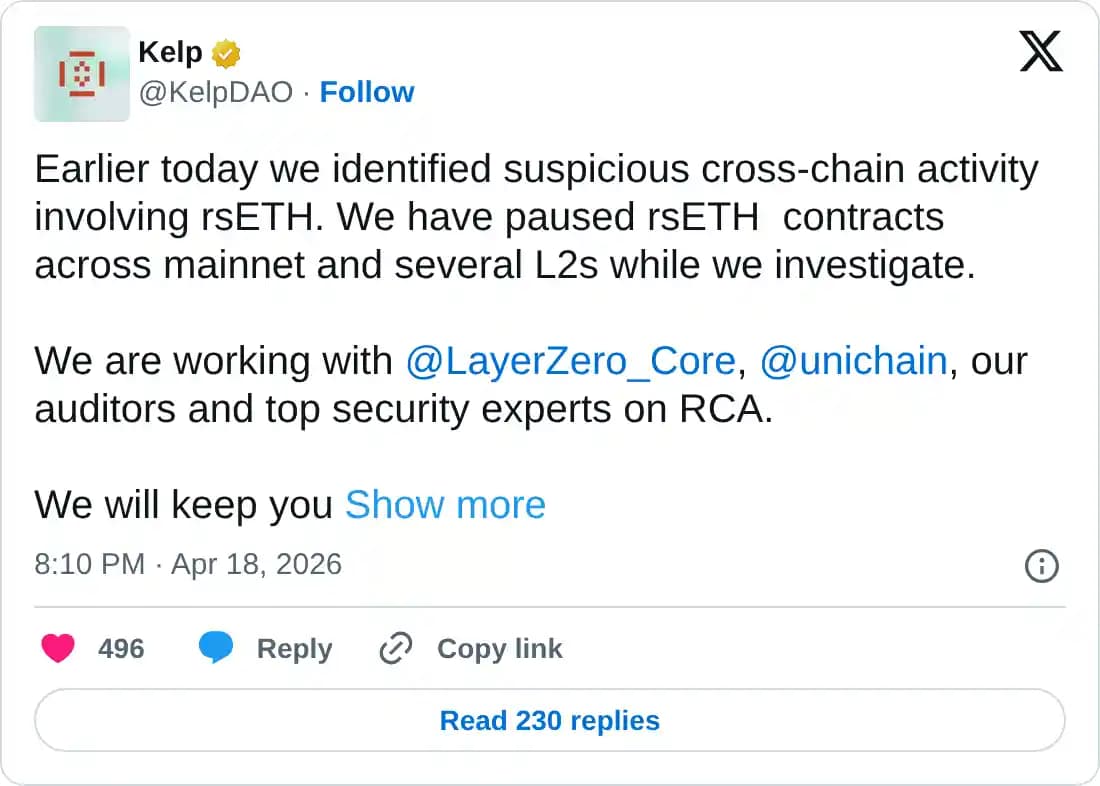
LayerZero attributes KelpDAO’s $290M to the Lazarus Group
KelpDAO, a liquid restaking protocol backed by YZi Labs, was exploited on Saturday, resulting in a $290 million loss. KelpDAO said in a statement published on Monday that “rsETH was drained from the rsETH bridging adapter through a forged cross-chain message,” after the hackers compromised two Remote Procedure Call (RPC) nodes hosted by LayerZero.
“A simultaneous DDoS attack was launched against the third RPC node. This was an attack on LayerZero's infrastructure. Kelp's own systems were not involved in building or operating that infrastructure,” Kelp explained.
In response, Kelp paused relevant smart contracts on the Ethereum (ETH) mainnet and Layer2s (L2s), as well as blacklisted all the wallets associated with the hacker. The team also stopped another exploit attempt targeting 40,000 rsETH, worth approximately $95 million.
In a statement issued on Monday, LayerZero attributed the $290 million exploitation to the infamous Lazarus Group. The protocol added that the incident was isolated to KelpDAO’s rsETH configuration and that there was zero contagion to other assets or applications in the ecosystem.
“The affected application was rsETH, issued by KelpDAO. Their OApp configuration at the time of this incident relied on a 1-of-1 DVN setup, with LayerZero Labs as the sole verifier – a configuration that directly contradicts the multi-DVN redundancy model that LayerZero has consistently recommended to all integration partners,” LayerZero added.
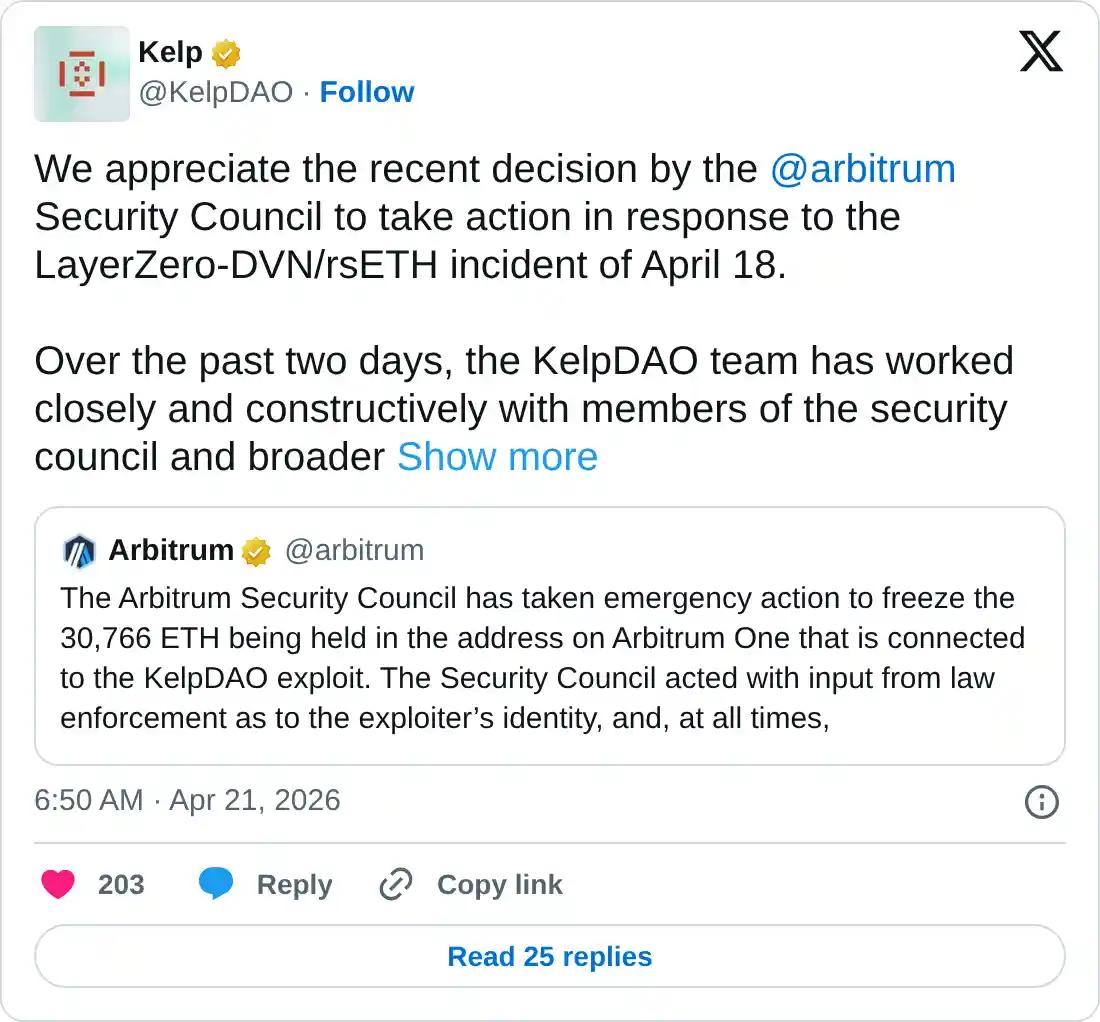
Notably, the Arbitrum Security Council moved swiftly and froze 30,766 ETH, worth around $71, that the hacker was holding on the Arbitrum One platform, addresses connected to the KelpDAO exploit.
Technical outlook: LayerZero under pressure as technicals weaken
LayerZero trades at $1.630, extending a bearish bias as price holds well beneath the key exponential moving averages (EMAs). The 100-day EMA at $1.850, the 200-day EMA at $1.861 and the 50-day EMA at $1.900 are all clustered overhead , while a broader downward resistance trendline drawn from the March 18 high at $2.40 reinforces the perception of a market trading within a corrective phase.
Momentum indicators echo this soft tone, with the Relative Strength Index (RSI) hovering around 37 on the daily chart and the Moving Average Convergence Divergence (MACD) negative histogram, hinting that selling pressure still dominates despite the recent stabilization above $1.60.
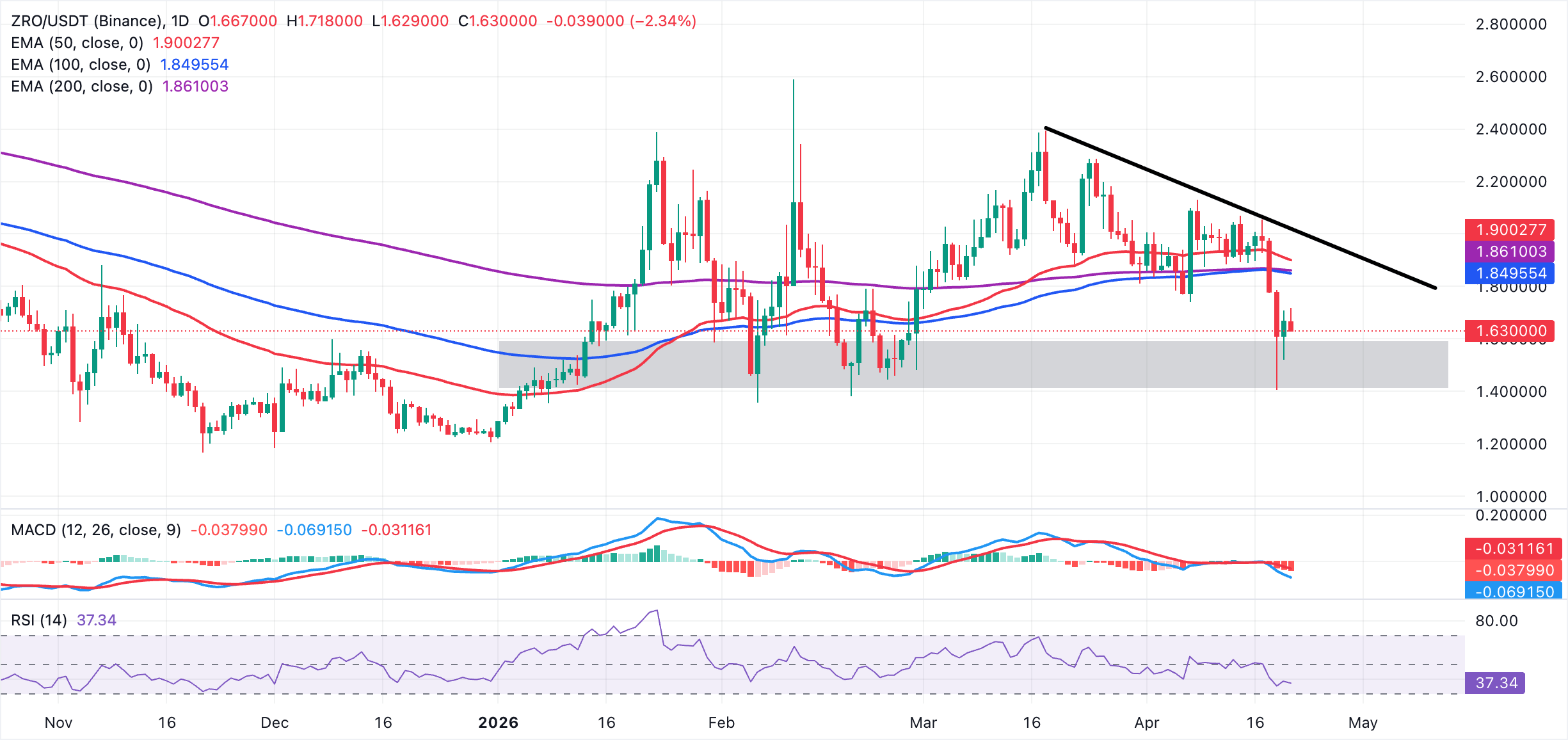
On the topside, initial resistance lies at the 100-day EMA around $1.850, followed closely by the 200-day EMA at $1.861, forming a dense supply cluster that bulls would need to reclaim to ease downside pressure. A sustained break above that area would expose the 50-day EMA at $1.900, ahead of the broader descending trend line that continues to cap the larger recovery attempts. In the absence of clearly defined support levels, the grey-marked region on the chart between $1.400 and $1.600 is in line to absorb selling pressure.
Ethereum FAQs
Ethereum is a decentralized open-source blockchain with smart contracts functionality. Its native currency Ether (ETH), is the second-largest cryptocurrency and number one altcoin by market capitalization. The Ethereum network is tailored for building crypto solutions like decentralized finance (DeFi), GameFi, non-fungible tokens (NFTs), decentralized autonomous organizations (DAOs), etc.
Ethereum is a public decentralized blockchain technology, where developers can build and deploy applications that function without the need for a central authority. To make this easier, the network leverages the Solidity programming language and Ethereum virtual machine which helps developers create and launch applications with smart contract functionality.
Smart contracts are publicly verifiable codes that automates agreements between two or more parties. Basically, these codes self-execute encoded actions when predetermined conditions are met.
Staking is a process of earning yield on your idle crypto assets by locking them in a crypto protocol for a specified duration as a means of contributing to its security. Ethereum transitioned from a Proof-of-Work (PoW) to a Proof-of-Stake (PoS) consensus mechanism on September 15, 2022, in an event christened “The Merge.” The Merge was a key part of Ethereum's roadmap to achieve high-level scalability, decentralization and security while remaining sustainable. Unlike PoW, which requires the use of expensive hardware, PoS reduces the barrier of entry for validators by leveraging the use of crypto tokens as the core foundation of its consensus process.
Gas is the unit for measuring transaction fees that users pay for conducting transactions on Ethereum. During periods of network congestion, gas can be extremely high, causing validators to prioritize transactions based on their fees.
(The technical analysis of this story was written with the help of an AI tool.)














