

Trump's Iran ceasefire about-face: did Tehran snub the peace talks first?
- Trump extended the Iran ceasefire via Truth Social on Tuesday, reversing earlier comments that he opposed any rollover.
- Iran had not confirmed attendance at Pakistan-brokered talks due Wednesday in Islamabad, with Tasnim reporting Tehran told US negotiators it would not attend.
- The US naval blockade of Iranian ports stays in force, Iran's closure of the Strait of Hormuz has not been lifted, and the nuclear enrichment impasse remains unresolved.
Donald Trump told CNBC's Squawk Box early Tuesday that he didn't want to extend the truce, warning Iran that time was running out. By Tuesday afternoon, the message had flipped. Citing a "seriously fractured" Iranian government and a request from Pakistan PM Shehbaz Sharif and Field Marshal Asim Munir, Trump said attacks would be held off until Tehran submits a "unified proposal" to end the war. No new deadline attached, no new leverage created. Special envoy Steve Witkoff and Jared Kushner were called back to Washington for consultations as Vice President JD Vance's scheduled trip to Islamabad was iced. Even the expiry itself is disputed: Trump says Wednesday evening Washington time, Pakistan says it already lapsed late Tuesday GMT.
Tehran's empty chair, and two Irans at the table
The pivot lines up neatly with events in Islamabad. Vance's trip for a second round of talks was put on hold after Iran failed to confirm a delegation. Semi-official Tasnim reported Tehran had informed US negotiators it would not attend while the blockade remained. Foreign Minister Abbas Araghchi called the naval siege an "act of war" and said Iran would not negotiate under the shadow of threat. But the fracture Trump flagged is real. Civilian leaders including Araghchi and parliamentary speaker Mohammad Bagher Ghalibaf favour continued talks. Islamic Revolutionary Guard Corps (IRGC) commander Gen. Ahmad Vahidi and his deputies oppose any concessions while US warships sit off Iranian ports. The recent US seizure of an Iranian cargo ship in the Arabian Sea, which Tehran's UN ambassador formally protested as a material breach of the ceasefire, has widened that split further.
A gift from China and the nuclear dust
Trump also disclosed that US forces intercepted a Chinese vessel carrying weapons he sarcastically called a "gift" to Iran, despite what he said was a prior understanding with President Xi Jinping that Beijing would not resupply Tehran during the ceasefire. That adds a second escalation vector just as the uranium question hardens. Tehran insists on its right to domestic enrichment for civilian purposes; Washington wants the enriched stockpile removed outright. Trump himself concedes that digging it out will be long and difficult, which is another way of saying the core sticking point isn't close to resolution.
What markets are watching
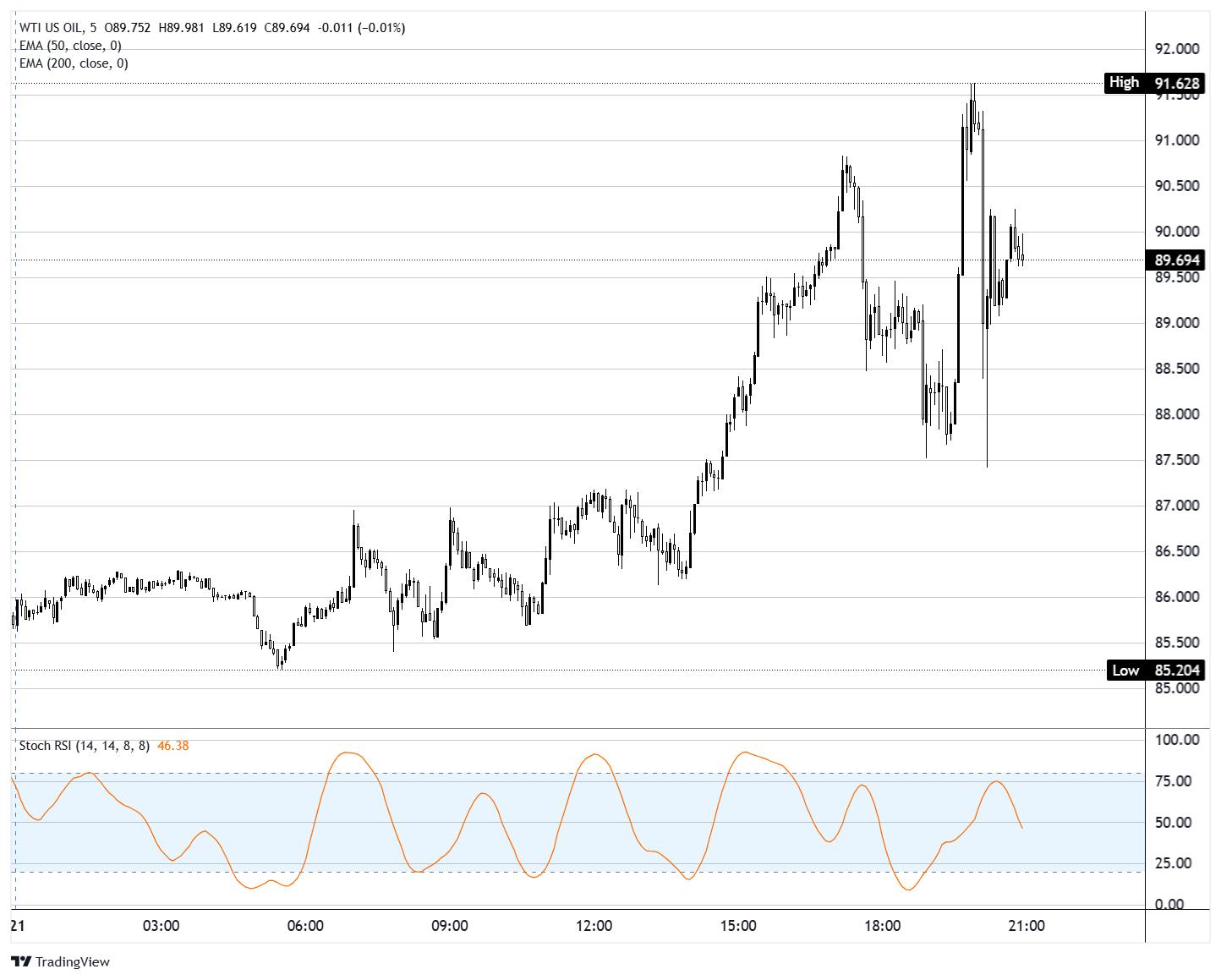
Oil has already priced the Hormuz disruption, but an open-ended ceasefire with no movement on the blockade leaves the tail risk intact. The US Dollar has drawn haven flows on every rhetorical escalation, and rate-cut pricing has drifted as energy-driven inflation concerns creep back into Federal Reserve (Fed) expectations. An extension that resolves nothing is not priced as peace, just as a delay. An adviser to Iran's parliament speaker has already labeled the move a ploy to buy time for a surprise strike.
Whose clock is really running now?
Trump bought time he said he didn't want to give; Iran bought time it didn't have to ask for. The blockade meant to serve as leverage has instead become Tehran's pretext for staying home, while IRGC hardliners get breathing room to reposition and replenish, and civilian negotiators lose whatever mandate they were clinging to. Every tanker probing the Strait, every vessel the US Navy intercepts, every drone that drifts off course is now a potential trigger with no deadline to funnel the pressure toward a deal. The ceasefire technically holds.
Whether either side actually wants it to hold is the real question markets should be pricing.
WTI Crude Oil 5-minute chart
WTI Oil FAQs
WTI Oil is a type of Crude Oil sold on international markets. The WTI stands for West Texas Intermediate, one of three major types including Brent and Dubai Crude. WTI is also referred to as “light” and “sweet” because of its relatively low gravity and sulfur content respectively. It is considered a high quality Oil that is easily refined. It is sourced in the United States and distributed via the Cushing hub, which is considered “The Pipeline Crossroads of the World”. It is a benchmark for the Oil market and WTI price is frequently quoted in the media.
Like all assets, supply and demand are the key drivers of WTI Oil price. As such, global growth can be a driver of increased demand and vice versa for weak global growth. Political instability, wars, and sanctions can disrupt supply and impact prices. The decisions of OPEC, a group of major Oil-producing countries, is another key driver of price. The value of the US Dollar influences the price of WTI Crude Oil, since Oil is predominantly traded in US Dollars, thus a weaker US Dollar can make Oil more affordable and vice versa.
The weekly Oil inventory reports published by the American Petroleum Institute (API) and the Energy Information Agency (EIA) impact the price of WTI Oil. Changes in inventories reflect fluctuating supply and demand. If the data shows a drop in inventories it can indicate increased demand, pushing up Oil price. Higher inventories can reflect increased supply, pushing down prices. API’s report is published every Tuesday and EIA’s the day after. Their results are usually similar, falling within 1% of each other 75% of the time. The EIA data is considered more reliable, since it is a government agency.
OPEC (Organization of the Petroleum Exporting Countries) is a group of 12 Oil-producing nations who collectively decide production quotas for member countries at twice-yearly meetings. Their decisions often impact WTI Oil prices. When OPEC decides to lower quotas, it can tighten supply, pushing up Oil prices. When OPEC increases production, it has the opposite effect. OPEC+ refers to an expanded group that includes ten extra non-OPEC members, the most notable of which is Russia.













