

UK CPI set to show sticky inflation in February as markets price a BoE rate hike
- The UK’s ONR Office publishes the February CPI data on Wednesday.
- The UK headline inflation is expected to remain well above target.
- Core inflation is also seen running hot, likely at 3.1% YoY.
The UK Office for National Statistics (ONS) will release the February Consumer Price Index (CPI) figures on Wednesday at 07:00 GMT, a print that will matter for markets. Consensus expectations point to inflation pressures keeping their grasp on the economy.
UK consumer inflation remains one of the most important inputs for the Bank of England (BoE) and typically carries real weight for the British Pound (GBP). Following the latest hawkish hold by the BoE on March 19, investors now anticipated the ‘Old Lady’ to hike its policy rate at its April 30 gathering.

What to expect from the next UK inflation report?
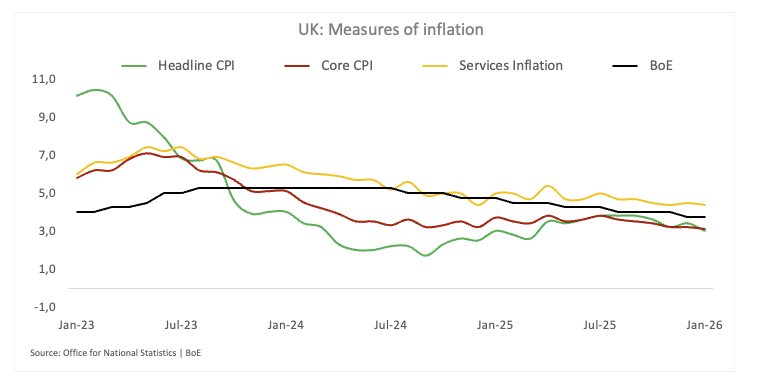
Headline UK CPI is expected to rise 3% in the year to February, matching the January reading. On a monthly basis, inflation is seen gaining 0.4%, reversing the 0.5% contraction recorded the previous month.
Core inflation, which strips out the more volatile food and energy components and is therefore more closely watched by the BoE, is forecast to have gained 3.1% on an annual basis. From a month earlier, core CPI is expected to have accelerated to 0.5%, after declining by 0.6% at the beginning of the year.
How will the UK CPI data affect GBP/USD?
The BoE’s rate-setting MPC voted unanimously to keep the bank rate at 3.75% last week, its second consecutive hold since it slashed rates by 25 basis points in December.
At its latest meeting, the BoE maintained its interest rates at 3.75%, but the event revealed a more hawkish stance than anticipated. The 9-0 decision, a sign of agreement, highlighted worries about inflation stemming from climbing energy costs. The Consumer Price Index is expected to hover around 3% in the second quarter and 3.5% in the third.
Governor Andrew Bailey noted that there has been an immediate rise in petrol prices and warned that household energy costs will increase if these trends continue. The Monetary Policy Committee (MPC) emphasised awareness of second-round effects, cautioning that prolonged energy shocks might necessitate stricter monetary policy, while acknowledging that weak growth could alleviate medium-term inflationary pressures.
Implied rates currently suggest a little more than 67 basis points of tightening will occur this year, while consensus sees the central bank increasing its policy rate by a quarter point at its next gathering.
Back to technicals, Senior Analyst at FXStreet, Pablo Piovano, notes that GBP/USD appears to have encountered some contention at its current yearly lows near 1.3200 (March 13). “Further weakness from here could expose a move toward the November 2025 base at 1.3010 (November 5),” Piovano adds.
“In case bulls regain the upper hand, there is interim resistance at the 55-day SMA at 1.3495, ahead of the weekly top at 1.3574 (February 26) and the YTD ceiling at 1.3868 (January 27),” he concludes.
Piovano also points out that momentum indicators remain bearish for now, as the Relative Strength Index (RSI) eases below the 47 level and the Average Directional Index (ADX) near 30 suggests quite a strong trend.
Interest rates FAQs
Interest rates are charged by financial institutions on loans to borrowers and are paid as interest to savers and depositors. They are influenced by base lending rates, which are set by central banks in response to changes in the economy. Central banks normally have a mandate to ensure price stability, which in most cases means targeting a core inflation rate of around 2%. If inflation falls below target the central bank may cut base lending rates, with a view to stimulating lending and boosting the economy. If inflation rises substantially above 2% it normally results in the central bank raising base lending rates in an attempt to lower inflation.
Higher interest rates generally help strengthen a country’s currency as they make it a more attractive place for global investors to park their money.
Higher interest rates overall weigh on the price of Gold because they increase the opportunity cost of holding Gold instead of investing in an interest-bearing asset or placing cash in the bank. If interest rates are high that usually pushes up the price of the US Dollar (USD), and since Gold is priced in Dollars, this has the effect of lowering the price of Gold.
The Fed funds rate is the overnight rate at which US banks lend to each other. It is the oft-quoted headline rate set by the Federal Reserve at its FOMC meetings. It is set as a range, for example 4.75%-5.00%, though the upper limit (in that case 5.00%) is the quoted figure. Market expectations for future Fed funds rate are tracked by the CME FedWatch tool, which shapes how many financial markets behave in anticipation of future Federal Reserve monetary policy decisions.
Economic Indicator
Core Consumer Price Index (YoY)
The United Kingdom (UK) Core Consumer Price Index (CPI), released by the Office for National Statistics on a monthly basis, is a measure of consumer price inflation – the rate at which the prices of goods and services bought by households rise or fall – produced to international standards. The YoY reading compares prices in the reference month to a year earlier. Core CPI excludes the volatile components of food, energy, alcohol and tobacco. The Core CPI is a key indicator to measure inflation and changes in purchasing trends. Generally, a high reading is seen as bullish for the Pound Sterling (GBP), while a low reading is seen as bearish.
Read more.Last release: Wed Feb 18, 2026 07:00
Frequency: Monthly
Actual: 3.1%
Consensus: 3.1%
Previous: 3.2%
Source: Office for National Statistics
The Bank of England is tasked with keeping inflation, as measured by the headline Consumer Price Index (CPI) at around 2%, giving the monthly release its importance. An increase in inflation implies a quicker and sooner increase of interest rates or the reduction of bond-buying by the BOE, which means squeezing the supply of pounds. Conversely, a drop in the pace of price rises indicates looser monetary policy. A higher-than-expected result tends to be GBP bullish.














