

Trade The World
AUD/USD holds steady as mixed US data keeps traders cautious
Von Vishal Chaturvedi
Veröffentlichungsdatum: 25 Oct 2025 | Änderungsdatum: 25 Oct 2025


POPULAR ARTICLES

The Australian Dollar (AUD) is virtually unchanged against the US Dollar (USD) on Friday after volatile two-way price action driven by a mix of US macro data.
- AUD/USD trades flat near 0.6510 after volatile swings driven by US data releases.
- Softer US CPI briefly lifted the Aussie before gains faded on stronger US PMI figures.
- Technically, AUD/USD consolidates below key moving averages, with support at 0.6480 and resistance near 0.6560.
The Australian Dollar (AUD) is virtually unchanged against the US Dollar (USD) on Friday after volatile two-way price action driven by a mix of US macro data. At the time of writing, AUD/USD trades around 0.6511, holding steady after earlier swings following the release of the US Consumer Price Index (CPI) and S&P Global Purchasing Managers Index (PMI) reports.
The Greenback briefly came under pressure after softer-than-expected inflation data lifted the Aussie earlier in the session. However, the momentum faded as the USD recovered following stronger business activity readings, which underscored ongoing resilience in the US economy. The US Dollar Index (DXY), which tracks the Greenback against a basket of six major currencies, hovers around 99.00, holding modest gains of about 0.4% for the week so far.
Data from the US Bureau of Labor Statistics (BLS) showed that the Consumer Price Index (CPI) rose 0.3% month-on-month in September, missing the 0.4% forecast and easing from August’s 0.4%. On a yearly basis, headline inflation rose 3.0%, below the 3.1% forecast and slightly above 2.9% in August. The Core CPI, which excludes food and energy, rose 0.2% MoM and 3.0% YoY, both softer than expected.
The data reinforced expectations that the Federal Reserve (Fed) will maintain its easing trajectory after September’s rate cut, with markets fully pricing another 25-basis-point reduction at the October 29-30 monetary policy meeting.
Meanwhile, the S&P Global Flash Composite PMI rose to 54.8 in October from 53.9 in September, marking the strongest private-sector expansion in three months. The Services PMI jumped to 55.2, while the Manufacturing PMI edged up to 52.2.
However, not all indicators pointed to strength. The University of Michigan (UoM) survey painted a weaker picture of household confidence. The Consumer Sentiment Index was revised down to 53.6 in October’s final reading from 55.0 initially, while the Consumer Expectations Index slipped to 50.3 from 51.2. Inflation expectations were mixed, with the 1-year outlook steady at 4.6% and the 5-year measure rising to 3.9% from 3.7%.
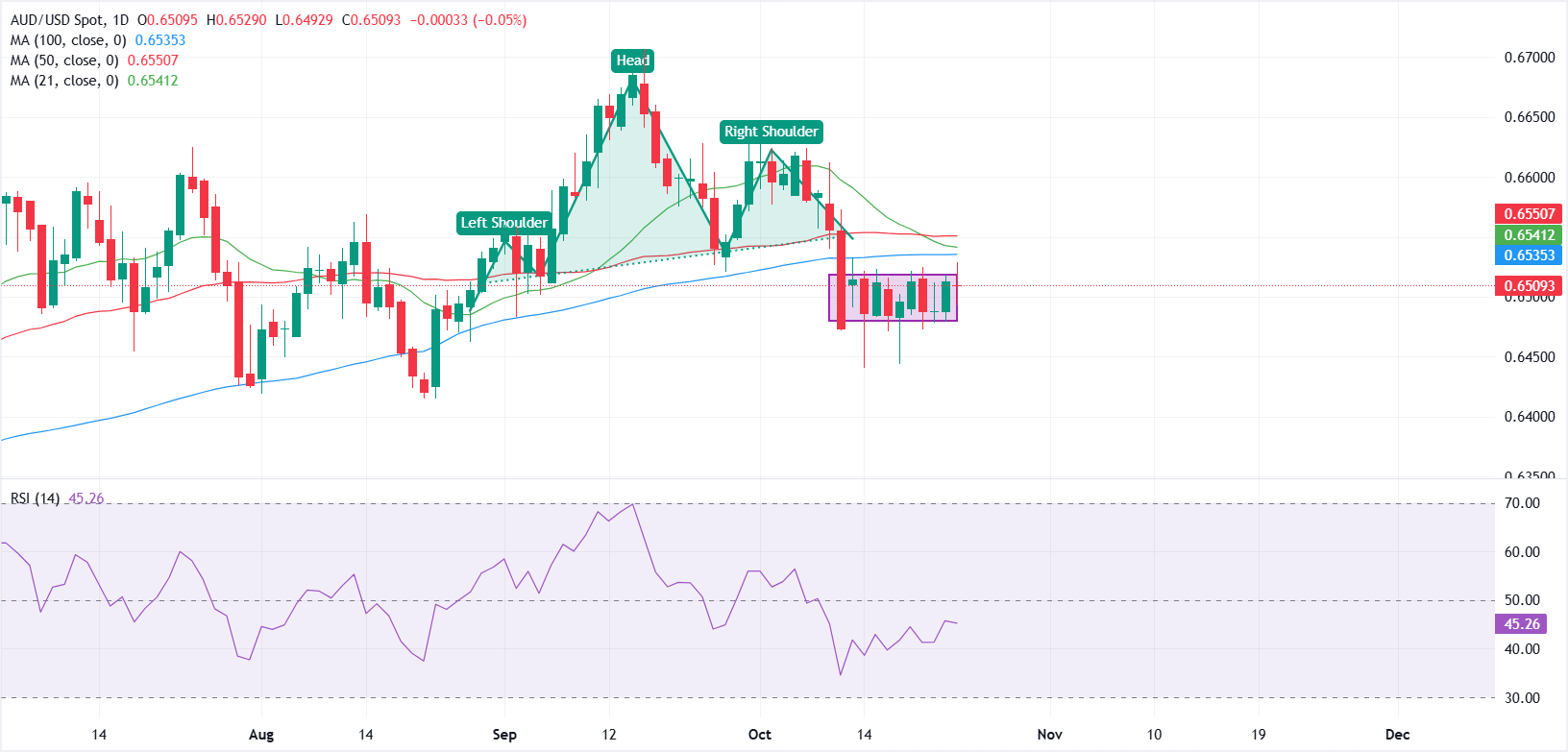
From a technical view, AUD/USD is moving sideways in a tight 0.6480–0.6520 range after a recent Head-and-Shoulders breakdown on the daily chart. The pair trades below the 21-day, 50-day, and 100-day moving averages, showing a slight bearish tilt. The RSI near 45 reflects a neutral tone, indicating that momentum remains balanced between buyers and sellers.
On the downside, immediate support lies at 0.6480, and a break below this area could pave the way toward 0.6450, followed by the August 22 low near 0.6415. On the upside, resistance is seen around 0.6535, and a daily close above 0.6560 could neutralize the bearish setup, opening the door toward 0.6600 in the near term.
Economic Indicator
RBA Trimmed Mean CPI (YoY)
The Consumer Price Index (CPI), released by the Australian Bureau of Statistics on a quarterly basis, measures the changes in the price of a fixed basket of goods and services acquired by household consumers The YoY reading compares prices in the reference quarter to the same quarter a year earlier. The trimmed mean, which is a measure of underlying inflation, is calculated as the weighted average of the central 70% of the quarterly price change distribution of all CPI components in order to smooth the data from the more-volatile components.Generally, a high reading is seen as bullish for the Australian Dollar (AUD), while a low reading is seen as bearish.
Read more.Next release: Wed Oct 29, 2025 00:30
Frequency: Quarterly
Consensus: -
Previous: 2.7%
Source: Australian Bureau of Statistics
The quarterly Consumer Price Index (CPI) published by the Australian Bureau of Statistics (ABS) has a significant impact on the market and the AUD valuation. The gauge is closely watched by the Reserve Bank of Australia (RBA), in order to achieve its inflation mandate, which has major monetary policy implications. Rising consumer prices tend to be AUD bullish, as the RBA could hike interest rates to maintain its inflation target. The data is released nearly 25 days after the quarter ends.

FXStreet
Über eine Million Nutzer verlassen sich auf FXStreet für Echtzeit-Marktdaten, Charting-Tools, Experteneinblicke und Forex-News. Der umfassende Wirtschaftskalender und die Bildungs-Webinare helfen Tradern, informiert zu bleiben und fundierte Entscheidungen zu treffen. FXStreet wird von einem Team von rund 60 Fachleuten getragen, verteilt auf den Hauptsitz in Barcelona und verschiedene Regionen weltweit.
Read More








