[TMGM Financial Breakfast] Gold Pulls Back After U.S. CPI Data — Safe-Haven Demand Weakening or Building Momentum?
The most significant macro catalyst of the day was the release of the U.S. April Consumer Price Index (CPI). Headline inflation came in at 3.8% year-on-year, above the market expectation of 3.7%, reinforcing concerns that inflation remains stubbornly persistent. The surprise was not only in the headline figure itself, but also in the underlying structure of the data. Energy prices continue to feed through into consumer prices, while the pace of cooling in core inflation has yet to accelerate as markets had hoped.

Following the CPI release, expectations for Federal Reserve rate cuts this year narrowed further. Markets had previously anticipated two rate cuts in 2026, but consensus has increasingly fragmented, with some institutions now considering a no-rate-cut scenario as their baseline outlook. The fading rate-cut narrative implies that real interest rates could remain elevated for longer — a key factor in gold pricing. Tighter monetary conditions directly reduce the appeal of non-yielding assets such as gold, limiting bullish momentum at higher price levels.
At the same time, the U.S. dollar index strengthened alongside shifting rate expectations, while the 10-year U.S. Treasury yield held firm near 4.4%. For gold, the combination of a stronger dollar and elevated real yields has become the most significant short-term challenge.
On the geopolitical front, tensions between the United States and Iran continued to escalate. President Donald Trump rejected Iran’s latest response in nuclear negotiations, describing it as “completely unacceptable,” casting further doubt over the prospects for a ceasefire agreement. However, unlike traditional market behavior, the renewed geopolitical risks did not translate into stronger gains for gold. Instead, the primary transmission channel has been through rising oil prices, which continue to reinforce inflation expectations and support higher nominal interest rates.
Unless tensions surrounding the Strait of Hormuz ease meaningfully, elevated energy prices are likely to keep fueling inflation pressures. In turn, rising inflation expectations could continue to suppress gold’s safe-haven premium, creating a negative feedback loop that may prove difficult to break in the near term.
Despite short-term pressure, gold’s medium- and long-term bullish fundamentals remain largely intact, supported by strong structural demand. JPMorgan continues to maintain a highly bullish outlook on gold prices, forecasting that combined investor and central bank demand could average 585 tonnes per quarter throughout 2026 — a level of demand the bank believes could ultimately support gold prices rising toward US$5,000 per ounce.
From a demand perspective, central bank buying remains the strongest long-term support for the gold market. Over the past several years, gold has overtaken U.S. Treasuries as the world’s largest reserve asset for the first time. A 2025 survey showed that 95% of central banks expect global gold reserves to continue increasing into 2026. This structural demand is largely independent of short-term interest rate fluctuations and provides a durable floor for gold prices.
Market Outlook:
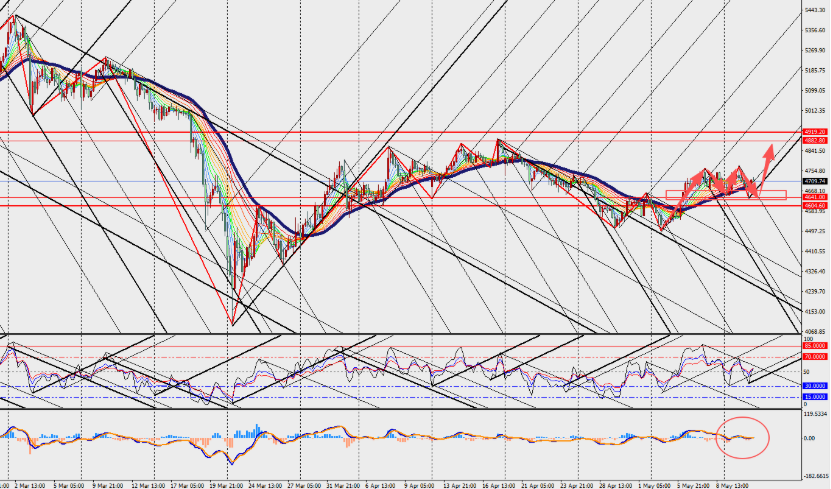
On the four-hour chart, gold remains in a volatile rebound pattern, with the MACD indicator showing bullish divergence below the zero line. Until there is greater clarity on interest rate expectations and geopolitical developments, gold is likely to remain trapped in a broad high-level trading range. Elevated interest rates and a strong U.S. dollar continue to cap upside momentum, while geopolitical risks and central bank buying provide downside support. A decisive directional trend may require a stronger catalyst to emerge.