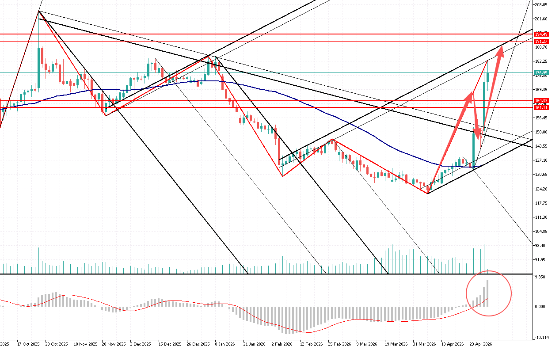
Qualcomm Shares Surge Over 15% After Earnings as Two Positive Signals Emerge
Qualcomm is navigating a challenging supply environment, but its progress in the data center market is encouraging. Last year, Qualcomm launched products competing with Nvidia’s data center chips, with its first customer being Humain, an AI startup backed by the Saudi government. Qualcomm stated that a leading hyperscale cloud operator is expected to begin adopting its chip products later this year, marking a key breakthrough in its entry into the data center market. The market sees this as an important step for Qualcomm to enter the AI infrastructure growth track currently dominated by Nvidia.

In addition to progress in its data center business, Qualcomm expects China’s smartphone industry to bottom out in the third quarter and resume quarter-on-quarter growth in the following quarter. China is one of Qualcomm’s largest markets, and this outlook is seen as a positive signal for improving prospects in its handset business. Previously, tight supply of memory chips driven by demand for AI PCs forced some Qualcomm customers to reduce smartphone production, which in turn suppressed demand for its chips. The market had been concerned that this pressure would continue to weigh on performance.
Financial results show that Qualcomm expects third fiscal quarter revenue (ending June) to be between $9.2 billion and $10.0 billion. Although the upper end of this guidance remains below the analyst consensus of $10.2 billion, the market is clearly focusing more on the recovery signals. The company expects adjusted earnings per share of $2.10 to $2.30, also below the market expectation of $2.38.
Qualcomm’s handset-related revenue reached $6.0 billion, broadly in line with expectations; IoT revenue was $1.73 billion; and automotive revenue came in at $1.33 billion. The market believes that the automotive and IoT segments continue to support its diversification strategy. To further boost investor confidence, Qualcomm also announced a share buyback program of up to $20 billion.
It is worth noting that Qualcomm’s stock had fallen about 8.5% year-to-date before the earnings release, making it one of the weakest performers among semiconductor stocks. The sharp after-hours rally is therefore seen as a response to valuation recovery.
Market Interpretation:
In recent years, Qualcomm has continued to reduce its reliance on the smartphone market while accelerating its expansion into automotive chips, IoT, and data center markets. However, it had not previously benefited from the data center boom. This time, management’s confirmation that a leading customer will adopt its chips is seen as an important step toward commercial validation.