

British Pound slips as Burnham fiscal pledge fails to lift Sterling
- Burnham pledges fiscal discipline, but finance-minister uncertainty lingers.
- WTI’s monthly surge keeps Fed rate-hike speculation alive.
- UK jobs, inflation and PMIs shape Sterling’s next catalyst.
The Pound Sterling reverses course and turns negative on the day as Andy Burnham is named the new Prime Minister and reassures that he will stick to the fiscal rules set by the former Chancellor, Rachel Reeves, who just resigned. The GBP/USD trades at 1.3425, after hitting a daily high of 1.3481.
GBP/USD slides as Burnham transition meets Oil-driven Fed risks

Sentiment turned upbeat, even though hostilities in the Middle East continued. Attacks between the US and Iran keep tensions high, keeping investors worried about a disruption in Oil supply, which the US crude oil benchmark, WTI so far up 21% in the month. This reignited speculation that the Federal Reserve could increase rates by 25 basis points towards the end of the year.
In the UK, the new PM, Andy Burnham, said he would not take risks with the economy, appealing to the previous government’s fiscal rules set by Reeves, who recently resigned. However, he reiterated that he would take measures to reduce the high cost of living.
In the meantime, market participants would remain aware of the naming of the new UK Finance Minister, though rumours point towards Shabana Mahmood, an interior minister, according to the Financial Times.
An absent economic docket on both sides of the Atlantic left traders adrift to developments in the Middle East. But in this week, the schedule in the UK will feature jobs and inflation data, Retail Sales and the release of Flash PMIs for July, on their preliminary readings.
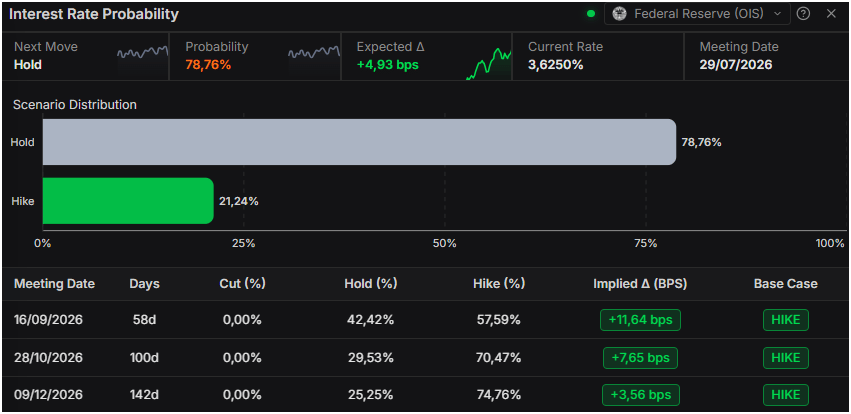
In the US, the Federal Reserve entered its blackout period ahead of the July 29 monetary policy meeting. So far, investors had priced in a 78% chance that the US central bank would hold rates unchanged, but odds for the October 28 meeting surpassed the 70% threshold for a 25-basis-point rate hike.
This week, the US economic docket will feature the release of jobs data. Initial Jobless Claims for the week ending July 18 are expected to rise from 208K to 212K.
GBP/USD Price Forecast: Technical utlook
In the daily chart, GBP/USD trades at 1.3421, holding a mild bullish bias as it stays above the clustered 50/100/200-day Simple Moving Average (SMA) group around 1.3377 and well above the rising support line drawn from 1.3159. The Relative Strength Index (14) at roughly 54 leans slightly positive without showing overbought conditions, suggesting room for further upside while the recent recovery phase remains supported by underlying demand.
On the topside, initial resistance is defined by the descending trend-line barrier, with its key reference point around 1.3481, where sellers could attempt to cap further gains. On the downside, immediate support is reinforced by the SMA cluster near 1.3377, ahead of the more distant ascending trend-line base from 1.3159, and only a daily close back below the moving averages would start to undermine the current constructive tone.
(The technical analysis of this story was written with the help of an AI tool. Know more.)
Pound Sterling Price Today
The table below shows the percentage change of British Pound (GBP) against listed major currencies today. British Pound was the strongest against the Swiss Franc.
| USD | EUR | GBP | JPY | CAD | AUD | NZD | CHF | |
|---|---|---|---|---|---|---|---|---|
| USD | 0.21% | 0.23% | 0.10% | 0.25% | -0.33% | -0.10% | 0.36% | |
| EUR | -0.21% | 0.04% | -0.11% | 0.03% | -0.54% | -0.33% | 0.14% | |
| GBP | -0.23% | -0.04% | -0.15% | -0.01% | -0.58% | -0.35% | 0.09% | |
| JPY | -0.10% | 0.11% | 0.15% | 0.17% | -0.41% | -0.14% | 0.26% | |
| CAD | -0.25% | -0.03% | 0.01% | -0.17% | -0.57% | -0.31% | 0.09% | |
| AUD | 0.33% | 0.54% | 0.58% | 0.41% | 0.57% | 0.26% | 0.70% | |
| NZD | 0.10% | 0.33% | 0.35% | 0.14% | 0.31% | -0.26% | 0.41% | |
| CHF | -0.36% | -0.14% | -0.09% | -0.26% | -0.09% | -0.70% | -0.41% |
The heat map shows percentage changes of major currencies against each other. The base currency is picked from the left column, while the quote currency is picked from the top row. For example, if you pick the British Pound from the left column and move along the horizontal line to the US Dollar, the percentage change displayed in the box will represent GBP (base)/USD (quote).











