




Dow Jones Industrial Average futures hold near records as Iran talks fracture
- DJIA futures rebound from an early dip back above 51,000, just shy of Monday's record territory.
- Iran suspends mediator talks over Israel's offensive in Lebanon, while Trump and Rubio insist negotiations are still alive.
- Oil eases after Monday's spike even as Tehran threatens to fully close the Strait of Hormuz.
- JOLTS job openings blow past forecasts ahead of a data-heavy week capped by Friday's payrolls.
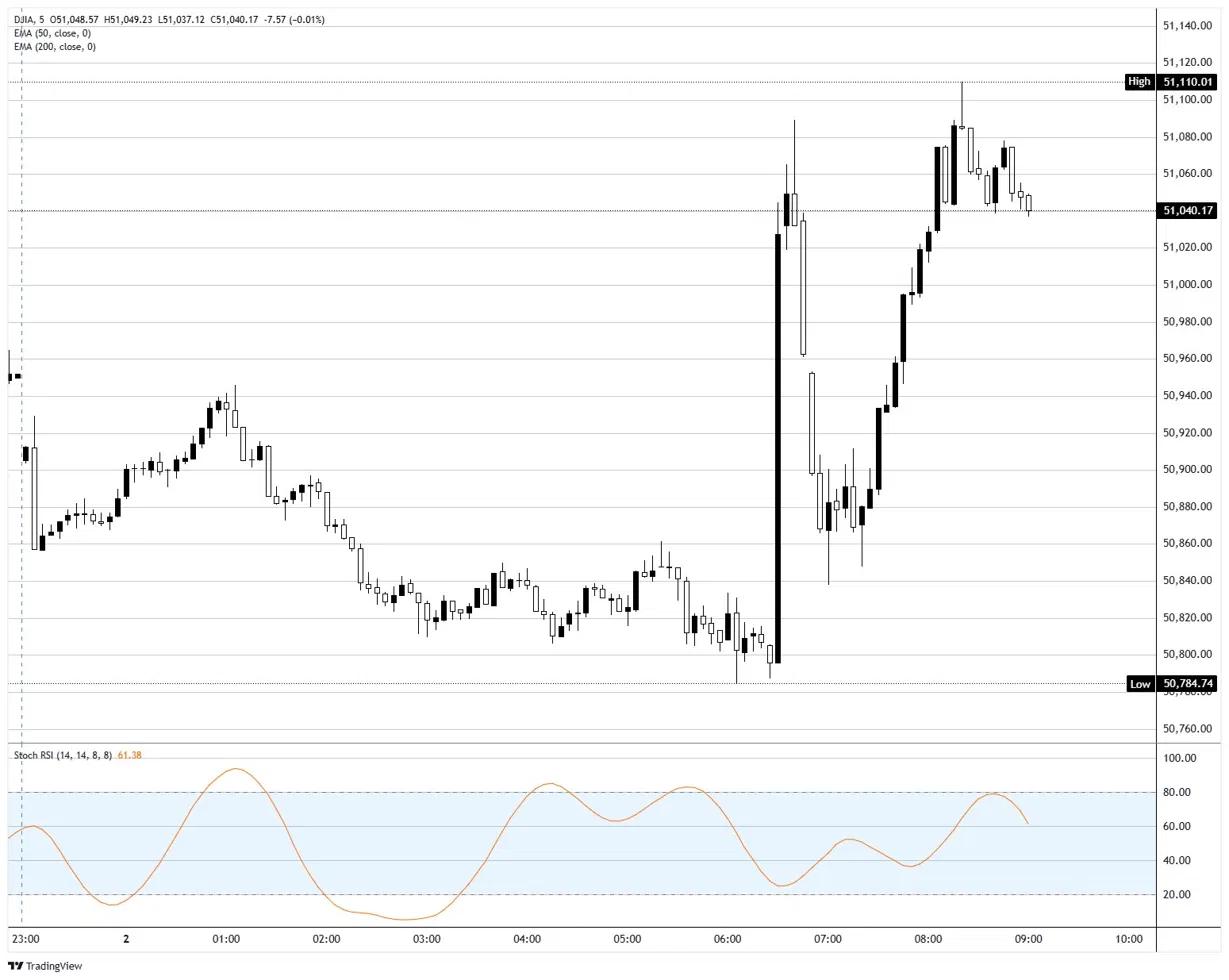
Dow Jones Industrial Average (DJIA) futures spent the overnight session doing their best impression of a market that has decided geopolitics no longer matter. After sliding toward 50,800 in early European trade, futures snapped higher and pushed back above 51,000, briefly tagging highs above 51,100 before easing into the US open. That kept the contract within touching distance of Monday's cash close, when the S&P 500 notched another record and the Nasdaq Composite led on a tech bid that simply ran over the Oil spike. The VIX sat near 16. For a tape staring down a fracturing ceasefire and a threatened closure of the world's most important Oil chokepoint, the complacency is hard to miss.

Tehran walks, Washington waves it off
The split screen is the story. On Monday, Iranian state media said Tehran had suspended talks and the exchange of texts through mediators in protest at Israel's expanding offensive in Lebanon, framing Lebanon as a precondition of the April ceasefire it now says has been violated on all fronts. By Tuesday, two semiofficial agencies reported that communication with mediators had stopped entirely after Israel threatened to bomb Beirut. Washington's version is unrecognizable. President Donald Trump posted that talks were back on at a rapid pace, said he had turned around a little glitch, and claimed Iran had not told the US it was walking. Then Benjamin Netanyahu said Israel would keep striking southern Lebanon as planned and his defense minister denied any Lebanon ceasefire existed. Three governments, three narratives, and a market that has chosen the most convenient one.
Rubio sells diplomacy to a skeptical Hill
Into that gap stepped Secretary of State Marco Rubio, testifying before the Senate Foreign Relations Committee on Tuesday in his first public appearance since the war began. His message: talks are alive, and Tehran has agreed to negotiate parts of its nuclear program it refused to touch a month ago. The framing was telling. Talks with Iran, he said, are not like talks with Switzerland and require the use of intermediators, a convenient way to explain how the US can insist negotiations continue even as Iran says it has stopped speaking to those very mediators. Rubio pointed to the Pakistan-brokered track in Islamabad, reopening the Strait of Hormuz, limited sanctions relief, and reviving nuclear talks under strict conditions. Lawmakers from both parties pressed him on the missing endgame. The optimism is doing a lot of work, and the tape is taking it at face value.
Oil blinks, equities yawn
The cleaner read on risk is in the Oil pit, and even there the fear is fading. Brent crude jumped more than 7% intraday on Monday on the Hormuz threat before paring to around 5%, then slipped back toward $94 on Tuesday, with West Texas Intermediate near $92. That is a market betting the closure threat is leverage rather than reality. Equities never even flinched, which is the part worth flagging. A record close on the day Iran suspends talks and warns of a full Hormuz shutdown is either supreme confidence in US diplomacy or a market that has stopped pricing tail risk.
JOLTS reheats the labor story
The macro calendar gives the bulls something firmer to lean on. The Job Openings and Labor Turnover Survey (JOLTS) for April landed at 7.618 million against a 6.88 million consensus, a hot print that says labor demand is not cracking. The week loads up from here: Wednesday brings the red-band Institute for Supply Management (ISM) Services Purchasing Managers Index (PMI), ADP payrolls and the Fed's Beige Book, and Friday delivers Nonfarm Payrolls (NFP), with consensus at a soft 85K against 115K prior and unemployment holding at 4.3%. With Oil still elevated year-on-year and the labor market refusing to roll over, the data leaves the Fed little room to lean dovish, which equities continue to ignore.
Levels to watch
The 51,000 handle is the line in the sand. Holding above it keeps the bid intact and the record-chase alive, with 51,100 the upside trigger. Lose 51,000 and the early-session 50,800 zone comes back into play, with the real test being whether a genuine escalation, an actual Hormuz closure or a Lebanon flare-up, finally forces the complacency trade to unwind. Until then the lean stays with the bulls, but it is built on trust in a story Tehran is openly contradicting.
Dow Jones 5-minute chart
Futures FAQs
The futures market is an exchange-based auction in which participants buy and sell contracts of an underlying asset at a predetermined future date and price. The set price is agreed upon today and is derived from the underlying asset. Futures contracts can be based on a wide range of assets, with commodities among the most popular, although currencies and indices are other common underlying assets. Futures prices depend on their underlying asset and act as a mechanism for firms, institutions, and large-position traders to manage risks through hedging.
Futures can be traded in different ways. The most common ways are via a regulated exchange or via Contracts For Difference (CFDs). In the former, liquidity is high and pricing is more transparent, with the broker serving only as an intermediary between you and the market. Still, it generally requires more capital. The largest futures exchanges are the Chicago Mercantile Exchange (CME) and the New York Mercantile Exchange (NYME). As for CFDs, these require less capital and thus trading is more flexible, but at the cost of less transparency.
The E-mini S&P 500 index, Crude Oil (Brent, WTI), Natural Gas, Gold, Silver, Copper, and soft commodities such as grains are among the most actively traded contracts. These offer strong liquidity and are closely followed by traders worldwide. Futures market volume consistently exceeds spot market volume, often significantly. This dominance is driven by leverage, hedging, and higher liquidity on exchanges.
Yes. Future gauges, particularly equity index futures such as those of the S&P 500 or the Nasdaq, are widely considered key gauges of market sentiment because they reflect investors’ expectations for the next session’s opening price. When equity futures drop, it is a sign of risk-aversion, signaling bearish market sentiment. On the contrary, rising equity futures suggest markets are risk on.
As a futures contract approaches its maturity date, the futures price converges upon the spot price, becoming almost identical at expiration. However, prices can diverge significantly before the contract ends. A market is in contango when future prices are higher than spot prices, while the mirror image is called backwardation (when current prices are higher than future prices). For commodities, the normal state of the market is contango because holding the asset over time incurs costs such as storage or insurance fees. When markets turn from contango to backwardation – or vice versa – it signals a shift in the trend: a change from contango to backwardation is taken as a bullish sign, while going from backwardation to contango is generally considered bearish.










