
News & AnalysisCareer

At around 1.1220 against the US Dollar (USD), the Euro (EUR) trades slightly lower in Tuesday’s European session, having relinquished its earlier gains. The reversal in the major currency pair follows a warning that the Federal Reserve (Fed) could pursue aggressive monetary tightening should inflationary pressures in the United States (US) continue to build, lending support to the US Dollar.

After reversing its earlier losses during European trading, the US Dollar Index (DXY) edged into positive territory above 101.70. The index measures the Greenback against a basket of six major currencies.
Speaking during the European session, Fed Governor Christopher Waller said: “Half-point Fed rate hike may be needed in December, if October core CPI inflation comes in around 0.3% or higher,”
A reading of 9/10 on the FXS Speechtracker, against a historical average of 7.3/10, highlights the markedly more hawkish tone of Fed Governor Waller’s remarks and a stronger inclination towards tightening than his established baseline. His explicit support for a half-point FED rate increase in December, conditional on October core CPI coming in at around 0.3% or higher, suggests little tolerance for any renewed deviation from the inflation target. Even with better figures, he favours an increase of at least a quarter-point. Waller also stressed the broad spread of price rises, anticipated further producer price pressures and argued that policy had been less restrictive than previously assumed. Taken together, these points suggest further rate increases are likely and that real rates need to rise to bring inflation back under control, an environment generally favourable to the Dollar but adverse for risk-sensitive assets.
With a 3.17-point increase to 145.50, the FXS Fed Sentiment Index moved further into hawkish territory, comfortably above the neutral 100 mark and consistent with the high FXS Speechtracker reading. Together, the indicators suggest markets are focusing on a renewed commitment to tightening. Unless forthcoming inflation figures demonstrate convincing progress towards the Fed’s target, traders are likely to price in greater odds of a higher terminal rate and a stronger trajectory for the Dollar.
Attention now turns to October’s US Consumer Price Index (CPI) figures, scheduled for release at 13:30 GMT.
Following September’s strong reading, Deutsche Bank economists now forecast a marked easing in price pressures. Ahead of the next Fed meeting, their outlook points to a more subdued October CPI report: “this time, our US economists expect inflation to have come down from its September pace, with both headline and core at +0.20% on the month,” they note.
Further tightening of monetary conditions has also received backing from European Central Bank (ECB) officials, providing a policy focus for the Euro.
At 7.6 against a historical average of 6.3, the FXS Speechtracker score indicates that the speech had a greater impact than usual and a distinctly hawkish slant. Describing Europe’s resilience as “reassuring” while stressing that French fiscal problems must be resolved in Paris suggests little tolerance for fiscal slippage, supporting a firmer bias for the Euro.
Upside price risks are underlined by guidance that core and food inflation should accelerate, with inflation likely to end the year “a little bit” above 4% and “more to come” before it peaks. The suggestion that a December rate increase would be prudent unless the data change reinforces expectations of further tightening. That prospect supports the Euro through interest rate differentials, while leaving rate-sensitive assets under pressure.
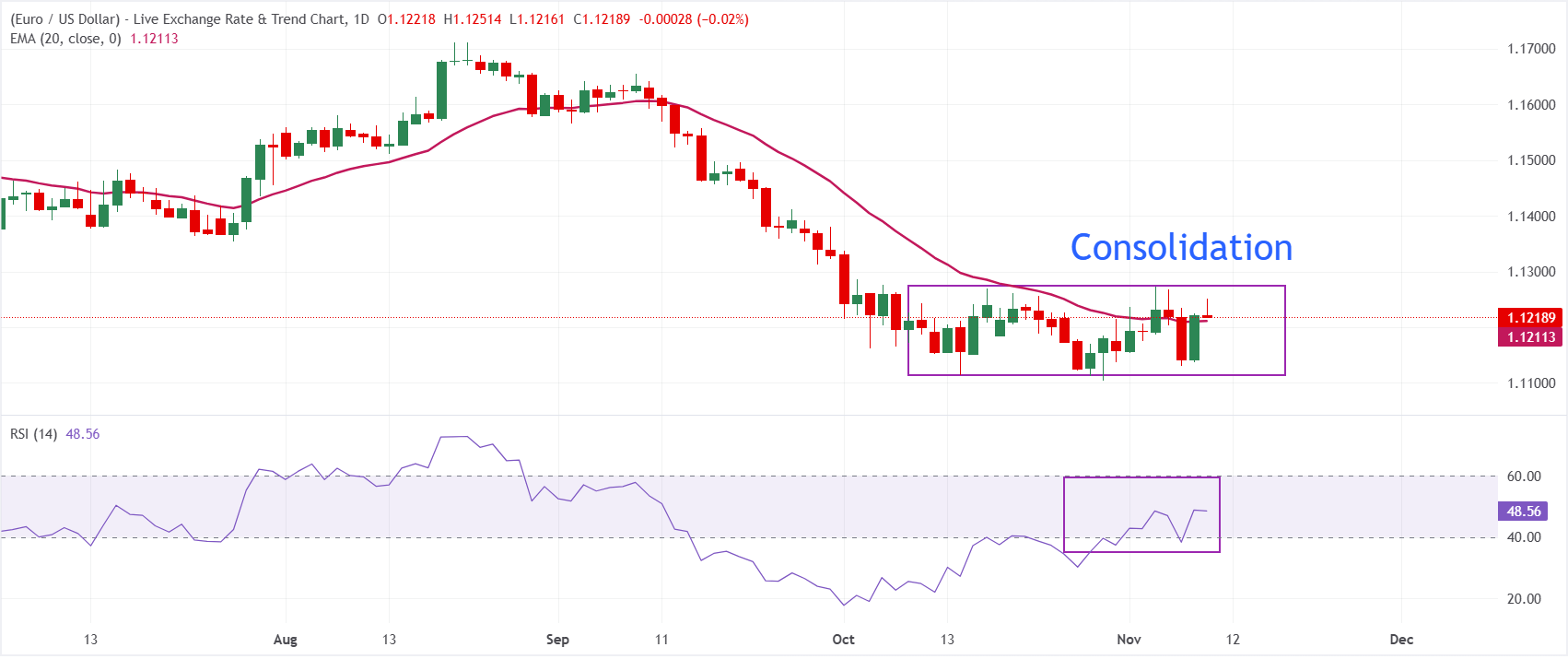
At 1.1219 on the daily chart, EUR/USD remains just above its 20-day exponential moving average (EMA) of 1.1211. This leaves the near-term outlook modestly constructive and points to support forming around the recent breakout zone. Meanwhile, a Relative Strength Index (RSI) reading of 48.6, close to neutral territory, suggests selling momentum has eased, without indicating either overbought conditions or a pronounced market trend.
The 20-day EMA near 1.1211 provides the first downside support. A daily close beneath it would open the way to a deeper retracement and undermine the current signs of stabilisation. Conversely, holding above this moving average would preserve the short-term structure, enabling buyers to maintain control as momentum consolidates.
(The technical analysis of this story was written with the help of an AI tool. Know more.)
By tracking the combined prices of a representative basket of goods and services at regular intervals, the Consumer Price Index (CPI) measures inflationary or deflationary trends. Compiled monthly, the figures are published by the US Department of Labor Statistics. The month-on-month (MoM) reading compares goods prices in the reference month with those of the preceding month. For a more accurate gauge of underlying price pressures, the CPI Ex Food & Energy leaves out the food and energy components, which are considered more volatile. A high reading is generally regarded as positive for the US Dollar (USD), whereas a low reading is usually viewed as negative.
Find out more.Next publication: Tue 10 Nov 2026 13:30
Publication frequency: Monthly
Consensus forecast: 0.2%
Previous reading: 0.3%
Data source: US Bureau of Labor Statistics
Annual inflation should be around 2% under the US Federal Reserve’s dual mandate, which combines price stability with maximum employment. Yet price stability has been the weakest pillar of that mandate since the onset of the global pandemic, a situation that persists today. Supply-chain disruption and bottlenecks continue to push prices higher, leaving the Consumer Price Index (CPI) at multi-decade highs. Having already acted to curb inflation, the Fed is expected to retain its aggressive policy stance for the foreseeable future.










The information provided on this website is of a general nature only and does not constitute personal financial advice. Before acting on any information on this website, you should consider the suitability of the information in relation to your objectives, financial situation and needs. Investing in CFDs and FX Margin Contracts carries significant risks and is not suitable for all investors. You may lose more than your initial deposit. You do not own, or have, any interest in the underlying asset. We recommend that you seek independent advice and ensure you fully understand the risks involved before trading. It is important that you read and consider the disclosure document before you acquire any product listed on the website. The information and advertisements offered on this website are not intended for use by any person in any country or jurisdiction where such use would be contrary to local laws and regulations. The Products and Services offered on this website are not intended for residents of the United States, Malaysia and Thailand.
TMGM is authorized and regulated in various jurisdictions.
Trademax Australia Limited, trading as TMGM, is regulated by the Australian Securities and Investments Commission (ASIC), AFSL no. 436416 and is located at Level 28, One International Tower, 100 Barangaroo Avenue, 2000 Sydney, NSW Australia.
Email: support@tmgm.com.au
Trademax Global Limited, trading as TMGM, is authorized and regulated by the Vanuatu Financial Services Commission (VFSC), registration number 40356 and registered at 1276, Kumul Highway, Port Vila, Vanuatu, Republic of Vanuatu.
Email: support@tmgm.com
Trademax Global Markets (SE) Limited, trading as TMGM, is authorized and regulated by the Financial Services Authority (FSA) of Seychelles, with license number SD224. The company is registered at Office No 13, Providence Estate ABIS Centre, Mahe, Seychelles.
Email: support@tmgm.com
Trademax Global Markets (International) Pty Ltd, trading as TMGM, is authorized and regulated by the Financial Services Commission, Mauritius (FSC) with license no. GB22201012, and registered at 33, Edith Cavell Street C/o IQ EQ Fund Services (Mauritius) Ltd Port Louis, 11324 Mauritius.
Email: support@tmgm.com
Copyright © TMGM. All rights reserved


