

Gold rebounds toward $4,650 as easing war fears lift demand
- Gold rebounds nearly 3% as de-escalation hopes revive haven demand.
- Falling Treasury yields and a weaker Dollar help underpin bullion prices.
- Weak JOLTS data and sticky inflation keep Fed outlook in focus.
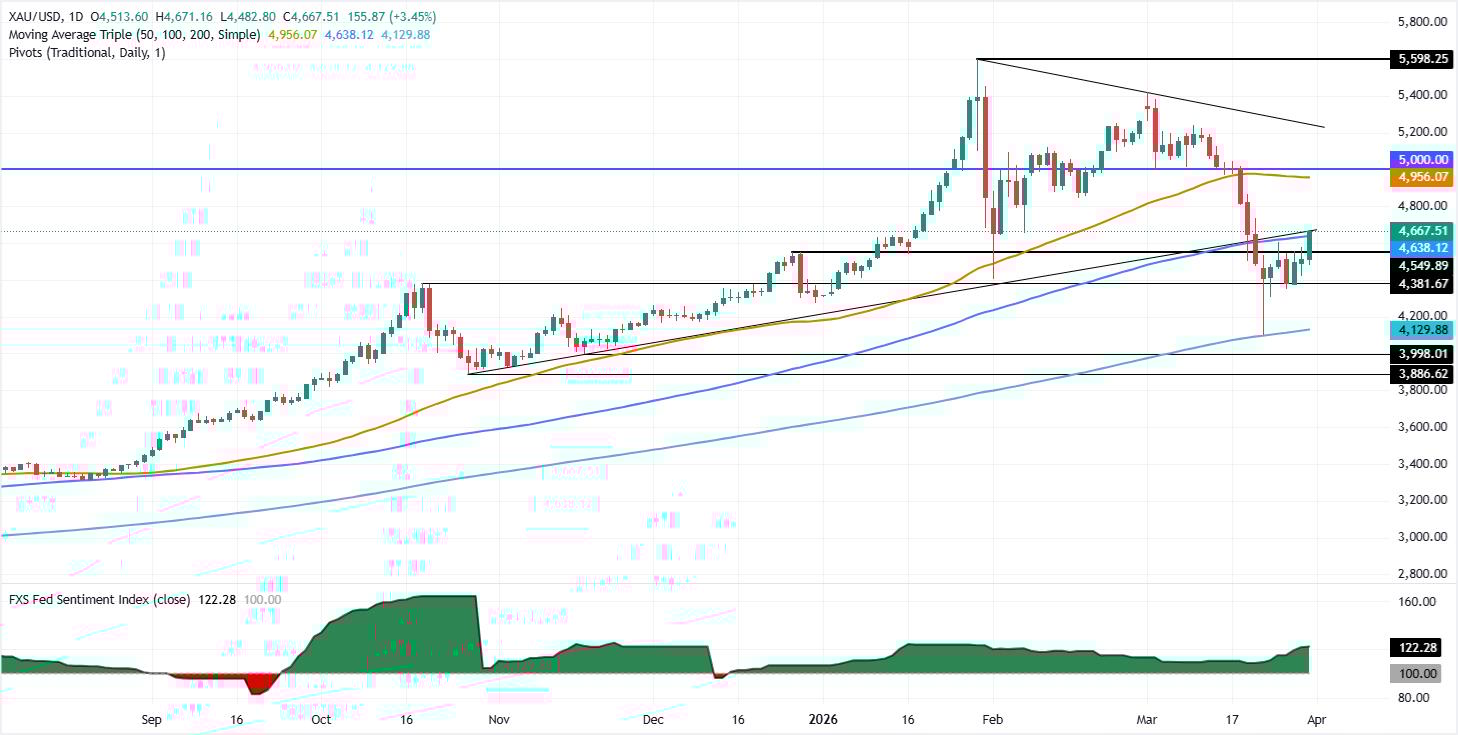
Gold (XAU/USD) price recovers some ground on Tuesday, rallying nearly 3% as the Iranian President Masoud Pezeshkian hinted that the regime is ready to end the war. Nevertheless, the yellow metal is poised to suffer monthly losses of more than 10% amid a broad sell-off sparked by the jump in energy prices. At the time of writing, XAU/USD trades at $4,648 after bouncing off daily lows of $4,482.

Bullion jumps as yields fall and truce hopes dent the US Dollar anew
Speculation of a possible de-escalation prompted traders to buy the yellow metal, which was further boosted by falling US Treasury yields. The US 10-year Treasury note falls four basis points to 4.31%, undermining the Greenback, which, according to the US Dollar Index (DXY), falls 0.58% to 99.91.
Late Monday, US President Donald Trump told aides he is willing to end the campaign against Iran even if the Strait of Hormuz remains largely closed, the Wall Street Journal reported. Recently, Press TV revealed that the Iranian President said that "Iran seeks no war but is prepared to end" but with security guarantees.
Earlier, the US Secretary of Defense Pete Hegseth said that peace talks are "very real", that they're active and that they are gaining strength, adding that "we would much prefer to get a deal."
Aside from geopolitics, data from the US revealed that the labour market is weakening, as shown by the Job Openings and Labor Turnover Survey (JOLTS). Job openings in February decreased to 6.882 million, down from 7.24 million and missing estimates for 6.92 million unfilled jobs.
The US Conference Board Consumer Confidence unexpectedly improved in March, but households still expect higher prices over the next year due to higher energy prices. The Consumer Confidence Index rose to 91.8 in March, up from February's downwardly revised 91.0 print.
Fed expected to hold rates in 2026, Schmid warns about Oil prices
Kansas City Fed President Jeffrey Schmid was hawkish on Tuesday, warning against "assuming" that the jump in energy prices would be transitory. Schmid added, "I don't think we can be complacent about the risks to inflation expectations." He commented that "It is now our job to follow through with policy actions that validate those expectations."
Expectations that the Federal Reserve would cut rates in 2026 vanished, as traders weighed high energy prices. At the beginning of the year, money markets priced in at least two 25-basis-point rate cuts by the Fed. However, the US central bank is not projected to ease policy in 2026.
XAU/USD technical outlook: Breaks the 100-Day SMA, bulls eye $4,700 as momentum builds
Gold price has broken above a key resistance level at the 100-day Simple Moving Average (SMA) at $4,617. However, a daily close above the latter is needed to open the door for further upside as further key resistance levels emerge.
The Relative Strength Index (RSI) shows that momentum is turning more constructive as the index approaches the RSI's neutral level, trending upwards.
If XAU/USD surpassed $4,700, the next resistance would be $4,800, ahead of the 20-day SMA at $4820. A breach of $4,900 exposes the 50-day SMA at $4,952.
Conversely, if Gold struggles to remain above $4,600, a re-test of $4,351, the March 26 daily low, is on the cards. Once cleared, there's nothing in the way to challenge the 200-day SMA at $4,106.
Gold FAQs
Gold has played a key role in human’s history as it has been widely used as a store of value and medium of exchange. Currently, apart from its shine and usage for jewelry, the precious metal is widely seen as a safe-haven asset, meaning that it is considered a good investment during turbulent times. Gold is also widely seen as a hedge against inflation and against depreciating currencies as it doesn’t rely on any specific issuer or government.
Central banks are the biggest Gold holders. In their aim to support their currencies in turbulent times, central banks tend to diversify their reserves and buy Gold to improve the perceived strength of the economy and the currency. High Gold reserves can be a source of trust for a country’s solvency. Central banks added 1,136 tonnes of Gold worth around $70 billion to their reserves in 2022, according to data from the World Gold Council. This is the highest yearly purchase since records began. Central banks from emerging economies such as China, India and Turkey are quickly increasing their Gold reserves.
Gold has an inverse correlation with the US Dollar and US Treasuries, which are both major reserve and safe-haven assets. When the Dollar depreciates, Gold tends to rise, enabling investors and central banks to diversify their assets in turbulent times. Gold is also inversely correlated with risk assets. A rally in the stock market tends to weaken Gold price, while sell-offs in riskier markets tend to favor the precious metal.
The price can move due to a wide range of factors. Geopolitical instability or fears of a deep recession can quickly make Gold price escalate due to its safe-haven status. As a yield-less asset, Gold tends to rise with lower interest rates, while higher cost of money usually weighs down on the yellow metal. Still, most moves depend on how the US Dollar (USD) behaves as the asset is priced in dollars (XAU/USD). A strong Dollar tends to keep the price of Gold controlled, whereas a weaker Dollar is likely to push Gold prices up.










