




Japan's Yen sleeps through a regional equity crash
- USD/JPY holds a fraction under 164.00, a few ticks beneath the weakest the Japanese currency has been against the Dollar since 1986.
- Korean equities fell close to 11% and the Nikkei 225 almost 4%, and the region's traditional haven did not catch a single bid.
- Friday's Bank of Japan hold is fully priced, which leaves Wednesday's Federal Reserve decision as the only genuinely live event in this pair.
The Yen trades a fraction under 164.00 on Tuesday, marginally weaker on the day, inside a 30-pip band with a floor above 163.50 and a high a few ticks beneath the standing cycle extreme. That extreme is the currency's weakest level against the Dollar in four decades, and the pair has now spent three sessions grinding at it without a meaningful pullback.
What makes that stillness remarkable is the backdrop it declined to notice. Tuesday delivered the largest single-session equity shock in Asia this year, and the currency that is supposed to be bought when Asia breaks did not move.
A haven that did not show up for work
Korea's benchmark fell close to 11%, triggering its eighth circuit breaker of the year, after a report that a Chinese manufacturer has begun mass production of lithography equipment long monopolized by a single Dutch supplier. Japan's own benchmark fell nearly 4% to its weakest since 22 May, led by chip-equipment names, while Taiwan's index dropped 4.7% and the artificial-intelligence trade came under pressure across the region.
A functioning haven currency rallies into that. This one did not, which says the Yen has stopped trading as insurance and now trades purely as the funding leg of a carry position that keeps getting cheaper to hold. Stable implied volatility and a policy rate of 1.00% will do that.
The mechanics are not subtle. Implied volatility across the majors has stayed compressed through the war, the intervention premium has been priced out of the forwards, and a 1.00% funding rate against American front-end yields above 4% pays the holder of that position to ignore precisely the kind of headline Tuesday produced. Books built on that arithmetic do not unwind because Korean semiconductors have a bad morning.
The defence line that was not there
Japan's Ministry of Finance spent roughly 11.7 trillion Yen, close to 72 billion Dollars, defending the currency between late April and late May, one of the largest intervention campaigns on record and nearly double the previous largest effort. The rate was back above the level that triggered it inside six weeks.
Officials have since dropped verbal warnings in favour of ambush tactics designed to keep the market uncertain about timing. The flaw in that doctrine is that removing the published line also removes the deterrent, and a market that has watched 162.00 pass without consequence will keep testing upward until something answers. The finance ministry has said it would act decisively against excessive moves, which is the language that preceded a campaign the market has already priced as ineffective.
Friday's meeting is not the event
The Bank of Japan concludes a two-day meeting on Friday with a hold at 1.00% fully priced per the calendar, following June's quarter-point move to a three-decade high. The quarterly outlook document is where the content sits, with current fiscal-year growth forecasts expected higher on artificial-intelligence-linked demand while core inflation is trimmed to account for energy subsidies.
That pairing is close to the worst available combination for the currency. Upgraded growth without an inflation upgrade hands the board its justification for patience, and patience at 1.00% against a Federal Reserve carrying cumulative hike odds above 91% into December is simply an instruction to leave the carry trade on. With Tokyo's core measure running near 1.7%, the real policy rate remains negative regardless of what the board says on Friday.
Turning this pair requires a Federal Reserve that stops hardening its terminal or a Japanese board that stops explaining why it can afford to wait. Neither appears on this week's agenda, and the currency desk at the finance ministry has already demonstrated what a record-sized operation buys in this regime, which is roughly six weeks.
The week ahead
Wednesday's Federal Open Market Committee decision at 18:00 GMT is the pair's only two-way event, with the press conference at 18:30 GMT and no Summary of Economic Projections attached. Rate futures put a hike at just over 30%, trimmed from just under 36% at the weekend, which leaves the statement itself carrying the entire signal.
Thursday at 23:30 GMT brings Tokyo's July Consumer Price Index, with the measure excluding fresh food expected at 1.7% against 1.6% previously, alongside a June unemployment rate held at 2.5%. Retail trade follows at 23:50 GMT, forecast at 3.1% YoY after 5.3%. Friday's rate decision carries no scheduled time, with the outlook report at 03:00 GMT and the press briefing at 06:30 GMT.
Technical outlook
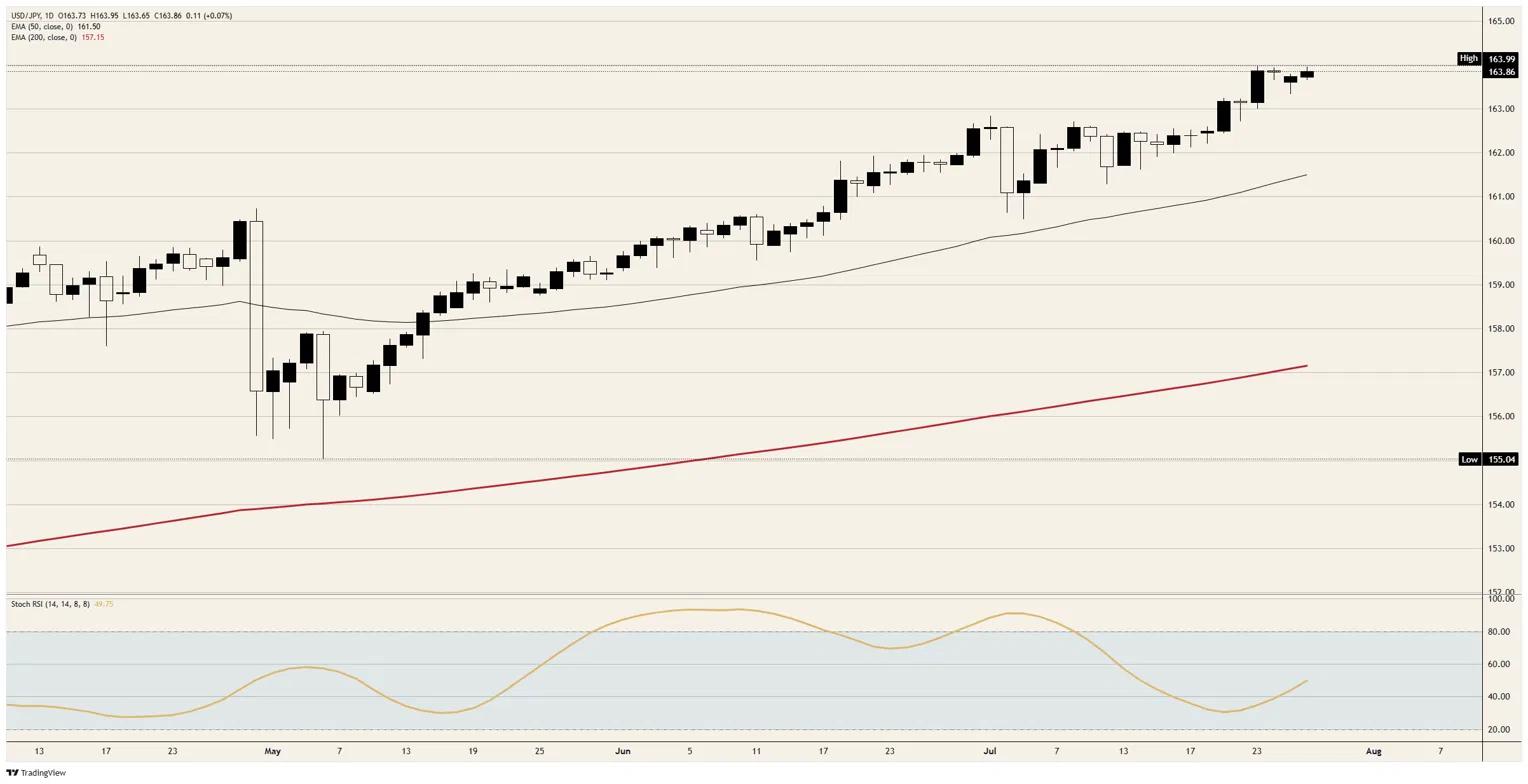
Resistance: the standing cycle high just beneath 164.00 is the only level that matters in the near term, and three sessions of pressure have not cracked it. Above there the chart is empty back to 1986, with 164.50 and 165.00 the round-number reference points.
Support: 163.50 is Tuesday's floor, with 163.00 the shelf broken on 21 July and the first level that would suggest a real reversal. The 50-day Exponential Moving Average near 161.50 is the trend line, rising steadily, and the 200-day sits far below near 157.00.
Bias: Bullish. The daily Stochastic Relative Strength Index near 50 has reset from overbought without a price decline, which is what a trending market looks like when it pauses rather than turns. Buy dips toward 163.50. Invalidation is a daily close beneath 163.00.
USD/JPY daily chart
Japanese Yen FAQs
The Japanese Yen (JPY) is one of the world’s most traded currencies. Its value is broadly determined by the performance of the Japanese economy, but more specifically by the Bank of Japan’s policy, the differential between Japanese and US bond yields, or risk sentiment among traders, among other factors.
One of the Bank of Japan’s mandates is currency control, so its moves are key for the Yen. The BoJ has directly intervened in currency markets sometimes, generally to lower the value of the Yen, although it refrains from doing it often due to political concerns of its main trading partners. The BoJ ultra-loose monetary policy between 2013 and 2024 caused the Yen to depreciate against its main currency peers due to an increasing policy divergence between the Bank of Japan and other main central banks. More recently, the gradually unwinding of this ultra-loose policy has given some support to the Yen.
Over the last decade, the BoJ’s stance of sticking to ultra-loose monetary policy has led to a widening policy divergence with other central banks, particularly with the US Federal Reserve. This supported a widening of the differential between the 10-year US and Japanese bonds, which favored the US Dollar against the Japanese Yen. The BoJ decision in 2024 to gradually abandon the ultra-loose policy, coupled with interest-rate cuts in other major central banks, is narrowing this differential.
The Japanese Yen is often seen as a safe-haven investment. This means that in times of market stress, investors are more likely to put their money in the Japanese currency due to its supposed reliability and stability. Turbulent times are likely to strengthen the Yen’s value against other currencies seen as more risky to invest in.










