

Ripple Price Forecast: XRP tests rebound strength amid mild return in retail interest
- XRP ticks up and trades around $1.15 on Monday despite escalating geopolitical tensions in the Middle East.
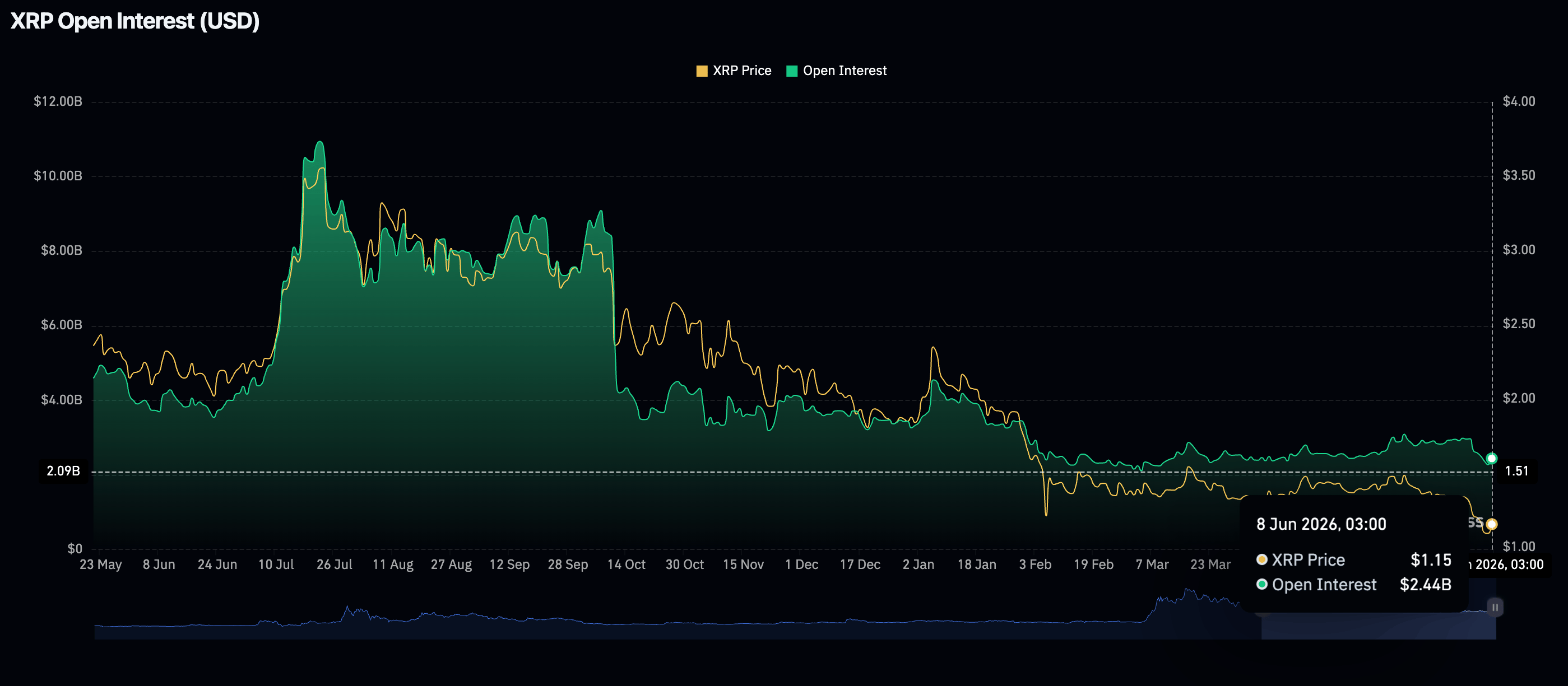
- XRP retail traders mildly increase risk exposure, as perpetual futures Open Interest edged higher at $2.44 billion.
- XRP’s technical picture remains weak, with the MACD and the SuperTrend indicators sustaining sell signals.
Ripple (XRP) edges higher, trading around $1.15 on Monday as appetite for risk gradually returns across the crypto market. Retail traders appear to be making a cautious return from the sidelines, as reflected in XRP derivatives.

XRP rebounds despite renewed geopolitical tensions
Risk-off sentiment continues to dominate, with most digital assets correcting after a brief weekend bounce. Israel and Iran exchanged strikes for the first time since the ceasefire agreement was reached on April 8.
Despite the escalation, United States (US) President Donald Trump told the Financial Times that the strikes between Israel and Iran do not change his desire to bring the ongoing peace negotiations to a conclusion.
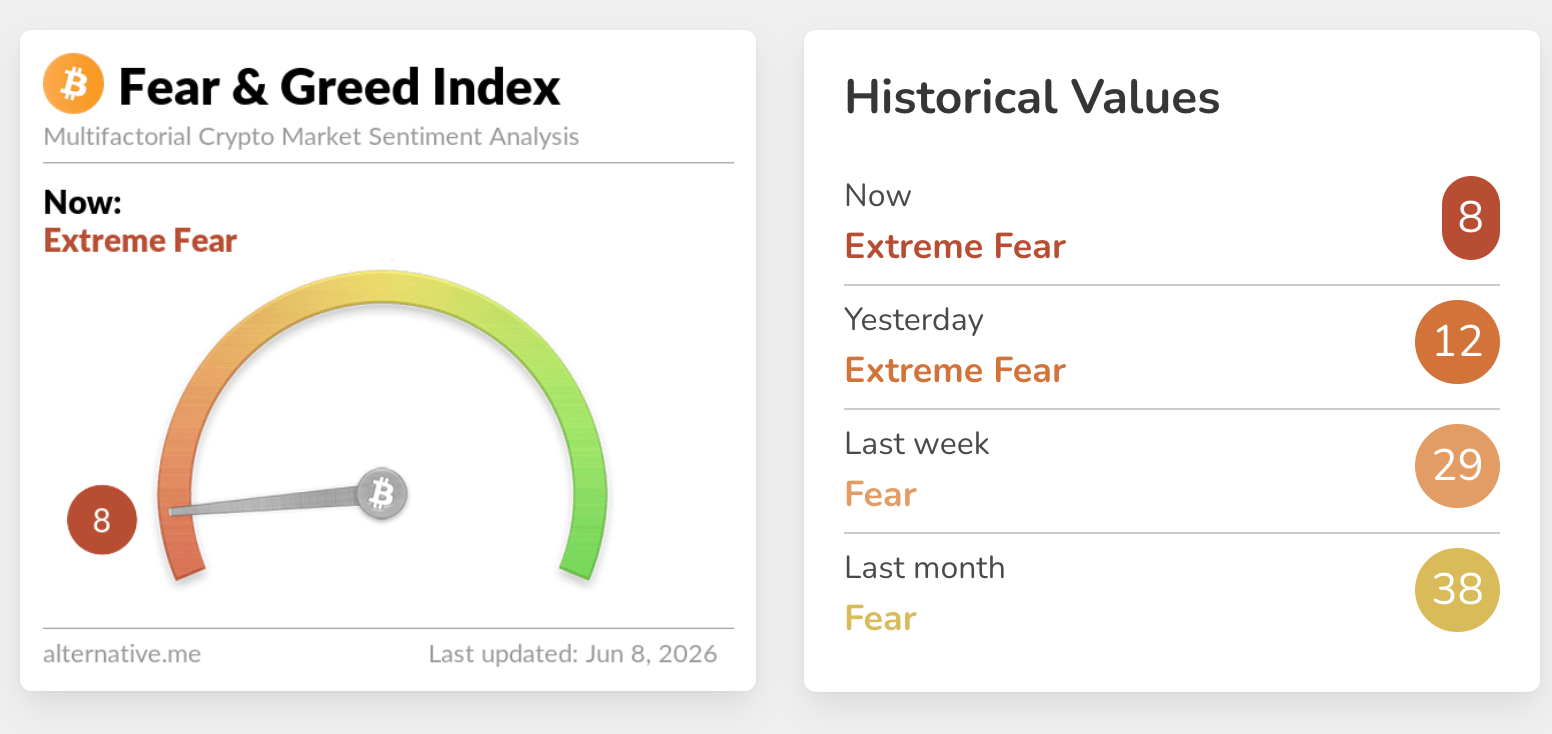
Appetite for risk assets remains on the back burner as investors navigate mounting geopolitical tensions and macroeconomic uncertainty, as evidenced by the crypto Fear & Greed Index, dropping to 8 in Extreme Fear territory on Monday, down from 12 the day before and 38 in May.
Should sentiment fail to improve this week, a sustained recovery in the XRP price could remain a pipe dream. Meanwhile, retail demand for derivatives increased slightly on Monday, with the perpetual futures Open Interest (OI) averaging $2.44 billion, up from $2.28 billion. This minor increase suggests that traders are increasingly piling into risk assets.
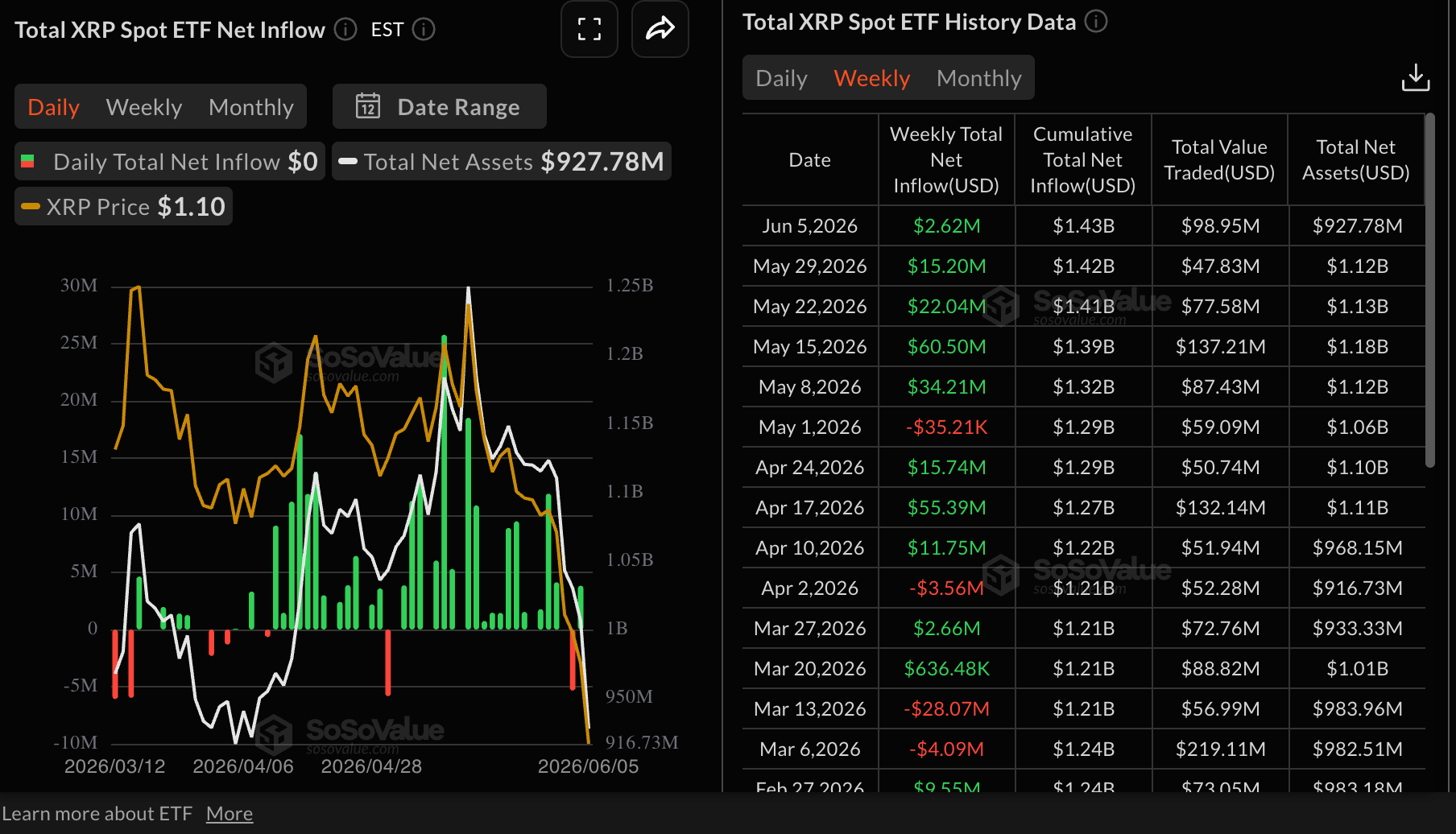
Meanwhile, XRP spot ETFs extended their mild bullish streak, with inflows of $2.62 million last week through Friday. This marked the fifth consecutive week of inflows, bringing cumulative inflows to $1.43 billion and net assets to $928 million, according to SoSoValue.
Price analysis: XRP gains momentum
XRP trades at $1.15, maintaining a bearish near-term bias as it holds well below the 50-day, 100-day and 200-day Exponential Moving Averages (EMAs). The cluster of medium-term resistance defined by the 50-day EMA at $1.33 and the 100-day EMA at $1.41, together with the longer-term 200-day EMA at $1.63, suggests that any rebound would face layered supply overhead.
A bearish SuperTrend signal at $1.26 and the intact downward resistance trendline, whose break point comes in near $1.52, reinforce the view that rallies are likely to be sold while the price remains capped beneath these levels.
Meanwhile, the Relative Strength Index (RSI) near 32 on the daily chart, and a negative Moving Average Convergence Divergence (MACD) histogram below the zero line both hint at persistent downside pressure.
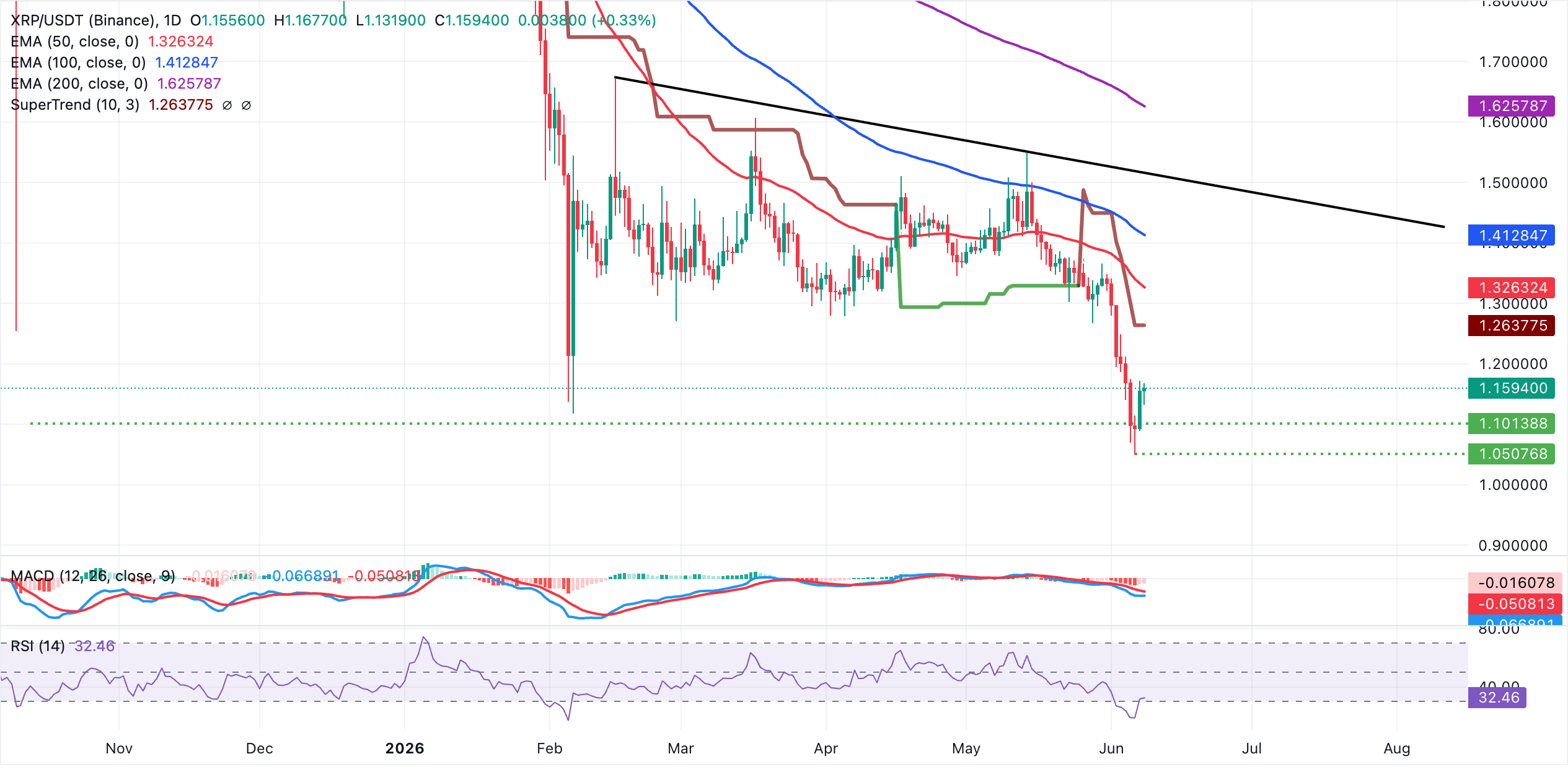
On the topside, initial resistance is seen at the SuperTrend barrier around $1.26, ahead of a more substantial supply zone around the confluence of the 50-day EMA at $1.33 and the 100-day EMA at $1.41. Beyond that, the descending trendline region near $1.52, followed by the 200-day EMA at $1.63, marks a broader reversal area that would need to be reclaimed to soften the broader bearish structure. If the sell-off persists, XRP could drop to retest support at $1.05 while exerting pressure on the pivotal $1.00 level.
(The technical analysis of this story was written with the help of an AI tool.)
Crypto ETF FAQs
An Exchange-Traded Fund (ETF) is an investment vehicle or an index that tracks the price of an underlying asset. ETFs can not only track a single asset, but a group of assets and sectors. For example, a Bitcoin ETF tracks Bitcoin’s price. ETF is a tool used by investors to gain exposure to a certain asset.
Yes. The first Bitcoin futures ETF in the US was approved by the US Securities & Exchange Commission in October 2021. A total of seven Bitcoin futures ETFs have been approved, with more than 20 still waiting for the regulator’s permission. The SEC says that the cryptocurrency industry is new and subject to manipulation, which is why it has been delaying crypto-related futures ETFs for the last few years.
Yes. The SEC approved in January 2024 the listing and trading of several Bitcoin spot Exchange-Traded Funds, opening the door to institutional capital and mainstream investors to trade the main crypto currency. The decision was hailed by the industry as a game changer.
The main advantage of crypto ETFs is the possibility of gaining exposure to a cryptocurrency without ownership, reducing the risk and cost of holding the asset. Other pros are a lower learning curve and higher security for investors since ETFs take charge of securing the underlying asset holdings. As for the main drawbacks, the main one is that as an investor you can’t have direct ownership of the asset, or, as they say in crypto, “not your keys, not your coins.” Other disadvantages are higher costs associated with holding crypto since ETFs charge fees for active management. Finally, even though investing in ETFs reduces the risk of holding an asset, price swings in the underlying cryptocurrency are likely to be reflected in the investment vehicle too.











