

USD/INR opens lower as RBI restricts oil refiners from spot dollar purchases
- The Indian Rupee gains at open against the US Dollar due to the RBI’s measures to curb dollar buying.
- US President Trump said that Iran is willing to give up its nuclear ambitions.
- FIIs remained net buyers in the last two trading days.
The Indian Rupee (INR) opens higher against the US Dollar (USD) on Friday, as the opening of special credit lines for state-run oil buyers to meet their foreign exchange needs has strengthened the Asian currency. The USD/INR pair declines to near 92.80 after remaining sideways in the last two trading days.

According to a Reuters report, the Reserve Bank of India (RBI), on Thursday, urged state-run oil refiners to curb spot dollar purchases and to tap a special credit line, in an attempt to reduce the impact of dollar buying by state-run oil refiners on the domestic currency. This facility was also started by the RBI when the Russia-Ukraine war started.
The Indian central bank has been taking several measures to limit the downside in the Indian Rupee against the US Dollar. In late March, the RBI directed banks to cap their net open rupee positions in the foreign exchange market at $100 million by the end of each business day.
Trump seems confident of a deal with Iran
Oil prices remain capped, and the market sentiment is broadly risk-on as United States (US) President Donald Trump has expressed confidence that a deal with Iran is very likely. “We're very close to a deal with Iran,” Trump said in a press briefing on Thursday. However, he warned that military actions against Tehran would resume if a deal is not reached.
The overall commentary from US President Trump appeared to be expressing optimism toward a permanent truce with Iran. Trump said that Iran is now “more willing to do things today they previously weren't”, such as giving up nuclear ambitions and handing over enriched uranium.
Upbeat market sentiment has diminished the safe-haven appeal of the US Dollar. As of writing, the US Dollar Index (DXY), which tracks the Greenback’s value against six major currencies, trades marginally higher to near 98.25, but is set for a consecutive negative weekly close.
Meanwhile, capped WTI Oil prices around $90 from the past few days after surging above $100 is also offering support to the Indian Rupee. Currencies from economies, such as India, which rely heavily on oil imports to meet their energy needs, take a recovery route when oil prices start correcting.
FIIs start buying in Indian stock market
The response by Foreign Institutional Investors (FIIs) toward the Indian equity market appears to start improving since the announcement of the two-week ceasefire between the US and Iran on April 8. In the last two trading days, FIIs have remained net buyers and have raised their stake worth Rs. 1,048.51 crore. However, the amount of investment is significantly lower than the selling pressure seen before the temporary truce announcement.
Technical Analysis: USD/INR falls below 20-day EMA
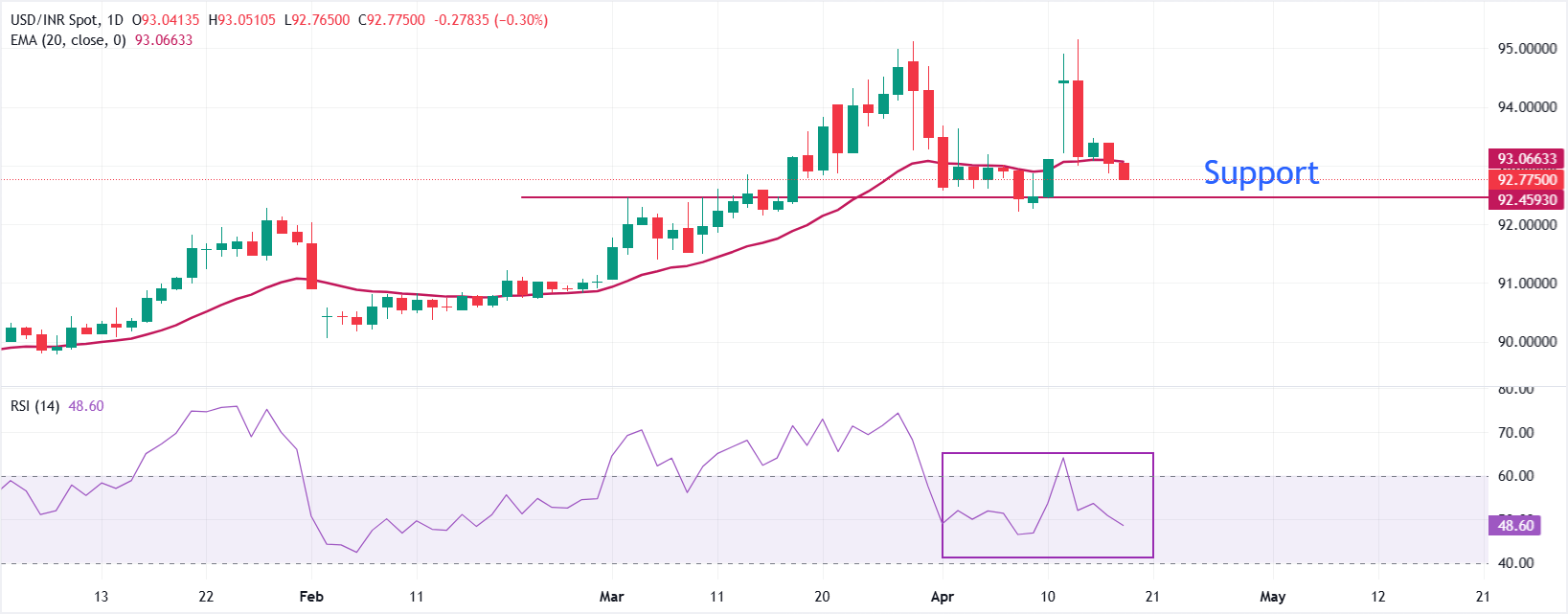
USD/INR trades lower at around 92.80, as of writing, holding a mildly bearish near-term bias as spot remains below the 20-period Exponential Moving Average (EMA) at 93.06. The recent pullback from last week’s highs has pushed the price under this short-term trend gauge, and the Relative Strength Index (RSI) at 48.6 has slipped just below the neutral 50 line, hinting that upside momentum is fading without yet signaling oversold conditions.
On the topside, initial resistance is now defined by the 20-day EMA at 93.07, where a daily close above would be needed to ease immediate downside pressure and reopen the path toward recent peaks above 95.00. As long as the pair holds beneath this moving average, rebounds are likely to struggle, leaving risks skewed toward additional consolidation or further slippage in the coming sessions toward the March 3 high of 92.46.
(The technical analysis of this story was written with the help of an AI tool.)
Indian Rupee FAQs
The Indian Rupee (INR) is one of the most sensitive currencies to external factors. The price of Crude Oil (the country is highly dependent on imported Oil), the value of the US Dollar – most trade is conducted in USD – and the level of foreign investment, are all influential. Direct intervention by the Reserve Bank of India (RBI) in FX markets to keep the exchange rate stable, as well as the level of interest rates set by the RBI, are further major influencing factors on the Rupee.
The Reserve Bank of India (RBI) actively intervenes in forex markets to maintain a stable exchange rate, to help facilitate trade. In addition, the RBI tries to maintain the inflation rate at its 4% target by adjusting interest rates. Higher interest rates usually strengthen the Rupee. This is due to the role of the ‘carry trade’ in which investors borrow in countries with lower interest rates so as to place their money in countries’ offering relatively higher interest rates and profit from the difference.
Macroeconomic factors that influence the value of the Rupee include inflation, interest rates, the economic growth rate (GDP), the balance of trade, and inflows from foreign investment. A higher growth rate can lead to more overseas investment, pushing up demand for the Rupee. A less negative balance of trade will eventually lead to a stronger Rupee. Higher interest rates, especially real rates (interest rates less inflation) are also positive for the Rupee. A risk-on environment can lead to greater inflows of Foreign Direct and Indirect Investment (FDI and FII), which also benefit the Rupee.
Higher inflation, particularly, if it is comparatively higher than India’s peers, is generally negative for the currency as it reflects devaluation through oversupply. Inflation also increases the cost of exports, leading to more Rupees being sold to purchase foreign imports, which is Rupee-negative. At the same time, higher inflation usually leads to the Reserve Bank of India (RBI) raising interest rates and this can be positive for the Rupee, due to increased demand from international investors. The opposite effect is true of lower inflation.











