

Washington Revokes Iran's Crude Oil Waiver Nineteen Days After Granting It
- The Treasury revoked the general licence permitting Iranian Crude Oil sales, ordering authorized transactions wound down by July 17, a month ahead of the original runway.
- The revocation followed strikes on three tankers transiting the Strait of Hormuz, attacks Tehran declined to claim while its state media blamed ignored warnings.
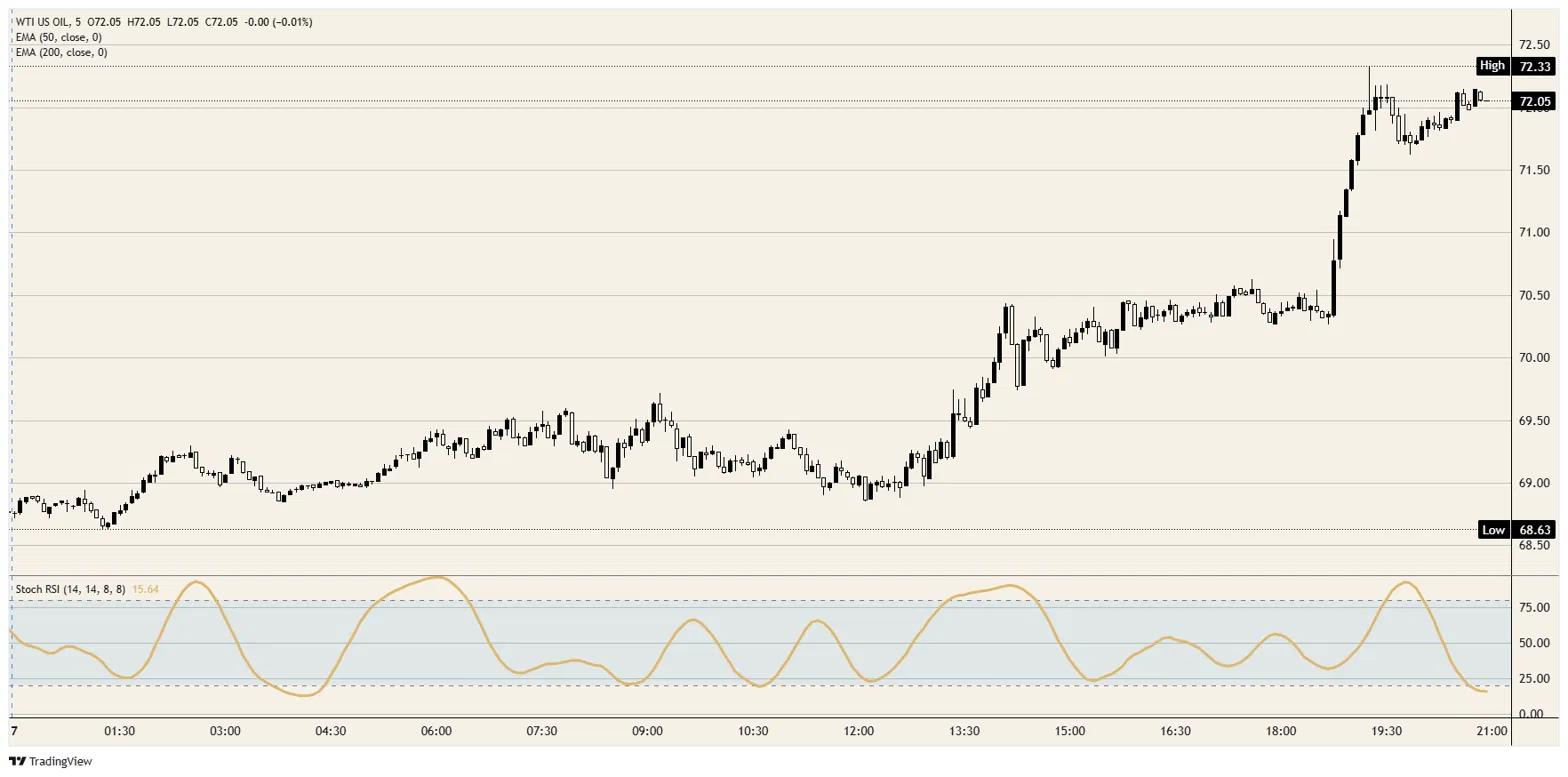
- WTI logged its largest single-day gain since early May, settling 5.00% higher at 72.05, while Brent added 5.22% to close at 75.86.
The United States Treasury Department revoked the general licence authorizing Iranian Crude Oil sales on Tuesday, ending the shortest-lived sanctions relief of the ceasefire era hours after three tankers were struck in the Strait of Hormuz. The move strips Tehran of the single largest revenue concession it extracted from last month's talks and puts the entire fourteen-point framework on notice.

Nineteen Days Of Goodwill
The waiver survived nineteen days between issuance and revocation, which tells the market everything it needs to know about how Washington scores compliance. The licence arrived in June under the fourteen-point memorandum of understanding that reopened the Strait of Hormuz and originally permitted Iranian sales through August 21; the Treasury now orders those transactions unwound by July 17.
American officials framed the decision in strictly transactional terms, calling the arrangement performance-based and describing Iran's conduct in the strait as intolerable behaviour that will carry consequences. The same officials insist negotiators continue working toward a final deal, a claim that sits awkwardly beside President Trump's warning that the United States will finish the job if no agreement materializes.
Three Tankers And A Route Nobody Trusts
The trigger arrived inside a single Tuesday window: three vessels were struck while transiting the corridor along Oman's coast that Iranian authorities have explicitly warned shipping away from. A Qatari liquefied natural gas carrier took a projectile that ignited its engine room, a Saudi-flagged supertanker absorbed missile damage nearby, and Tehran claimed none of it while state television observed that at least one ship ignored warnings from Iranian forces.
Enforcement is the question the administration left unanswered, since nobody in Washington has said whether restored sanctions mean another naval blockade of the strait, the mechanism that zeroed out Iranian exports in April and would mark a genuine escalation if revived. Iran shipped roughly 50 million barrels through its shadow fleet in June regardless, and negotiations now sit shelved until at least July 18.
Twenty Minutes To Reprice A Ceasefire
Crude Oil delivered the market's verdict faster than any diplomat could have, with Brent tearing 5.22% higher to close at 75.86 while West Texas Intermediate added 5.00% to settle at 72.05, its largest single-day advance since early May. The bulk of the move landed shortly after 18:30 GMT, and both benchmarks still sit far below the war's triple-digit prints, which is precisely why the tape has room to panic if enforcement means warships.
Crude Oil Technical Outlook
Resistance: Tuesday's highs at 76.22 on Brent and 72.33 on West Texas Intermediate cap the move for now; beyond those, nothing meaningful stands before the falling 200-day Exponential Moving Averages at 81.79 and 77.42, untouched since the mid-June breakdown.
Support: The pre-spike consolidation shelves at 74.00 on Brent and 70.50 on West Texas Intermediate are the first test of whether this is repricing or reflex; beneath them, Tuesday's session lows at 72.14 and 68.63 separate a rebuilt geopolitical premium from another failed bounce.
Bias: Bullish while the consolidation shelves hold, with the daily Stochastic Relative Strength Index turning higher from oversold on both benchmarks and headline risk now running asymmetrically to the upside. A blockade headline gaps this market higher, while a diplomatic breakthrough before July 18 is the only visible route back below 70.00 on West Texas Intermediate.
WTI Crude Oil 5-minute chart
WTI Oil FAQs
WTI Oil is a type of Crude Oil sold on international markets. The WTI stands for West Texas Intermediate, one of three major types including Brent and Dubai Crude. WTI is also referred to as “light” and “sweet” because of its relatively low gravity and sulfur content respectively. It is considered a high quality Oil that is easily refined. It is sourced in the United States and distributed via the Cushing hub, which is considered “The Pipeline Crossroads of the World”. It is a benchmark for the Oil market and WTI price is frequently quoted in the media.
Like all assets, supply and demand are the key drivers of WTI Oil price. As such, global growth can be a driver of increased demand and vice versa for weak global growth. Political instability, wars, and sanctions can disrupt supply and impact prices. The decisions of OPEC, a group of major Oil-producing countries, is another key driver of price. The value of the US Dollar influences the price of WTI Crude Oil, since Oil is predominantly traded in US Dollars, thus a weaker US Dollar can make Oil more affordable and vice versa.
The weekly Oil inventory reports published by the American Petroleum Institute (API) and the Energy Information Agency (EIA) impact the price of WTI Oil. Changes in inventories reflect fluctuating supply and demand. If the data shows a drop in inventories it can indicate increased demand, pushing up Oil price. Higher inventories can reflect increased supply, pushing down prices. API’s report is published every Tuesday and EIA’s the day after. Their results are usually similar, falling within 1% of each other 75% of the time. The EIA data is considered more reliable, since it is a government agency.
OPEC (Organization of the Petroleum Exporting Countries) is a group of 12 Oil-producing nations who collectively decide production quotas for member countries at twice-yearly meetings. Their decisions often impact WTI Oil prices. When OPEC decides to lower quotas, it can tighten supply, pushing up Oil prices. When OPEC increases production, it has the opposite effect. OPEC+ refers to an expanded group that includes ten extra non-OPEC members, the most notable of which is Russia.











