What could a US ground invasion of Iran mean for Bitcoin and cryptocurrencies?
The Middle East war has become a key driver of global market sentiment, leading to alternating risk-on and risk-off phases amid recurring cycles of de-escalation and escalation during the conflict. However, the broader impact on global markets has been definitely negative, pushing investors toward safe-haven assets.
The US Dollar (USD) has outperformed across markets, while global Equities have come under significant pressure since the onset of the conflict. Meanwhile, Bitcoin (BTC) has mostly traded sideways as the broader crypto market had already undergone a correction of more than 50% since its all-time high before the war started on February 28.

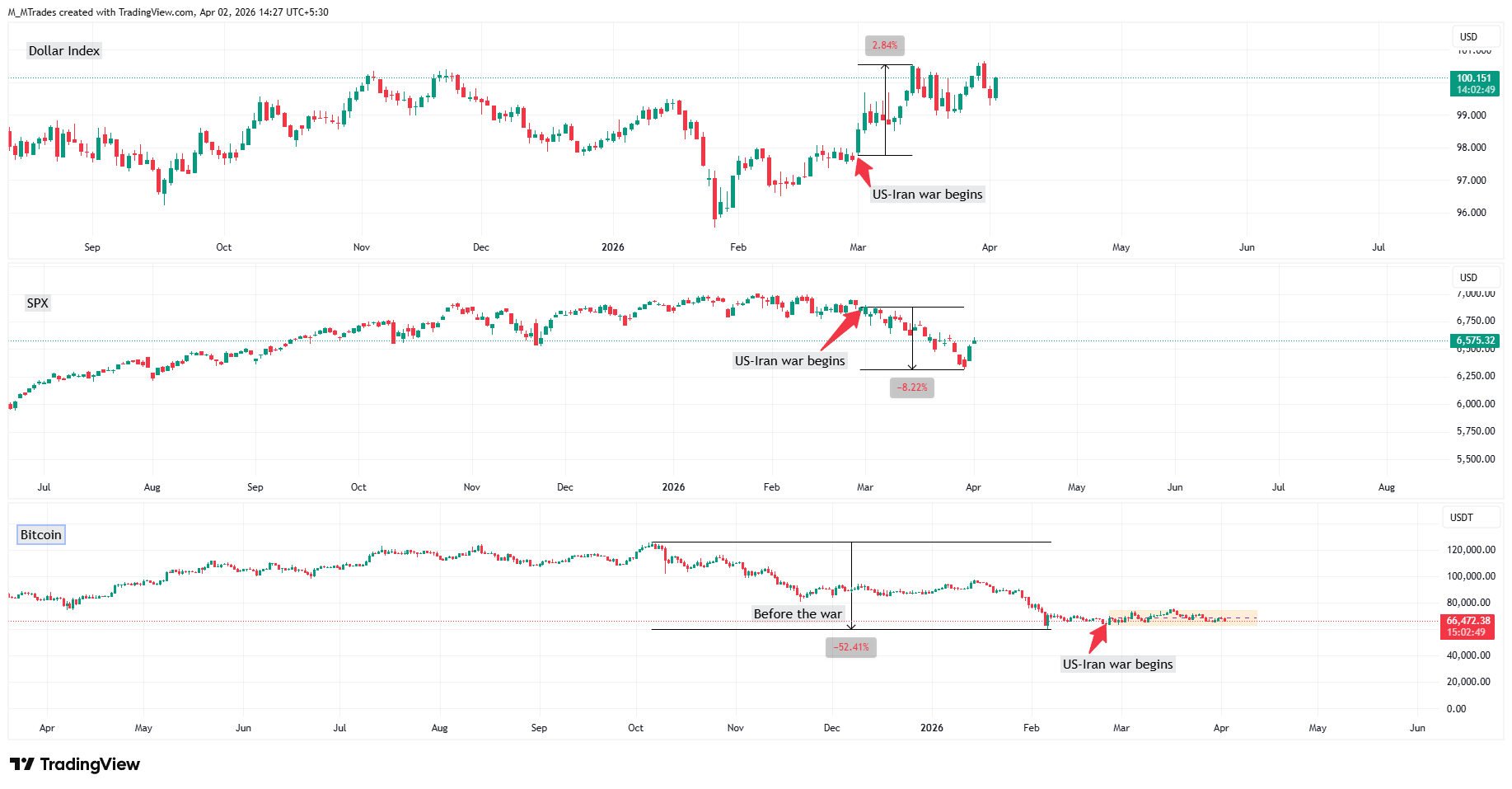
However, concerns don’t end there, as growing speculation about a potential US “boots on the ground” attack continues to weigh on overall market sentiment.
Signs that the US could launch a ground invasion
The “Operation Epic Fury” campaign, launched by the United States (US) on February 28, initially expected a swift outcome, potentially even a regime-change scenario similar to past interventions (such as in Venezuela). Still, it has not played well so far, with the prolonged war now extending for over a month. The conflict has evolved from an initial airstrike campaign into a more prolonged and uncertain engagement, targeting energy facilities and resulting in the closure of the Strait of Hormuz, with some now suggesting a possible ground invasion.
Recent reports indicate an increasing US military buildup in the region, including the deployment of additional US Marines and US Special Operations forces, signaling a possible escalation beyond an air-led campaign.
“Altogether, there are more than 50,000 American troops in the Middle East now, roughly 10,000 more than usual, as Donald Trump decides on his next step in the war,” reports the New York Times.
In the past, decisions taken by US President Donald Trump have mostly come during the weekends, when the financial markets are closed and the events could not severely hurt them. So, expecting a possible ground invasion during the weekend is highly likely.
What could be the effect on Bitcoin and the broader crypto market?
If a “boots on the ground” scenario were to materialize, the implications for Bitcoin and the broader crypto market should be negative and could unfold through several channels. The longer the war drags on, the worse it will be for risky assets and cryptocurrencies.
Global inflation spike
Concerns about global inflation have persisted as the war has dragged on. The effects of this war include concerns about energy supply disruptions, as major oil supply units were damaged during the conflict. Countries like India, China, Thailand, the Philippines and others in the east could be affected in the long term by this disruption, as they depend heavily on Gulf Oil to meet their energy needs.
This effect could trigger a global inflation spike at a time when many central banks around the world are still grappling with inflation above target. With the recent Federal Reserve (Fed) hawkish stance on interest rates, market participants are already pricing in that the central bank will hold rates steady at current levels by the end of 2026. This scenario could hurt Bitcoin and also the broader crypto market, which generally struggles in high-interest-rate environments because higher borrowing costs reduce liquidity and push markets towards safer, yield-bearing assets.
Risk-off sentiment
In the short term, war and geopolitical uncertainty trigger a “risk-off” flow, with investors moving away from volatile, risk-sensitive assets such as Bitcoin and other cryptos toward more stable Bonds or cash.
The “inflation hedge” or “digital gold” narrative of Bitcoin remains premature, as market participants continue to favor traditional safe havens like the US Dollar (USD) and Gold. While Bitcoin has gained broader acceptance, it is still viewed as a relatively new, developing, and high-beta asset class, making it more sensitive to risk-off sentiment.
Mining disruption
Iran relies on cryptocurrencies due to US sanctions, and Bitcoin has served as a tool for paying for imports and settling trade. Iran legalized crypto mining in 2019 and has played a role in its economy. With a possible ground invasion and attacks on its power plants, electricity could be disrupted, disrupting the crypto mining industry.
Such a disruption in mining activity could temporarily reduce the network’s hash rate, posing a “significant risk” to miner profitability and adding downside pressure on Bitcoin price.
Spiral effect
With Bitcoin and crypto prices falling due to the above-mentioned effects, a bankruptcy scenario could unfold, as explained in this report. If a bankruptcy occurs, liquidity is drained from the market, leading to a downward spiral that hurts crypto markets the most. Given that cryptocurrencies are a relatively new asset class with growing acceptance and a very recent regulatory framework, the prospect of bankruptcy tends to quickly spark fear and undermine market acceptance. This young ecosystem is highly interconnected, so a failure in one sector can easily trigger a domino effect.
Why did a potential ground invasion not yet take place?
Despite the high-probability case of a ground invasion, traders should also keep in mind that the event may not occur. There are some reasons this scenario may not materialize.
Mid-term elections
The 2026 mid-term elections are scheduled for November and are likely to shape Donald Trump’s and the Republican Party’s policy approach. Prolonging the conflict, particularly through a ground attack, could carry significant political risks. With higher casualties, rising energy prices, and voter backlash amid ongoing economic weakness, all of which could hurt their vote bank.
No Kings protest
The pressure from American citizens on the Trump administration was evident in the “No King” protests held in cities across the US.
Reports estimate more than 8 million people attended to protest policies imposed by US President Donald Trump and things like the Iran war, immigration enforcement and the rising cost of living.
Moreover, the Pew Research Center survey of US adults conducted between March 16 and March 22 highlighted that about six-in-ten Americans (61%) disapprove of Trump’s handling of the conflict, while 37% approve. This widespread anti-war sentiment is likely acting as a constraint on further escalation and increasing political pressure on Trump to avoid committing to a prolonged ground war.
Rising US national debt
The US national debt has surged past $39 trillion just weeks into the Iran war, highlighting the fiscal strain the conflict is placing on the US. Moreover, a ground invasion would dramatically increase costs, adding to this debt and increasing pressure on the broader economy.
Higher yield in the bond market
It has become increasingly clear that Bond markets will dictate just how long President Trump
can continue to increase pressure in the Iran War. The 10-year Note yield has risen 45 basis points since the war began on February 28, nearing the 4.40% mark and reflecting investor fears about US fiscal sustainability amid a prolonged war.
The Kobeissi Letter suggests that the US economy cannot handle a 5% 10-year Note yield, and this could further put pressure on Trump.
Technical outlook: BTC to drop intensively if ground attack unfolds
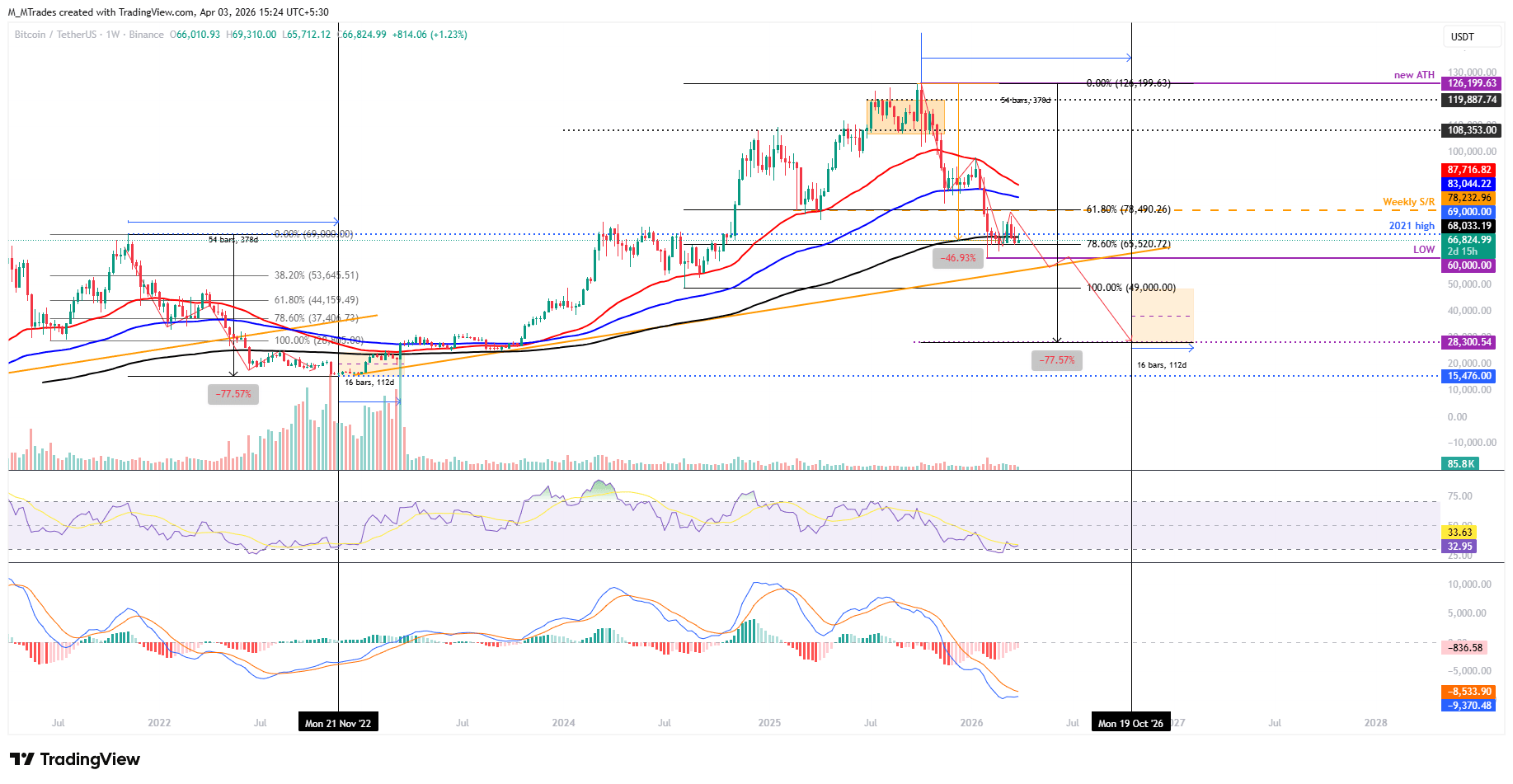
Our weekly bearish chart is still in play. The Bitcoin weekly chart shows price action resembling that of the late-2021 and 2022 bear market.
In 2021, BTC hit a new all-time high of $69,000 in November, then corrected by more than 77% to a bottom of around $15,476 in November 2022, taking 378 days. Bitcoin then consolidated for the next 112 days before the start of another bull cycle in 2023.
Now let’s look at the current cycle: BTC reached a new all-time high at $126,199 in October 2025 and has since corrected by over 46% through the end of March, closing below the 200-week Exponential Moving Average at $68,033.
Such a massive price correction is often followed by a consolidation or a short-term relief period within a broader downward trend. As seen below, BTC has been consolidating between $60,000 (the February low) and the 61.8% Fibonacci retracement level at $78,490 (drawn from the August 2024 low of $49,000 to the October 2025 all-time high of $126,199) since early February. These price consolidations are normal and were also seen during the previous bear market cycle.
If the 2021-2022 pattern holds, BTC could reach a low of $28,300 (77.51% down from the 2025 all-time high) by roughly mid-October. Then, it would need around 100 more days before the start of another bull cycle.